
Light Meets the Brain: Three Scientists Win 2026 Nobel Medicine Prize
Three scientists have won the 2026 Nobel Prize in Physiology or Medicine for discoveries that made it possible to control nerve cells with light.
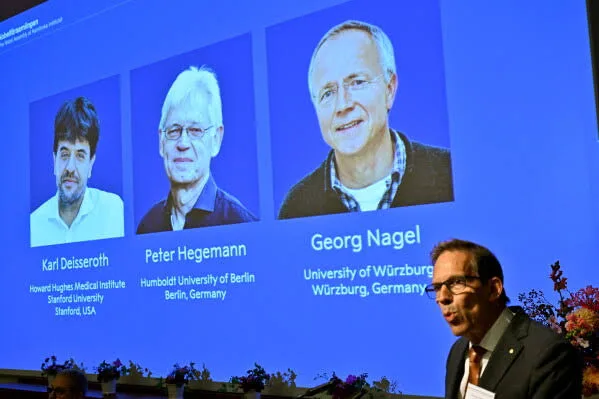
American scientist Karl Deisseroth and German researchers Peter Hegemann and Georg Nagel have been awarded the 2026 Nobel Prize in Physiology or Medicine for discoveries that transformed scientists' ability to investigate how the brain works.
The Nobel Assembly at Karolinska Institutet announced the award in Stockholm on Monday, recognising the trio “for their discoveries concerning light-gated ion channels and optogenetics.” The three scientists will share a prize of 12 million Swedish kronor, roughly $1.2 million.
Their achievement centres on optogenetics, a technique that allows researchers to use light to activate or silence selected nerve cells. The approach has become an important tool in neuroscience because it gives scientists an unusually precise way to manipulate individual neurons and observe how particular circuits affect behaviour, movement and disease.
The story began decades ago with a much simpler biological question. In the early 1990s, Hegemann was studying how the single-celled green alga Chlamydomonas responds to light. His research suggested that a light-sensitive protein could act as a channel through which electrically charged particles move across a cell membrane.
Nagel later helped test that idea by transferring genes from the algae into frog eggs. The experiments led to the identification of channelrhodopsin-2, a protein that opens an ion channel when exposed to blue light. Their subsequent work showed that the protein could make other cells respond electrically to light.
Deisseroth then took the discovery into neuroscience. Working at Stanford, he and his colleagues used genetic methods to introduce light-sensitive proteins into nerve cells, including neurons in living mice. By delivering light to those cells, researchers could control their activity and begin mapping connections between particular neural circuits and behaviour.
That ability represented a major change in brain research. Instead of simply observing electrical activity and trying to infer what a group of neurons was doing, scientists could manipulate specific cells and examine what happened when those cells were switched on or off. The Nobel Assembly said the technique has opened a new era in neuroscience and is now used in laboratories around the world.
The significance of the work extends beyond laboratory experiments. Researchers are exploring optogenetic approaches for treating neurological and sensory disorders, although many of these applications remain experimental. One area already being investigated in clinical trials is vision restoration for people with retinitis pigmentosa, a genetic condition that can cause severe loss of sight. Researchers are also examining whether light-based approaches could eventually make cochlear implants more precise by stimulating auditory nerves with greater selectivity.
The award also illustrates how discoveries in one area of biology can become tools for an entirely different field. Hegemann and Nagel were studying light responses in algae; their findings ultimately helped create a method for probing the circuitry of the mammalian brain.
The three laureates reportedly reacted with surprise and delight when informed of the award. Nobel Assembly Secretary-General Thomas Perlmann said he spoke with all three and that they were particularly pleased to receive the honour together. Deisseroth, who was at his home in California when the call arrived, told the Associated Press that he had been working late before going to bed and was then confronted with the unexpected news.
The medicine award opens this year's Nobel announcements, with prizes in physics, chemistry, literature, peace and economic sciences to follow. The Nobel ceremonies traditionally culminate on December 10, the anniversary of Alfred Nobel's death.
The broader importance of this year's medicine prize lies in what it says about the future of neuroscience: the brain is increasingly becoming something scientists can not only observe but manipulate with remarkable precision. Optogenetics is not itself a finished treatment for most neurological conditions, but it has given researchers a powerful experimental language for understanding how individual cells and circuits contribute to memory, movement, perception and disease. The Nobel recognition underscores how a discovery that began with light-sensitive algae has grown into one of modern neuroscience's most influential technologies.

Health
Mbah Commissions Anchorage Pharmaceutical Production Facility in Enugu
22 Oct 2026

Health
UK-Based Indian Nurse Wins $250,000 Global Nursing Award for Organ Donation Leadership
13 Sept 2026

Health
Malaria: Benue Commits ₦294.5m to Seasonal Prevention Campaign
22 Aug 2026

Health
Ebola Patient Set for Evacuation From Nigeria for Treatment
26 Oct 2026

Health
Swiss Government Identifies Ebola Patient as Diplomat’s Wife in Abuja
25 Oct 2026
Partner with Follow Global Trends
Display banners, sponsored stories and founder spotlights.
You may also like

Health
Vanessa Trump Says She’s Cancer-Free Six Months After Diagnosis
24 Oct 2026

Health
France Confirms World’s First Human Case of Shamonda Virus
22 Oct 2026

Health
Nigeria Confirms First Ebola Case Since 2014, Tracks 44 Contacts
20 Oct 2026
Health
NAFDAC Uncovers Suspected ₦500m Fake Alcohol Factory
20 Oct 2026

Health
Pope Leo XIV Officially Diagnosed With Lung Cancer After Surgery
14 Oct 2026

Health
Pope Leo XIV to Undergo Surgery to Remove Early-Stage Lung Nodule
11 Oct 2026