
Nigeria, US Sign Deal to Unlock $700bn Mineral Wealth
Nigeria and the United States have signed a landmark critical minerals agreement aimed at unlocking up to $700 billion in investment across mining, processing and strategic industrial value chains.
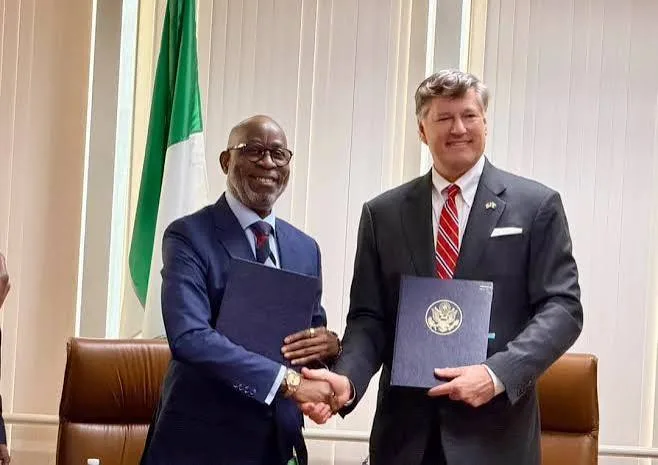
Nigeria and the United States have signed a landmark Critical Minerals Cooperation Agreement designed to attract as much as $700 billion in long-term investment into Nigeria’s mining and mineral processing sector, marking one of the country’s most ambitious resource development partnerships in recent years.
The agreement was signed at Nigeria’s Mission House in New York during high-level engagements surrounding the 81st United Nations General Assembly. Nigeria’s Minister of Solid Minerals Development, Dele Alake, signed on behalf of the Federal Government, while US Deputy Secretary of State Christopher Landau represented the United States, underscoring both countries’ commitment to strengthening cooperation in the strategic minerals sector.
Beyond diplomatic symbolism, the framework is expected to create a structured platform for business-to-business transactions, enabling American and Nigerian companies to collaborate on exploration, mining, processing, refining and manufacturing across Nigeria’s mineral value chains. Officials said the partnership will leverage the growing bilateral relationship to attract investment into Nigeria’s estimated $700 billion mineral resource base while promoting greater value addition within the country.
Speaking at the signing ceremony, Alake described the agreement as a defining moment in Nigeria’s economic transformation, saying it represents a deliberate shift away from the country’s historical dependence on exporting raw materials.
“Some agreements manage the present, and some agreements shape the future. The framework we sign today belongs to the second kind,” Alake said.
“In signing this framework, Nigeria and the United States affirm a shared conviction: that the supply chains for these critical minerals must be secure, resilient and built on responsible investment.”
The minister said Nigeria’s objective is not to remain merely a supplier of raw minerals for industries abroad, but to build domestic processing plants, develop manufacturing capacity, create skilled jobs and retain a much larger share of the value generated from its natural resources. According to him, local beneficiation will become a central pillar of the government’s minerals strategy.
The United States has increasingly sought partnerships with mineral-rich countries as governments race to diversify supplies of critical resources used in batteries, electric vehicles, semiconductors and renewable energy infrastructure. Nigeria possesses commercially significant deposits of lithium, tin, cobalt, nickel, rare earth elements and other strategic minerals, positioning it as a potential supplier in rapidly expanding global supply chains.
Officials stressed that the projected $700 billion reflects the long-term investment potential of Nigeria’s broader critical minerals ecosystem rather than an immediate funding commitment. The estimate encompasses opportunities across exploration, extraction, processing facilities, logistics infrastructure, power, manufacturing and supporting industries that could be unlocked through sustained public-private investment.
The agreement also aligns with Nigeria’s broader economic strategy of reducing dependence on crude oil by expanding non-oil exports and developing the solid minerals sector. Successive governments have identified mining as a key driver of diversification, but inadequate infrastructure, limited processing capacity and illegal mining have continued to constrain the industry’s contribution to the economy.
Analysts say the partnership could significantly enhance investor confidence if accompanied by stronger regulation, transparent licensing and improved security across mining communities. As global demand for critical minerals accelerates with the transition to cleaner energy and advanced technologies, countries that develop domestic value chains are expected to capture far greater economic benefits than those exporting raw ores alone.
For Nigeria, the agreement represents more than a mining deal, it is a strategic industrial policy aimed at repositioning the country within global manufacturing supply chains. If successfully implemented, it could transform Nigeria from a predominantly raw mineral exporter into one of Africa’s leading hubs for critical minerals processing, industrial production and high-value investment.
More on Nigeria
Nigeria
Nigeria Targets 24-Hour Electricity for Major Commercial Corridors
1 Oct 2026
Nigeria
IMF Warns Nigeria Against Restoring Petrol Subsidy
16 Oct 2026

Nigeria
Only Lagos and Enugu Can Cover Recurrent Spending With IGR, World Bank Says
10 Oct 2026

Nigeria
Nigeria Mourns as NAF Names 25 Killed in Ondo Military Plane Crash
6 Oct 2026

Nigeria
Washington DC Declares October Nigerian American Heritage Month, Marks Nigeria Day
4 Oct 2026
Partner with Follow Global Trends
Display banners, sponsored stories and founder spotlights.
You may also like

Nigeria
Tinubu Ends Four-Week European Working Vacation, Returns to Nigeria
30 Sept 2026
Nigeria
Nigeria Heads to UNGA 81 With Shettima Leading High-Level Delegation
20 Sept 2026

Nigeria
AI Could Threaten Jobs of Nigerian Graduates as IMF Raises Global Alarm
13 Oct 2026

Nigeria
Ogaga Ifowodo Wins $100,000 NLNG Literature Prize for ‘Why Does God Need a Gun?’
9 Oct 2026
Nigeria
Nigeria to Host Global Alliance–World Public Relations Forum 2026 in Historic African First
24 Sept 2026

Nigeria
World Bank: 67.27 Million Nigerians Covered by Cash Transfer Programme
21 Sept 2026