
Ghana to Submit Formal Application to Join BRICS
Ghana has approved plans to formally seek BRICS membership, saying the move will broaden its economic partnerships while maintaining ties with the IMF, World Bank and traditional allies.
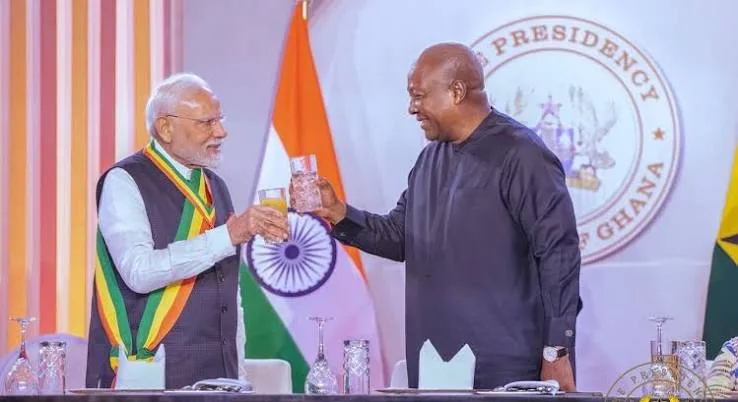
Ghana is preparing to formally apply for membership of BRICS, as President John Dramani Mahama’s government seeks to diversify the country’s international economic partnerships and gain more options for trade, investment and development cooperation.
Foreign Affairs Minister Samuel Okudzeto Ablakwa announced the decision on October 6 during a joint press briefing in Accra with India’s External Affairs Minister Subrahmanyam Jaishankar, who was visiting Ghana. Ablakwa said Cabinet had approved the move and that Accra would now begin preparations for a formal application while seeking support from existing BRICS members.
The minister presented the proposed membership as part of the Mahama administration’s broader economic strategy, which aims to move Ghana from economic stabilisation toward stronger growth, industrialisation and job creation. He said BRICS could give Ghana additional development options and deepen cooperation with countries across the Global South.
“We are not going to walk away from our traditional partners,” Ablakwa said, stressing that the government wants to maintain relationships with institutions such as the International Monetary Fund and World Bank while building additional partnerships. Ghana, he argued, needs more options rather than replacing one group of international partners with another.
India is already emerging as an important diplomatic partner in the application. Ablakwa said Ghana had formally approached New Delhi for assistance, pointing to the longstanding relationship between the two countries and India's position as one of the founding members of BRICS.
Jaishankar said India understood Ghana's interest and supported its aspirations, but also made clear that joining BRICS is not a decision India can make alone. Membership must ultimately be considered by the wider group.
That distinction is important because Ghana's announcement represents the beginning of an accession process, not an admission into the bloc. Under BRICS' established procedure, a country first declares its interest, after which its request is circulated among members. Member-country representatives examine the application before it can move through the foreign ministers and leaders, with the final decision requiring consensus among BRICS members.
BRICS currently has 11 full members: Brazil, Russia, India, China, South Africa, Egypt, Ethiopia, Iran, Saudi Arabia, the United Arab Emirates and Indonesia. The group has expanded substantially since South Africa joined the original BRIC countries, and it has also created a separate partner-country category. Nigeria, for example, became a BRICS partner country in 2025, a status that is different from full membership.
For Ghana, the attraction is largely economic and diplomatic. Ablakwa said membership could help the country broaden its access to markets, investment and cooperation while creating opportunities to add greater value to its natural resources. The government also sees stronger South-South relationships as part of its effort to create jobs and accelerate industrial development.
The move would also place Ghana alongside a growing group of African countries engaging with BRICS in different ways. South Africa is a full member, while Egypt and Ethiopia joined during the bloc's recent expansion. Nigeria and Uganda have taken the partner route. Ghana's decision therefore comes as African governments increasingly explore relationships with emerging economic powers while continuing to engage with established Western-led financial institutions.
However, BRICS membership would not automatically translate into new investment or cheaper development financing. The benefits would depend on the agreements Ghana could secure, the willingness of member countries to invest and trade with it, and the extent to which Accra could convert diplomatic relationships into concrete projects, markets and industrial opportunities.
The application also comes at a time when Ghana is seeking to strengthen its economic position after a difficult period of debt and fiscal pressures. The government has repeatedly emphasised investment, industrialisation and greater value addition as part of its economic agenda. Expanding diplomatic and commercial relationships could potentially support those goals, although membership itself would not remove Ghana's domestic economic challenges.
There is also a geopolitical calculation. BRICS describes itself as a coordination forum for countries of the Global South and has pushed for greater representation of developing countries in institutions such as the United Nations, IMF, World Bank and WTO. Ghana's interest therefore fits into a broader debate over whether the global economic and political system should give emerging and developing countries a larger voice.
Still, Accra is signalling that it does not intend to frame the move as a break with the West. The government's insistence that BRICS membership would complement rather than replace existing partnerships suggests a strategy of diversification rather than alignment with one geopolitical camp.
If Ghana eventually secures membership, it would add one of West Africa's more established democracies and economies to an increasingly influential Global South grouping. For now, however, the significance lies in the direction Ghana is choosing: expanding its diplomatic options, seeking new sources of trade and investment, and attempting to position itself between established international institutions and the emerging economic networks represented by BRICS. The next test will be whether that strategy can produce tangible economic gains rather than simply another diplomatic affiliation.
More on Africa

Africa
Ghana Launches Marrify App to Verify Marriage and Divorce Status
5 Sept 2026

Africa
Ethiopia, Eritrea Break Diplomatic Ties as Tigray Fighting Escalates
2 Oct 2026
Africa
Fatima Ezzahra El Mansouri Makes History as Morocco’s First Female PM
30 Sept 2026
Africa
Guinea-Bissau’s Embaló Plans Return From Exile, Eyes Presidency
29 Sept 2026
Africa
Gambia Orders Nigerian Banks to Replace Foreign Staff With Qualified Gambians
24 Sept 2026
You may also like

Africa
24-Hour AfCFTA Certificate Reform Set to Accelerate Nigeria’s Non-Oil Exports
10 Sept 2026
Africa
Tanzania Mourns Death of First Gentleman Hafidh Ameir Hassan
7 Sept 2026
Africa
Uganda Welcomes Home King Oyo Nyimba for Final Burial After Historic Reign
6 Sept 2026
Africa
ECOWAS Swears In Five Judges as Faye Calls for Stronger Public Trust in Regional Justice
7 Oct 2026
Africa
Zimbabwe Tycoon Wicknell Chivayo and Wife Killed in Helicopter Crash
1 Oct 2026
Africa
Kenya’s Ruto Tours Dangote Refinery Ahead of Lamu Refinery Launch
26 Sept 2026