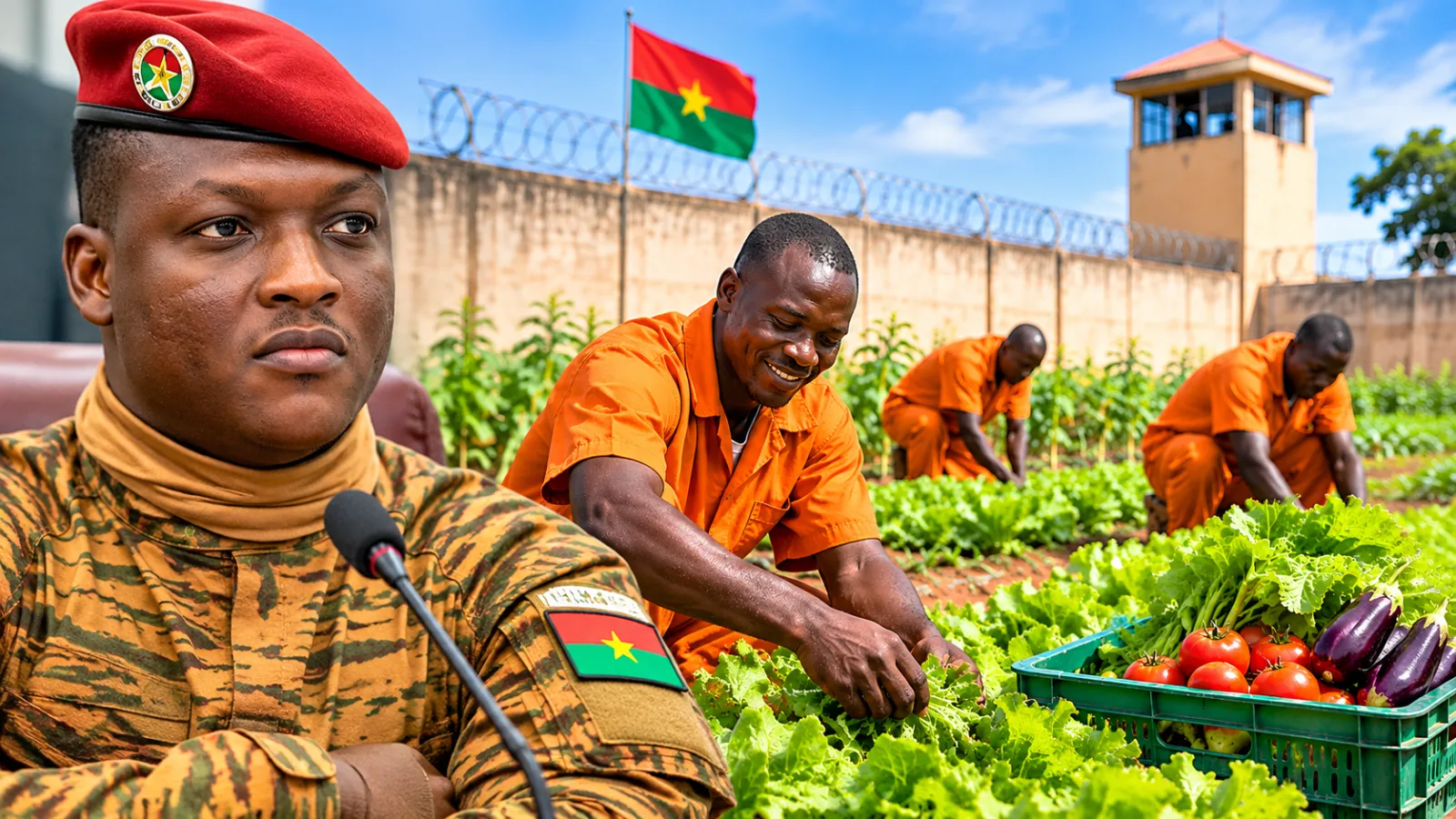
Burkina Faso turns prisoners into farmers under an expanded penal reform programme that shifts thousands of convicted individuals and petty offenders out of standard cells and onto open agricultural estates. The reform aims to ease heavy prison congestion while contributing directly to national food self-sufficiency goals.
On October 14, 2026, parliament revised the national Travaux d'Intérêt Général framework to modernise judicial sentencing. Under the amended statute, petty offenders no longer sit idle in overcrowded cells. If an offender poses no public danger and has compensated the victim, judges now assign community labour instead of incarceration. The legislation also extends agricultural community placement to individuals serving longer terms once they complete one-third of their sentence.
The Historic Roots and Modern Scale of Baporo
As Burkina Faso turns prisoners into farmers, the centrepiece of this penal transformation remains Baporo, an open-environment agricultural facility originally established by revolutionary leader Thomas Sankara in 1984. The institution operates without high perimeter barriers, integrating rehabilitation with large-scale cereal cultivation.
Detainees at the Sanguié Province facility cultivate 130 hectares of maize, rice, sorghum, soybeans, cowpeas, and sesame. The agricultural compound produced 240 tonnes of staple food in 2025, and authorities established an ambitious harvest target of 782.5 tonnes across more than 300 hectares for the 2026 season.
Inmates work alongside government agronomists, acquiring practical skills in modern irrigation, soil improvement, and post-harvest handling. Officials emphasise that these technical competencies provide viable livelihoods once individuals complete their sentences and reintegrate into rural communities.
Strong Incentives and Humanising the Penal System
The government created strong legal incentives to encourage active participation and good conduct in the fields. Under the revised community framework, participating workers receive a deduction of three months from their prison sentence for every single month of labour performed.
The policy has altered judicial outcomes across the country on a wide scale. Nearly 4,000 individuals have benefited from the community work programme since November 2024, and more than 3,000 participants are actively performing agricultural duties in designated zones.
Explaining why Burkina Faso turns prisoners into farmers, Head of State Captain Ibrahim Traoré noted that the primary objective is to phase out punitive confinement in favour of social productivity. Traoré stated that the government has decided to humanize the prisons, reduce the total number of detention facilities, and concentrate inmates inside dedicated production zones to serve national development.