China Asks Nigerian Media to Align Taiwan Coverage With One-China Position
Beijing has urged Nigerian media to avoid describing Taiwan as a sovereign state separate from China, while offering journalists training and professional exchanges.
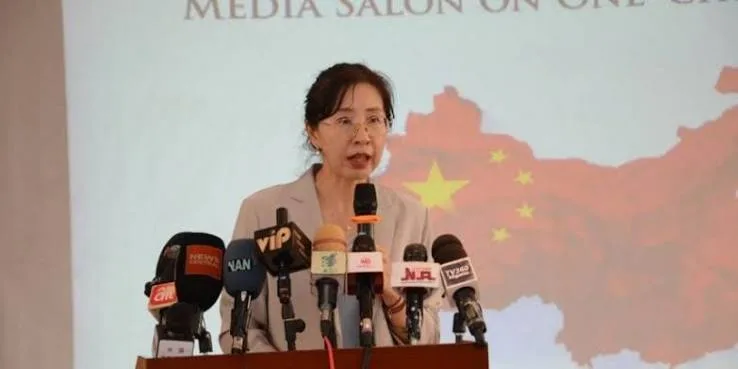
China has urged Nigerian media organizations to avoid language that portrays Taiwan as an independent sovereign country, while offering journalists training programmes, professional exchanges and opportunities to visit China. The appeal was made during a meeting with Nigerian media executives in Lagos, where Chinese officials explained Beijing’s position on Taiwan and discussed wider media cooperation between the two countries.
Xu Fan, director of bilateral relations and commerce at the Chinese Consulate General in Lagos, said China did not object to Nigerian journalists reporting on Taiwan but opposed descriptions that, in Beijing’s view, suggested the island was a separate country. He specifically questioned terminology such as “Taiwan ambassador to Nigeria”, arguing that it conflicted with the diplomatic position shared by China and Nigeria.
The discussion also covered opportunities for cooperation through journalist training, media delegations, seminars and professional exchanges. Xu described Nigerian media organizations as partners in promoting mutual understanding, while Chinese representatives encouraged stronger cooperation in reporting, broadcasting and communication. The meeting came amid efforts by Beijing and Abuja to deepen bilateral relations through economic, cultural, educational and media partnerships.
China’s position rests on its longstanding claim that Taiwan is part of its territory and that the People’s Republic of China is the sole legitimate government representing the whole of China. Nigeria formally endorsed the One-China principle in a joint statement issued during President Bola Tinubu’s state visit to Beijing in September 2024. That statement said Nigeria recognized the government in Beijing as the sole legal government representing China and regarded Taiwan as part of Chinese territory.
Taiwan, however, is self-governed, with its own elected leadership, military, currency and institutions. Beijing has never exercised control over the island under the government established in mainland China in 1949, and Taiwan’s current government rejects Beijing’s sovereignty claim. Most countries, including Nigeria, maintain formal diplomatic relations with Beijing rather than Taipei, while some maintain unofficial economic and cultural ties with Taiwan.
Xu also cited United Nations General Assembly Resolution 2758, adopted in 1971, which recognized the representatives of the People’s Republic of China as the only legitimate representatives of China at the UN and removed the representatives of Chiang Kai-shek from the organization. Beijing regards the resolution as supporting its One-China position. Taiwan’s foreign ministry disputes that interpretation, arguing that the resolution addresses who represents China at the United Nations and does not explicitly determine Taiwan’s sovereignty or authorize Beijing to represent Taiwan in the UN system.
The meeting reportedly prompted a robust exchange with Nigerian media executives, who emphasized the importance of editorial independence and the need for journalists to report issues of public interest freely. Their position highlights a central tension in the engagement: diplomatic missions can explain their governments’ positions and challenge reporting they consider inaccurate, but editorial decisions remain a matter for news organizations operating under their own professional and legal responsibilities.
The offer of media training and exchanges comes against a broader backdrop of expanding China-Nigeria cooperation. In September, the News Agency of Nigeria reported that China had expressed readiness to deepen collaboration through professional exchanges, technological cooperation and joint content production. A two-week seminar in Beijing brought together about 28 young Nigerian media professionals to discuss broadcasting convergence and communication skills.
Such programmes can provide journalists with professional contacts, technical knowledge and access to reporting opportunities. At the same time, media organizations must assess any training or travel opportunity with clear editorial safeguards, transparency about sponsorship and the freedom to report independently on issues that may be sensitive to the host government. Those safeguards are particularly important when exchanges involve countries with sharply differing positions on geopolitical disputes.
The latest engagement illustrates how diplomacy increasingly extends beyond government-to-government negotiations into the media environment, where terminology and framing can influence how international disputes are understood. China is seeking greater consistency between Nigerian reporting and its One-China position, while Nigerian journalists have stressed their responsibility to maintain editorial independence. The lasting test will be whether deeper cooperation improves access to information and professional capacity without narrowing the space for independent reporting on Taiwan or other contested international issues.
More on Global

Global
Norway Unveils $63.6 Billion Wealth Fund Withdrawal Plan for 2027
7 Oct 2026
Global
White House Launches “Trump TV” After Major US Networks Lose Access
23 Sept 2026
Global
CNN, MS NOW and Politico Return to White House After Judge Restores Access
24 Sept 2026
Global
India Leads Dubai Property Demand in 2026 as US Climbs to Second
23 Sept 2026
Global
Trump Sanctions ICC Over Prosecution of Americans, Vows to Cripple Court
10 Oct 2026
You may also like
Global
South African Jurist Navi Pillay Wins 2026 Nobel Peace Prize for Human Rights Work
9 Oct 2026
Global
US Suspends Microsoft, Infosys, Wipro and Major IT Firms From Green Card Programme
8 Oct 2026
Global
Syria Weighs Military Support for Saudi Arabia as Houthis Escalate
8 Oct 2026

Global
German Export Recovery Loses Steam as U.S. Trade Falls Sharply
8 Oct 2026

Global
Anne Carson Wins 2026 Nobel Prize in Literature for Genre-Bending Work
8 Oct 2026
Global
Costa Rica’s Grynspan Tops Fifth UN Chief Poll, but Veto Threat Remains
8 Oct 2026