
Anne Carson Wins 2026 Nobel Prize in Literature for Genre-Bending Work
Canadian writer Anne Carson has won the 2026 Nobel Prize in Literature for a body of work that blends poetry, prose and classical tradition in unconventional forms.
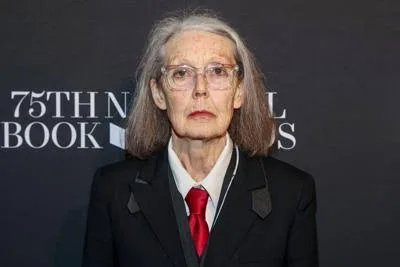
Canadian poet, essayist and translator Anne Carson has won the 2026 Nobel Prize in Literature, bringing one of contemporary literature's most unconventional voices to the centre of global attention.
The Swedish Academy announced the award on Thursday, praising Carson's “bold and inventive oeuvre” and her ability to create new forms through what it described as a playful engagement with the classical tradition. The prize recognizes a career in which poetry, prose, translation, scholarship and visual art have repeatedly crossed traditional boundaries.
Carson, 76, was born in Toronto and trained as a classicist, developing an extensive knowledge of ancient Greek literature that has remained central to her writing. Rather than treating classical texts as distant historical artefacts, she has repeatedly brought their characters, language and conflicts into conversation with contemporary life.
Her reaction to the Nobel announcement was characteristically understated. Speaking after the Swedish Academy reached her in Iceland, where she currently spends much of her time, Carson described the news as “crazy” and said she was deeply surprised. Academy permanent secretary Ingrid Carlberg said the initial telephone conversation was brief, with Carson telling her she was listening to the wind in Iceland.
Carson's literary career has never fitted neatly into a single category. Her books can move between poetry, fiction, essay, translation and criticism, often within the same work. The Swedish Academy highlighted this relationship between her classical scholarship and her search for new meanings, noting that her translations of ancient Greek can themselves be read as creative literary works.
Among her best-known books is “Autobiography of Red,” a 1998 verse novel that reimagines the ancient Greek myth of Geryon while placing the character in a distinctly modern emotional world. The book became one of the works most closely associated with Carson's ability to use ancient material to explore contemporary questions of identity, desire and vulnerability.
Her later work continued that experimentation. “The Beauty of the Husband: A Fictional Essay in 29 Tangos” examined the breakdown of a marriage through a hybrid literary form, while “Norma Jeane Baker of Troy” brought together the story of Helen of Troy and the cultural mythology surrounding Marilyn Monroe. Her books have also incorporated visual elements, collaborations and unusual physical formats, reinforcing her reputation as a writer unwilling to remain within conventional literary categories.
Carson's engagement with antiquity is also rooted in her academic career. She studied classics at the University of Toronto and later taught ancient Greek and classical literature at universities in Canada and the United States. Her scholarly background has remained closely connected to her creative work rather than existing separately from it.
The University of Toronto celebrated the award as a major moment for its academic community, describing Carson as an alumna and noting that she becomes the fifth University of Toronto faculty member to receive a Nobel Prize.
The award also makes Carson the first Canadian recipient of the Nobel Prize in Literature since Alice Munro won in 2013. Munro, who was known primarily for her short stories, remains one of Canada's most internationally recognized literary figures. Carson's selection gives Canadian literature another major global moment while recognizing a very different form of writing.
Carson is also the 19th woman to receive the Nobel Prize in Literature, according to reporting following the announcement. The recognition comes after several years in which the Swedish Academy has awarded the prize to writers working across different literary traditions and forms.
The 2026 award carries a monetary prize of 12 million Swedish kronor, alongside the Nobel medal and diploma. Carson is expected to receive the prize formally at the Nobel ceremony in Stockholm on December 10, the anniversary of Alfred Nobel's death.
Her selection is significant partly because it rewards experimentation rather than a conventional literary genre. Carson's work demonstrates how ancient texts can be reinterpreted without simply reproducing them, and how poetry can overlap with scholarship, fiction, theatre and visual art. In recognizing that approach, the Swedish Academy has once again used its most prestigious literary award to draw international attention to writing that resists easy classification.
For Carson, the Nobel represents the culmination of a career built around crossing boundaries: between old and new, scholarship and imagination, poetry and prose. For contemporary literature, her victory is also a powerful reminder that the most influential writing does not always fit comfortably inside a single genre, and that sometimes the most radical way forward is to look back at the oldest stories and find entirely new ways to tell them.
More on Global

Global
Nigeria to Host CANEX 2026 as Government Targets Global Creative Markets
2 Oct 2026
Global
India Leads Dubai Property Demand in 2026 as US Climbs to Second
23 Sept 2026
Global
US Suspends Microsoft, Infosys, Wipro and Major IT Firms From Green Card Programme
8 Oct 2026
Global
Syria Weighs Military Support for Saudi Arabia as Houthis Escalate
8 Oct 2026

Global
German Export Recovery Loses Steam as U.S. Trade Falls Sharply
8 Oct 2026
You may also like
Global
Costa Rica’s Grynspan Tops Fifth UN Chief Poll, but Veto Threat Remains
8 Oct 2026

Global
Norway Unveils $63.6 Billion Wealth Fund Withdrawal Plan for 2027
7 Oct 2026

Global
Trump Approves Firing Squad Execution of Nidal Hasan 17 Years After Fort Hood Massacre
7 Oct 2026
Global
London’s Super-Rich Are Leaving and $160 Billion of Wealth Is at Stake
5 Oct 2026
Global
U.S. Pulls Bombers From UK Base After Suspected Terror Plot
5 Oct 2026
Global
Russian Strikes Hit Kyiv’s Dnipro Crossings, Triggering Traffic Chaos
3 Oct 2026