
U.S. Pulls Bombers From UK Base After Suspected Terror Plot
The U.S. has withdrawn all of its bombers from RAF Fairford after a suspected terror plot raised fresh security concerns around the base used for operations against Iran.
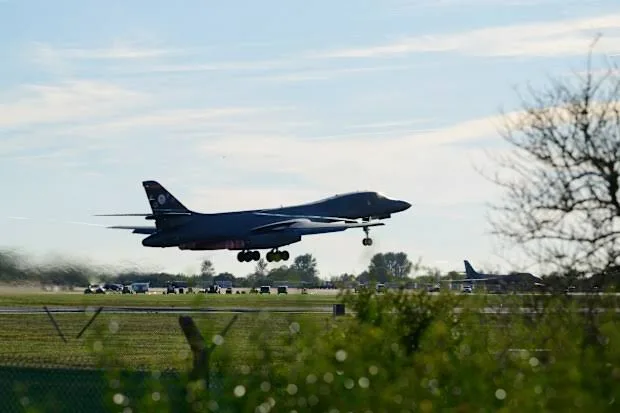
The United States has withdrawn all of its bombers from RAF Fairford in southern England and returned them to home stations in the U.S., days after British authorities arrested suspects over an alleged terrorist plot linked to the military installation.
The Pentagon confirmed on Sunday that every U.S. bomber deployed at Fairford had been redeployed to its American home base. The announcement came after B-1B Lancer bombers were seen leaving the Gloucestershire airfield, which has played a significant role in U.S. military operations against Iran.
The move is particularly significant because Fairford had been serving as a forward operating location for American long-range bombers during the ongoing conflict with Iran. Around a dozen B-1 bombers had been stationed there, while six B-52 Stratofortress bombers had already returned to the United States in an earlier drawdown.
U.S. officials cited by Reuters said the withdrawal followed heightened security concerns after several people were arrested in connection with a suspected plot targeting the base. Other reporting indicated that U.S. commanders had received additional warnings about a possible threat, although the Pentagon has not publicly detailed the nature of those warnings.
The underlying British investigation began in the early hours of September 27, when police received a report about three suspicious vehicles travelling toward RAF Fairford. Armed officers subsequently arrested five men in the nearby village of Whelford on suspicion of explosives offences and preparing a terrorist act.
The incident prompted a major security response. About 85 households in the surrounding area were evacuated while authorities examined the vehicles. Counter Terrorism Policing later confirmed that no improvised explosive devices had been found, although investigators recovered a quantity of petrol.
The five men were subsequently released on police bail and remain under investigation. British counter-terrorism officials have stressed that their release does not mean the investigation has ended.
A further arrest followed on October 1, when police detained a dual British-Iranian national in London on suspicion of preparing terrorist acts. He was also later released on bail, according to Counter Terrorism Policing.
The investigation has increasingly attracted attention because of the base's role in U.S. military operations against Iran. British authorities have said they are examining the possibility of foreign-state involvement, including the use of proxies, but have repeatedly cautioned against drawing conclusions before the investigation is complete.
Iran has denied involvement. British Prime Minister Andy Burnham has nevertheless said there are strong indications that Iran may have played a role, while U.S. Secretary of State Marco Rubio has said investigators believe a foreign actor may have been involved. Neither government has publicly produced evidence establishing Tehran's responsibility for the Fairford incident.
The security concerns are unfolding against an already tense backdrop. RAF Fairford has been used by American bombers for decades and became strategically important during the current U.S.-Iran conflict. Iran has previously warned that British bases used to support attacks against Iranian targets could be considered legitimate targets.
The bomber withdrawal does not, however, amount to a broader U.S. military withdrawal from Europe or the Middle East. The United States continues to maintain substantial military assets in the region, including naval forces being positioned for possible further operations.
For Washington, moving the bombers back to the United States reduces the immediate exposure of high-value aircraft at a facility that has become increasingly connected to the Iran conflict. For Britain, meanwhile, the episode highlights the security complications that can arise when American military operations are conducted from British territory.
The larger significance of the Fairford decision may therefore extend beyond the aircraft themselves. It demonstrates how an overseas military base can quickly become part of the wider battlefield when a regional conflict generates threats far from the front line. As British investigators continue to determine who, if anyone, was behind the suspected plot, the U.S. withdrawal shows that Washington is willing to alter the positioning of strategically important assets when the security risk around an allied base changes.
More on Global
Global
Hormuz Crisis: Trump Rejects Iran’s Seven-Day Reopening Plan
28 Sept 2026

Global
UK Urges Households to Stockpile Food, Water Amid Rising Russia Security Concerns
21 Sept 2026
Global
Russian Strikes Hit Kyiv’s Dnipro Crossings, Triggering Traffic Chaos
3 Oct 2026
Global
UN Chief Says Africa Deserves Permanent Security Council Representation
26 Sept 2026

Global
UK Intensifies Defence Talks as Russian Security Threats Grow
26 Sept 2026
You may also like
Global
Trump Tells UN Iran Must Choose Between a Deal or “Annihilation”
22 Sept 2026
Global
London’s Super-Rich Are Leaving and $160 Billion of Wealth Is at Stake
5 Oct 2026
Global
Trump Welcomes Xi to Washington Amid Talks on Trade and Global Security
25 Sept 2026
Global
UN General Debate Opens Today as World Leaders Gather in New York
22 Sept 2026
Global
Trump Says Iran Faces ‘Economic Destruction’ Unless New Deal Is Reached
21 Sept 2026
Global
Dangote Launches $16bn Kenya Refinery Project to Transform East Africa’s Fuel Market
2 Oct 2026