
Brazil Votes in Pivotal Election as Lula and Bolsonaro Rival Vie for Presidency
More than 158 million Brazilians are voting in a tightly contested election that could reshape the country’s domestic politics and its place in the Americas.
Brazilians are heading to the polls on Sunday in one of the most closely watched presidential elections in the Americas, with incumbent Luiz Inácio Lula da Silva facing right-wing Senator Flávio Bolsonaro in a contest that has become a test of Brazil’s political direction and the staying power of the conservative wave across Latin America.
The first round is taking place on October 4, with more than 158.7 million registered voters eligible to participate. Brazilians are choosing not only their president and vice president but also governors, senators and members of the federal and state legislatures. Voting runs from 8 a.m. to 5 p.m. Brasília time.
The presidential race has been dominated by Lula, 80, and Flávio Bolsonaro, 45, the eldest son of former President Jair Bolsonaro. Lula is seeking a fourth non-consecutive presidential term, while Flávio is campaigning to extend his family's political influence after his father's conviction and imprisonment over his role in a coup plot following the 2022 election.
Polls entering voting day point to a race too close to call. Recent surveys have generally put Lula slightly ahead in the first round, while simulations for a potential runoff have shown the two candidates within a narrow margin. A Datafolha poll reported by Reuters on October 1 put Lula ahead of Flávio by three percentage points in a second-round scenario, underscoring how little separates the two leading contenders.
Brazil's electoral system requires a presidential candidate to secure more than half of the valid votes to win outright. If no candidate reaches that threshold, the two leading candidates will meet again on October 25. The same runoff system applies to gubernatorial races where no candidate wins a majority.
Why this election matters
The contest is taking place against a backdrop of deep political fatigue. Brazil remains highly polarised after years of confrontation between Lula's Workers' Party and the Bolsonaro movement, while voters have also been dealing with concerns about living costs, public security, government spending and corruption.
A major banking scandal has become one of the campaign's most damaging issues, with investigations touching figures and political networks associated with both sides. At the same time, crime and economic pressures have remained central to the debate, giving Bolsonaro an opening to campaign on tougher security measures and fiscal restraint while Lula has highlighted social programmes, employment and his government's economic and environmental record.
The election is also unfolding after one of the most serious institutional crises in Brazil's recent history. Jair Bolsonaro was sentenced to 27 years in prison after being convicted over a plot to overturn the 2022 election result. His supporters' January 2023 attack on government buildings in Brasília remains a defining reference point in the country's political debate. Flávio Bolsonaro has said he would seek an amnesty or pardon for his father and others convicted in connection with the unrest if elected.
The choice before voters is consequently about more than the personalities of the two frontrunners. Lula represents a return to the left's established political tradition and has campaigned on social welfare, environmental protection and stronger engagement with China and the wider Global South. Flávio Bolsonaro is running on a conservative platform centred on public security, reduced government spending and closer relations with the United States.
The Trump factor
The election also carries an unusually strong international dimension.
U.S. President Donald Trump has openly expressed interest in the Brazilian contest and has cultivated ties with the Bolsonaro family. Washington's relationship with Brasília has already been strained by disagreements over tariffs, trade and Brazil's judicial treatment of Jair Bolsonaro.
Flávio Bolsonaro has positioned himself closer to Washington, while Lula has accused the Bolsonaro camp of allowing foreign interests to influence Brazilian politics. Allegations of U.S. interference have become a campaign issue, although claims about the extent and impact of such interference remain politically contested.
The next president will also have to manage Brazil's relationships with China and the United States, its two most important trading partners, while navigating Brazil's role in BRICS and the wider Global South. That makes the election consequential not only for Latin America but also for international trade, climate diplomacy, critical minerals and the balance of influence between Washington and Beijing.
More than a presidential contest
The presidential race is receiving the greatest international attention, but voters are also choosing members of Congress and state governments. Those results could determine how easily the next president can pass legislation and govern, particularly in a political system where coalition-building is often essential.
That could become particularly important on economic policy. Brazil enters the election with public debt above 80 percent of GDP, high interest rates and continuing concerns about fiscal sustainability. Both leading campaigns have offered different approaches to government spending, taxation, social programmes and economic management, but the next administration will face pressure to balance those priorities with demands for stronger growth and improved living standards.
For voters, however, the immediate question is simpler: whether to extend Lula's return to power or give the Bolsonaro movement another chance to lead the country. The large number of voters who remain dissatisfied with both political camps could become particularly important if the contest moves into a second round.
Brazil's election is therefore being watched well beyond its borders. As Latin America experiences a broader shift toward conservative governments in several countries, the world's fourth-largest democracy by population is deciding whether to continue under a left-wing president or move toward a new Bolsonaro presidency. Whatever happens on October 4, or in a likely October 25 runoff, the result will help define Brazil's political direction, its relationship with the United States and China, and the balance of ideological power across the Americas for years to come.
More on Politics
Politics
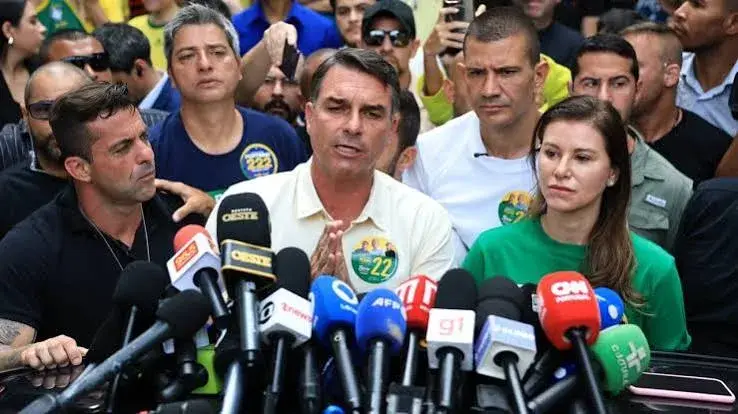
Brazil Election Shock: Flávio Bolsonaro Beats Lula in First Round
5 Oct 2026
Politics
Brazil Cuts Fuel Taxes as Lula Faces Crucial Presidential Runoff
13 Oct 2026
Politics
Brazil Suspends Sports Betting to Protect Election Integrity
28 Sept 2026
Politics
Elon Musk Sets US Political Donation Record With $446 Million
25 Oct 2026
Politics
Vance Declines to Endorse Netanyahu Ahead of Israeli Election
21 Oct 2026
Partner with Follow Global Trends
Display banners, sponsored stories and founder spotlights.
You may also like
Politics
Elon Musk Donates $276 Million to Boost Republicans Chances Ahead of US Midterms
13 Oct 2026
Politics
Atiku Calls Tinubu’s 90-Day Relief Plan ‘Election Bait’, Demands Answers
24 Oct 2026
Politics
2027 Elections: Atiku Demands Access to Nigeria’s 103m Voters
23 Oct 2026
Politics
2027 Elections: 9.3 Million Young Nigerians Join The Register
2 Oct 2026
Politics
Kwankwaso Says NDC Will Reintroduce Fuel Subsidy if Obi Wins 2027 Election
23 Sept 2026
Politics
Peter Obi Pushes Production-Driven Economy at ECFR Roundtable in Paris
20 Oct 2026