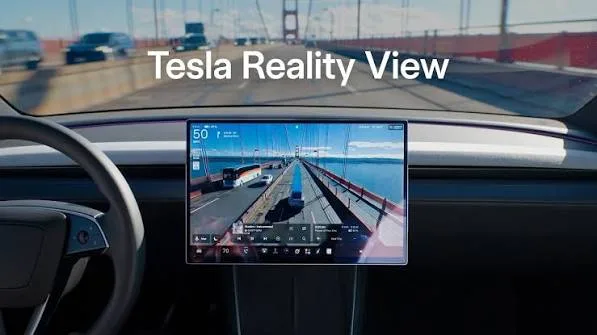
The most eye-catching feature in FSD V15 is Tesla Reality View. It replaces the older, simplified driving visualisation with a more detailed, lifelike representation of the surrounding road environment.
The new display recreates nearby vehicles, buildings, pedestrians, road markings and other objects. It also shows the vehicle's projected movements and navigation directions.
The visual experience has drawn comparisons with video games because of its detailed, three-dimensional appearance. However, Reality View is a generated visualisation of the driving environment, not a conventional video recording of the road.
Tesla says the feature is designed to help drivers understand what the system is planning to do. Drivers can reportedly choose between a full-screen view, map view, split-screen display or a quieter interface.
Tesla claims major improvements in safety-critical situations
Tesla says FSD V15 upgrades its end-to-end driving network and improves its handling of safety-critical situations by 25 times.
The company has not publicly provided a detailed explanation of the measurement behind that figure. Therefore, the claim should be treated as Tesla's own performance statement rather than an independently established safety result.
The update also targets several driving challenges that Tesla has highlighted, including improved detection of:
- Road signs
- Animals
- Debris
- Potholes
- Standing water
Tesla also says the software should handle speed more naturally around school zones and during bad weather.
These improvements could make everyday driving smoother. However, independent testing will be important in determining how consistently the new software performs in real-world conditions.
New navigation, speed-camera and Bike Rack features
FSD V15 introduces several additional features beyond the redesigned visualisation.
Tesla says navigation will initially learn preferences for the beginning and end of trips using fleet route preferences. Future releases are expected to extend this learning across entire journeys.
The update also introduces Speed Camera Slowdown, which allows the system to slow down when it detects a speed camera. Drivers can override the slowdown, and the software reportedly remembers a location after repeated overrides.
Another addition is Bike Rack Mode, designed to allow FSD operation when a bike rack or similar hitch accessory is installed.
The feature changes some vehicle behaviours around parking and reversing when enabled.
Rollout has started, but availability remains limited
Tesla began distributing FSD V15 to its first group of customers on November 21, 2026. The first version is identified as FSD V15.0.1, included in software update 2026.38.6.11.
The rollout remains limited, and availability depends on vehicle hardware and software eligibility. Early reports indicate that the first wave is associated with newer vehicles equipped with Tesla's AI4/HW4 computing hardware, although Tesla has not published a complete eligibility list.
Tesla CEO Elon Musk has indicated that a wider rollout is expected in December 2026.
Owners should therefore not assume that every Tesla will receive the update immediately.
FSD remains a supervised driving system
Despite the dramatic new visuals and claimed improvements, Tesla's Full Self-Driving system remains a supervised driver-assistance technology.
Drivers must continue paying attention to the road and remain prepared to take control at any time. The new Reality View interface does not change that responsibility.
The update could represent a significant software and visualisation upgrade for Tesla vehicles. Its real significance, however, will depend on how well the improvements perform under everyday driving conditions.