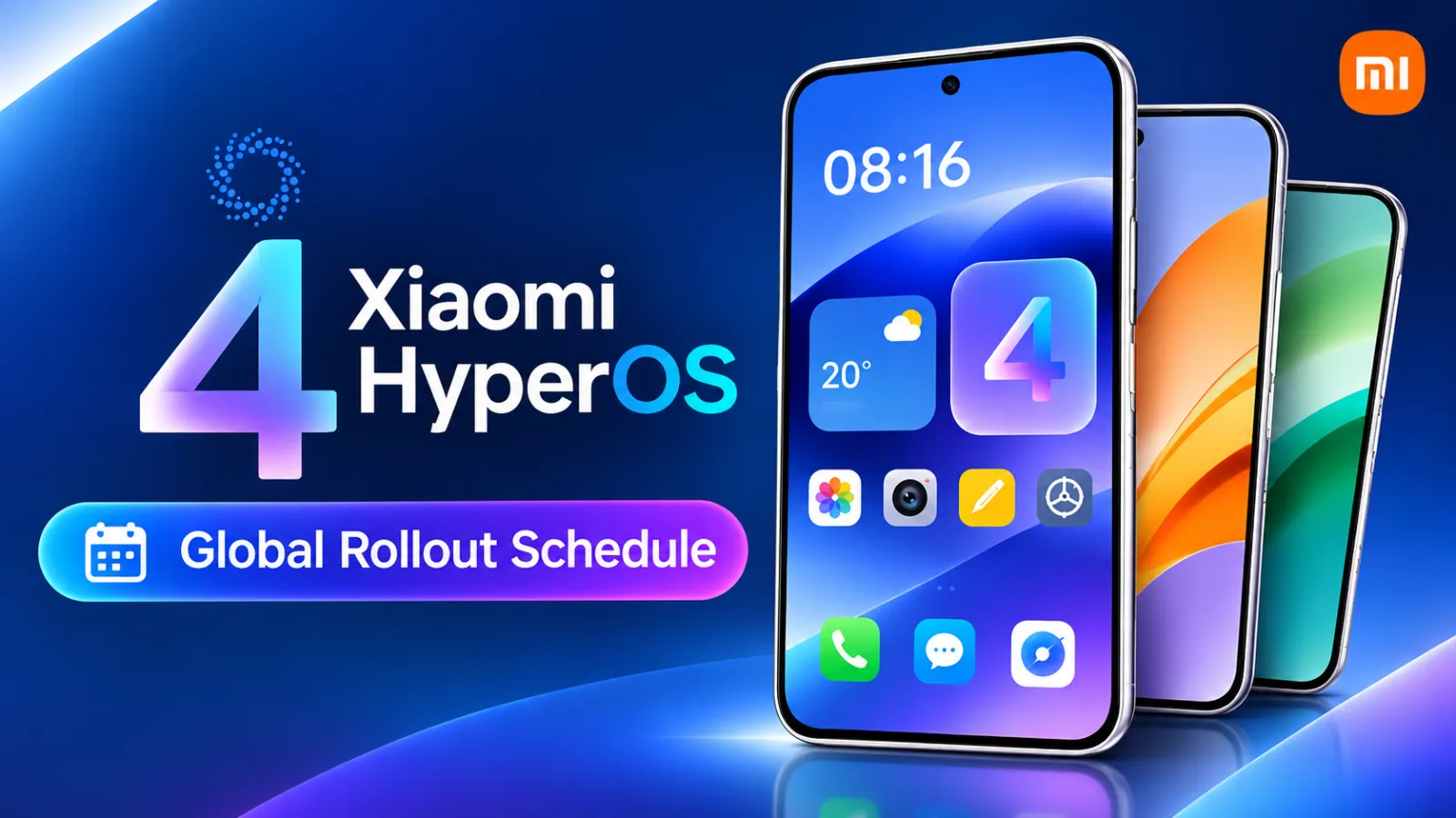
The Xiaomi HyperOS 4 global rollout has officially been unveiled, confirming an extensive software roadmap for international users. The multi-phase schedule details the release window for more than 80 smartphones and tablets across global markets.
This deployment covers devices under the core Xiaomi flagship brand, the popular Redmi lineup, and the performance-oriented POCO sub-brand. The rollout spans November and December 2026, delivering upgraded system animations, refined privacy controls, and cross-platform file sharing.
Xiaomi HyperOS 4 Global Rollout: Three Phased Waves
To maintain server reliability and software stability, the Xiaomi HyperOS 4 global rollout operates across three sequential phases. The initial deployment wave starts in early November 2026, prioritizing recent flagships and high-volume handsets.
Early November recipients include the Xiaomi 17 Ultra, Xiaomi 17, Xiaomi 17T Pro, Xiaomi 17T, Xiaomi 15 Ultra, and Xiaomi 15. The Leica Leitzphone powered by Xiaomi is also scheduled during this initial release window.
Redmi users will see immediate distribution across the Redmi Note 17 family, including the Pro Max 5G, Pro 5G, and 5G models. The Redmi Note 15 lineup, standard Redmi 17 devices, and Redmi 15 models share this early deployment window.
POCO devices scheduled for early November include the POCO F8 Ultra, POCO F8 Pro, POCO X8 Pro Max, POCO X8 Pro, and the standard POCO X8. The POCO M8 lineup and C-series models will also receive software builds alongside the Xiaomi Pad 8 and Pad 8 Pro tablets.
Mid-November Rollout for Performance Hardware and Tablets
The second rollout wave commences in mid-November 2026, expanding coverage to high-performance gaming hardware and productivity tablets.
This phase includes the Xiaomi 15T and Xiaomi 15T Pro smartphones. It also delivers the operating system upgrade to the POCO F9 Ultra, POCO F9 Pro, and the entire POCO F7 device family.
Tablet hardware features prominently throughout this second phase. The update will deploy across the Xiaomi Pad 7, Xiaomi Pad 7 Pro, and the compact Xiaomi Pad Mini.
Additional tablets slated for mid-November upgrades include the POCO Pad X1, POCO Pad M1, and the Redmi Pad 2 Pro series in Wi-Fi and 5G editions.
December Expansion for Previous-Generation Devices
The final wave will unfold across December 2026, bringing updated software to earlier flagship generations and popular previous-year models.
Eligible hardware in this wave includes the Xiaomi 14 series, Xiaomi 13 lineup, Xiaomi 13T models, and the compact Xiaomi MIX Flip. The widely adopted Redmi Note 14 family is also scheduled for software delivery during December.
POCO owners with earlier performance hardware will receive updates during this window, led by the POCO F6 series.
Company notices state that release dates represent regional start windows rather than simultaneous global installation dates. Carrier approvals and regional testing may cause minor distribution differences across specific countries.
Visual Refinement and Cross-Platform Compatibility
The new update incorporates a translucent visual style known as Soft Light Glass. The aesthetic introduces frosted interface elements, streamlined system notifications, and versatile lock screen customization.
Under-the-hood optimizations improve background memory handling and system fluidity. Internal benchmarks indicate an 8.7 percent improvement in sustained application launch speeds, alongside accelerated camera capture performance.
Cross-platform data transfer has also received major attention. The platform offers deeper compatibility with third-party operating systems, enabling seamless direct sharing of images, documents, and web links between Xiaomi hardware and Apple iOS devices.
Device owners can check for the upgrade through their phone settings menu. Users should back up important files and ensure at least 10 gigabytes of available storage before downloading the installation package.