paceX achieved an aerospace milestone on Saturday afternoon, catching its massive Starship spacecraft in midair as it returned from orbit.
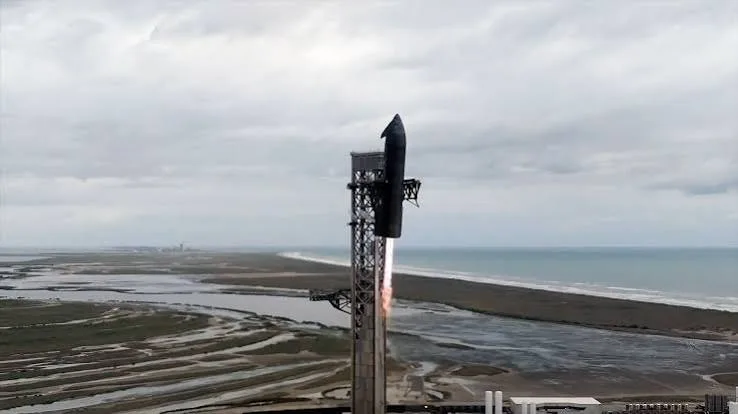
The stainless steel vehicle descended over the company’s Starbase facility in South Texas shortly after 3:00 p.m. local time. Falling belly-first through the clouds, the spacecraft fired its Raptor engines, flipped vertically, and eased between the mechanical arms of the launch tower.
Engineers at mission control cheered as the tower arms, nicknamed "chopsticks," closed around the rocket. The capture marks the first time SpaceX has recovered the orbital upper stage directly on the pad.
A Precise Descent and Tower Catch
The landing sequence demanded extraordinary navigational accuracy. Starship entered Earth's upper atmosphere at hypersonic speeds, protected by thousands of hexagonal ceramic heat tiles.
As it reached the lower atmosphere, the vehicle deployed its steering flaps to brake horizontally. Near the ground, onboard computers ignited the center engines to swing the 165-foot craft into an upright stance.
The launch tower, known as "Mechazilla," held open two giant motorized steel arms. Starship hovered briefly between them, venting vapor before coming to rest on specialized structural pins.
The successful catch took place around 4:20 p.m. Eastern Time, concluding a tense terminal descent watched by thousands of spectators along the South Texas coastline.
From Orbital Test Flight to Ground Recovery
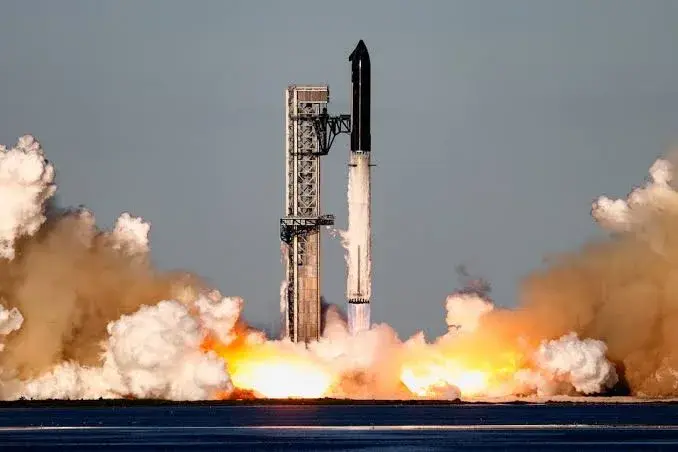
Saturday's recovery capped Test Flight 15, which lifted off from the Boca Chica launchpad on Friday afternoon.
Following stage separation, the upper stage fired its six Raptor engines and reached orbit. Starship circled Earth 14 times during a 22-hour solo mission, testing onboard guidance, payload bay systems, and thermal shields.
The flight had mixed results in its opening minutes on Friday. SpaceX aborted a planned catch of the 232-foot Super Heavy booster, diverting it to an offshore splashdown in the Gulf of Mexico, where it exploded.
Despite the booster loss, flight controllers proceeded with Starship’s full orbital agenda, clearing the spacecraft for its historic descent back to Texas.
The Quest for Rapid Full Reusability
Recovering both stages without water landings represents the foundation of SpaceX’s long-term business model.
Traditional rockets discard their hardware in the ocean or leave stages in orbit. By catching both the booster and the spacecraft with tower arms, SpaceX eliminates heavy landing legs and avoids corrosive saltwater recovery.
Company leadership has described full, rapid reusability as the defining challenge of modern space exploration. Catching the upper stage brings the system closer to aircraft-like turnaround times.
The milestone also supports NASA’s Artemis lunar program. The space agency holds multi-billion-dollar contracts with SpaceX to use modified Starship vehicles to land American astronauts on the moon.
Flight Context and Next Steps
The flight began during a complex operational window on Friday, coinciding with an unrelated nationwide FAA air traffic ground stop caused by federal telecommunications failures.
SpaceX conducted the launch within its pre-cleared maritime and airspace safety corridor. Aviation authorities lifted the broader domestic flight ground stop later Friday evening.
Technicians at Starbase will now inspect Starship’s structure, Raptor engines, and heat shielding. Data from Saturday’s catch will guide preparations for future tests aimed at recovering both rocket stages on a single mission.