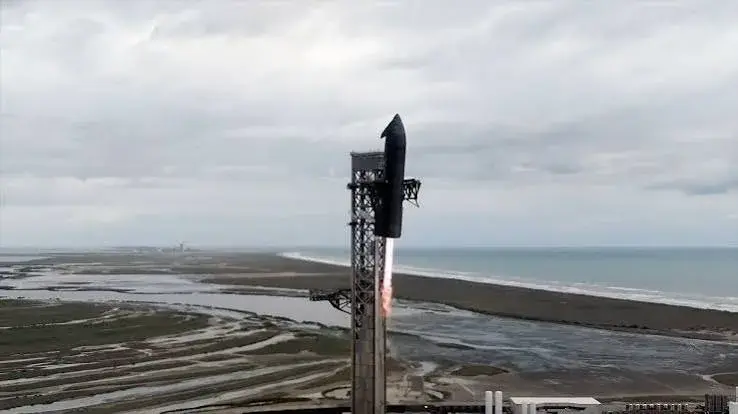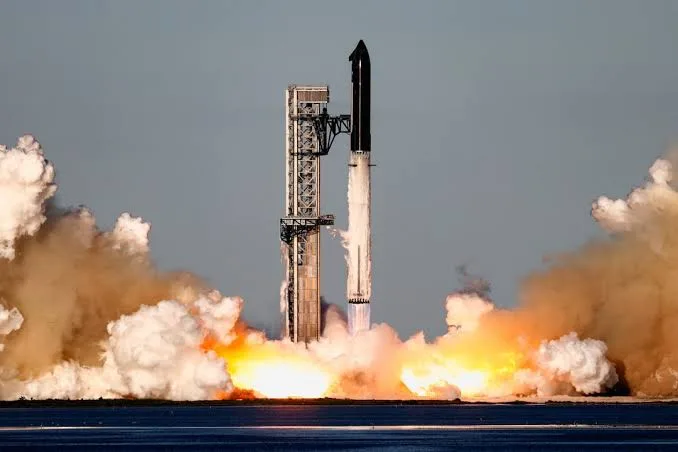
SpaceX successfully launched its towering Starship vehicle on its 15th test flight on Friday evening, creating a striking contrast as the world’s most powerful rocket ascended into orbit while commercial airliners remained grounded across the United States.
The 400-foot rocket lifted off at 5:47 p.m. Eastern Time from SpaceX's Starbase facility at Boca Chica, Texas. Propelled by 33 Raptor engines delivering more than 18 million pounds of thrust, the uncrewed spacecraft cleared the launch pad and soared over the Gulf of Mexico on its most complex test mission to date.
The launch proceeded despite a severe telecommunications outage at the Federal Aviation Administration that had halted domestic airline departures nationwide nearly two hours earlier.
Liftoff in South Texas During a National Aviation Freeze
The timing of Flight 15 placed commercial spaceflight in sharp juxtaposition with everyday civil aviation.
At 3:54 p.m. Eastern Time on Friday, federal aviation regulators ordered an unprecedented nationwide ground stop due to internal network failures across regional air traffic control centers.
While thousands of passenger flights sat stalled at airport gates from coast to coast, SpaceX’s launch operation remained on schedule. An FAA spokesperson confirmed to reporters that the agency's commercial launch license and dedicated airspace clearing for the South Texas corridor were unaffected by the broader commercial telecommunications stoppage.
The towering rocket ignited without delay, lighting the evening sky over the southern Texas coastline as automated tracking systems monitored its flight path toward space.
Super Heavy Booster Diverts to Gulf After Catch Aborted
Flight 15 was designed as SpaceX’s first attempt to recover both stages of the massive launch vehicle during a single mission.
Initial ascent proceeded smoothly, with the rocket achieving successful hot-staging—the separation of the Ship upper stage from the Super Heavy booster—about two and a half minutes into the flight.
SpaceX initially hoped to guide the giant 232-foot booster back to the launch pad, where mechanical "chopstick" arms on the Starbase tower were prepared to catch it mid-air. However, mission controllers called off the catch maneuver shortly after stage separation after automated criteria were not fully met.
Instead of returning to the launch tower, the booster executed a planned diversion trajectory over the Gulf of Mexico. The vehicle made a controlled descent, hovering briefly over the open water approximately six and a half minutes after launch before bursting into flames upon splashdown.
Upper Stage Reaches Orbit and Deploys Starlink Cargo
While the booster recovery fell short of a tower catch, Starship’s upper stage achieved major technical milestones in space.
The spacecraft fired its own engines to reach orbital velocity approximately 27 minutes after liftoff. Once settled into low Earth orbit, Starship began deploying a payload of 26 operational Starlink satellites, marking its second test flight carrying commercial revenue-generating cargo for SpaceX’s satellite internet network.
Mission plans slated the spacecraft for an extended 22-hour orbital voyage, circling the Earth roughly 14 times.
Engineers programmed the spacecraft to test in-space engine relights and thermal protection tiles before attempting an unprecedented return and pinpoint catch at Starbase on Saturday.
The High-Stakes Path Toward Full Rocket Reusability
Flight 15 represents a critical proving ground for SpaceX’s long-term space exploration roadmap.
The company is developing Starship as a fully and rapidly reusable launch system designed to drastically reduce the cost of delivering cargo and people to orbit. NASA has contracted modified versions of Starship as the Human Landing System for its Artemis III and Artemis IV missions, which aim to return American astronauts to the lunar surface.
Achieving routine, reliable recovery of both the Super Heavy booster and the upper-stage vessel remains the core engineering hurdle standing between experimental test flights and operational deep-space missions.
As controllers monitor the upper stage's orbital journey, the dramatic Friday evening launch demonstrated SpaceX's relentless launch tempo even on an afternoon when the nation's broader aviation network was temporarily brought to a standstill.