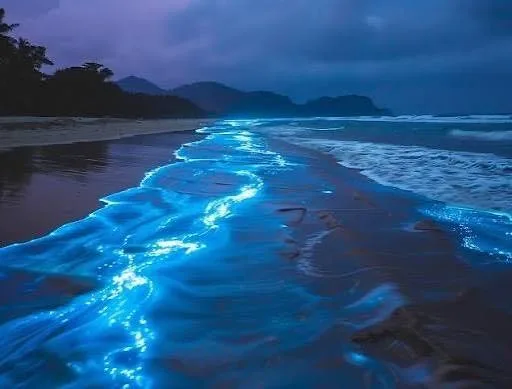
The sea is glowing blue along parts of the United Arab Emirates' eastern coastline, creating a striking natural spectacle after dark.
The phenomenon has been spotted at Al Aqah Beach in Fujairah, with similar sightings reported around Khorfakkan and Dibba Al Fujairah.
Videos circulating online show waves producing bright blue flashes as they break against the shore. Movement in the shallow water can also create glowing trails, leaving beach visitors amazed by the unusual sight.
Scientists identify the phenomenon as bioluminescence, a natural process in which living organisms produce light.
The current display is linked to microscopic marine organisms commonly known as Noctiluca scintillans, or sea sparkle.
The glowing beaches have attracted residents and photographers making late-night trips to the coast. Some observers have described the current display as among the most impressive they have witnessed in the UAE.
What Is Making the UAE Sea Glow Blue?
The blue light comes from tiny organisms living in coastal waters.
Noctiluca scintillans is a microscopic marine organism sometimes called sea sparkle. When the water is disturbed, it can produce flashes of light through a chemical reaction inside its cells.
Waves, moving water and other disturbances can trigger the glow. The effect becomes particularly visible at night, when surrounding darkness allows the blue light to stand out.
Researchers at the Sharjah Marine Science Research Centre, associated with the University of Khorfakkan, have captured microscopic images of the organisms involved.
Marine experts explain that these organisms occur naturally in UAE coastal waters and across parts of the Arabian Gulf. However, their visibility depends on conditions that allow them to gather and produce a noticeable display.
The phenomenon does not mean the sea itself has changed colour. Instead, thousands or millions of tiny light-producing organisms create the appearance of glowing water.
Fujairah and Khorfakkan Draw Night Visitors
Al Aqah Beach in Fujairah has become one of the main locations attracting visitors this week.
Residents have travelled from other parts of the UAE after seeing photographs and videos of the glowing waves online.
Similar reports have emerged from Khorfakkan Beach, while sightings have also been reported around Dibba Al Fujairah.
The phenomenon is not limited to one particular beach. Its visibility can vary across the coastline, depending on marine conditions and the concentration of organisms.
Photographers and visitors have described seeing glowing blue streaks across the water. Some videos show the light appearing around moving feet and hands near the shoreline.
However, a display seen at one location may not appear elsewhere. The glow can also weaken or disappear from the same beach between nights.
How Long Could the Bioluminescence Last?
The current display may continue for several weeks, although experts warn that its duration cannot be guaranteed.
Muhammed Sajjad, known online as the UAE weatherman, told Khaleej Times that he expects the glow could remain visible along parts of the UAE coast for three weeks or longer.
That estimate depends on changing environmental conditions.
Bioluminescence sightings in the UAE commonly occur during October and November, as well as between March and May.
Warm water, calm conditions and very dark surroundings can make the phenomenon easier to observe.
However, changing currents, waves, organism concentrations and other conditions may affect visibility. A beach that glows one night could appear completely dark the next.
Visitors hoping to witness the display should therefore check for fresh reports before making a long journey.
Visitors Should Enjoy the Glow Safely
The glowing waves may look inviting, but visitors should exercise caution around the sea at night.
Emirates 24|7 reports that experts advise people against entering the water at night to chase the glowing effect.
The presence of bioluminescence does not automatically confirm that seawater is safe for swimming. The glow alone cannot establish water quality or identify every organism present.
Beachgoers should remain aware of waves, currents, slippery surfaces and limited visibility.
People visiting to photograph the phenomenon can enjoy it from a safe distance without entering the water. They should also avoid disturbing marine life unnecessarily.
The spectacle offers a reminder of the unusual natural events that can appear along the UAE coastline.
For residents and visitors, the glowing sea is a beautiful sight. But its unpredictable nature means there is no guarantee it will remain visible for long.