
The Brands Rewriting the South-East Story
From aviation and manufacturing to media, sport, hospitality and retail, a new generation of brands is giving the South-East a different story to tell.
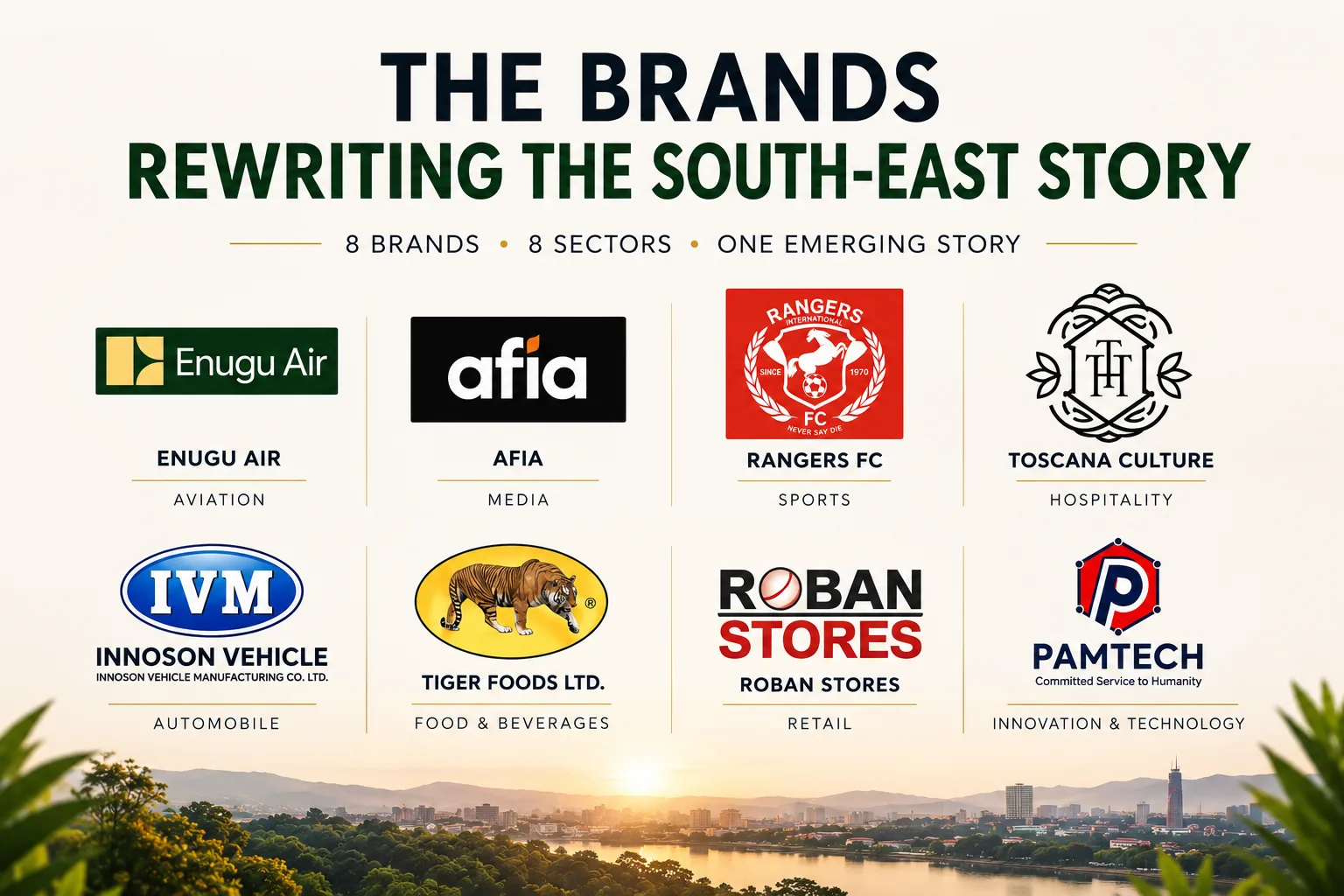
There is a familiar way of talking about the South-East. It is the land of commerce and enterprise, of markets and businesses built from little more than determination, family networks and an appetite for risk. It is also a region whose public image has often been shaped by stories of political tension, insecurity, migration and the unresolved weight of history.
But somewhere beneath those familiar narratives, another story is being built. It is not being written primarily in government offices or political speeches. It is being written by brands.
Look closely at what is happening across the region and a pattern begins to emerge. An airline is trying to make Enugu more connected. A media company is building a platform dedicated to telling the South-East's story. A football club continues to carry the emotional memory of a people. Hospitality businesses are turning culture into experience. An indigenous manufacturer is putting vehicles on Nigerian roads. A food company is turning production into consumer brands. A retailer is building modern shopping experiences around the purchasing power of the region's growing urban population, and an innovative company is creating new ways of solving everyday problems.
Taken individually, these are businesses and institutions pursuing their own commercial ambitions. Taken together, they begin to look like something else: the early architecture of a new regional identity.
Enugu Air represents connectivity. Afia represents narrative. Rangers represents identity. Toscana Culture represents experience. Innoson represents manufacturing. Tiger Foods represents value creation. Roban represents consumption. And Pamtech represents technology and innovation.
Consider Enugu Air. Aviation is more than getting people from one city to another. Connectivity changes how a place participates in an economy. It affects business travel, tourism, investment, conferences, family connections and the ease with which people perceive a city as accessible.
Enugu Air's recent admission into the African Airlines Association as its 50th member offers an indication of how quickly the young carrier's ambitions are moving beyond being simply a state-linked domestic airline. The carrier currently serves six domestic destinations from its base at Akanu Ibiam International Airport and has stated plans for regional and international expansion.
That is significant because the South-East has long had the economic activity to justify stronger connectivity, even when its infrastructure has struggled to keep pace with the ambitions of its people. An airline cannot solve that problem by itself. But it can change the conversation around accessibility. It says, in effect, that Enugu is not merely a place people leave from; it is a place people should be able to fly into, do business in and connect through.
And then there is the question of who tells the story.
This is where Afia Media becomes particularly interesting. A region cannot completely control its reputation if it does not participate actively in producing the narratives through which other people understand it. Afia has positioned itself as a South-East-focused broadcaster across television, radio and digital platforms, while increasingly moving beyond conventional programming into a broader conversation about regional development.
In July, the organization announced its Uwa Bu Afia: Reimagining the South East annual lecture and awards initiative, bringing together policymakers, business leaders, traditional rulers, academics, entrepreneurs and members of the diaspora to discuss the region's future. It has also launched the Obuzo Advertising Grant to help South-East businesses gain access to television and radio advertising.
That is more significant from a brand perspective than it may initially appear. Media is not simply a distribution channel. It is a mechanism for deciding what deserves attention. For decades, the South-East has been consumed through narratives largely produced elsewhere. Afia's proposition is different: what if the region becomes a producer of its own narrative? That is not about pretending that the region has no problems. In fact, it is the opposite. Owning a narrative means having enough confidence to discuss weaknesses alongside opportunities, debate difficult questions and still insist that the region is more complicated than its worst headlines.
Sport operates differently, but its power is just as profound. Few institutions illustrate the relationship between identity and place better than Rangers International Football Club of Enugu.
Rangers is not simply another football team competing for points. Founded in 1970, the club emerged in the aftermath of the Nigerian Civil War and became deeply woven into the identity of Enugu and the wider South-East. Its history includes multiple domestic titles and the 1977 African Cup Winners' Cup. In 2026, Rangers added another chapter by winning the Nigerian Premier Football League title and repeating its 2024 feat, reinforcing its status as one of the region's most recognizable sporting institutions. That kind of longevity is itself a brand asset.
People may not remember the details of a company's annual report, but they remember where they were when their club won. They remember the shirts, the songs, the stadium and the feeling of belonging to something larger than themselves. Rangers therefore represents something that economic development conversations sometimes overlook: a region also needs institutions that people can feel.
Then comes hospitality.
Toscana Culture represents another dimension of the story: the possibility of turning place, culture, food, entertainment and social experience into a commercial proposition.
Enugu's hospitality economy has evolved considerably, and Toscana's positioning around culture and entertainment reflects a broader shift in how urban consumers experience the city. The brand has been associated with efforts to celebrate Igbo heritage through music, food, dance and community, while its hospitality offering adds another layer to the city's leisure economy. This matters because a region's attractiveness because a region's attractiveness is not determined only by factories and office buildings. People invest where they can imagine living. They return to places where they can enjoy themselves. Visitors remember experiences, not development plans. The ability to create sophisticated spaces around culture and hospitality therefore contributes to the intangible infrastructure of a city.
And if aviation makes the region more accessible while hospitality makes it more enjoyable, manufacturing provides perhaps the clearest physical evidence of what the South-East can produce.
Few brands embody that argument more powerfully than Innoson Vehicle Manufacturing. From Nnewi, Innoson has spent years challenging one of Nigeria's most deeply embedded consumer assumptions: that serious automobiles must come from somewhere else.
The company describes itself as the first Made-in-Africa automobile brand and has built its identity around replacing dependence on imported used vehicles with locally manufactured alternatives. Its factory is located in Nnewi, Anambra State, while its product range now includes cars, multipurpose vehicles, pickups and other commercial vehicles. The significance of Innoson is therefore larger than the number of vehicles it sells. It is psychological. Every locally manufactured vehicle challenges the old hierarchy in which foreign automatically means better and indigenous automatically means inferior. Manufacturing does not just create products. It changes what people believe is possible.
The same argument applies to Tiger Foods. Based in Onitsha, Anambra State, Tiger Foods has built a substantial food-processing business around spices, seasonings, tomato products, beverages and other consumer food categories. The company continues to participate in major industry platforms and has expanded its product portfolio beyond the narrow idea of a single local food manufacturer.
Food manufacturing may not carry the same glamour as aviation or automobiles, but it arguably tells an equally important story: A region's economic sophistication can be measured partly by whether it can move from trading commodities to processing them, branding them, packaging them and building consumer loyalty around them. That is the transition from commerce to value creation. And that transition has always been central to the South-East's economic story.
And then there is Roban Stores. Roban Stores may appear, at first glance, to be the least dramatic brand on this list. It sells groceries, household products and everyday consumer goods. But that is precisely why its expansion is worth noticing. Retail is where an economy meets the consumer.
Roban's continuing expansion illustrates the growing demand for organized, modern shopping environments in the region. Its newest Premier Layout outlet in Enugu opened in August 2026, while the company has continued expanding its footprint, including a second location in Nnewi.
A modern retail chain says something subtle about the market around it. It says there are consumers with purchasing power, consumers who value convenience, presentation, consistency and experience, and consumers whose expectations are changing. In other words, Roban is not simply selling products. It is responding to the emergence of a different South-East consumer.
Pamtech Group adds another important dimension to this story: technology and innovation. From its base in Owerri, the company has grown beyond its original business interests as an oil and gas company into a diversified group with operations spanning technology, automotive, media, transportation and real estate. Its technology ventures have also focused on digital solutions to everyday problems, showing how South-East entrepreneurship is increasingly moving beyond traditional trading into platforms, systems and technology-enabled services that is redefining a people.
The more interesting question is what these brands collectively tell us about where the South-East is heading.
A successful airline makes connectivity tangible. A strong media platform makes narrative ownership tangible. A football club makes collective identity tangible. A hospitality brand makes culture experiential. A manufacturer makes industrial ambition visible. A food company turns production into something consumers can recognize on a shelf. A modern retailer makes the changing purchasing power of a population visible, and a technology company can demonstrate that the region is capable of building for the digital economy.
Put together they demonstrate something important: the region's own businesses are creating another source of meaning, through what they build and what people experience. The South-East may not be waiting for a new story. It may already be building one; one brand at a time.
More on Brands
Brands
AI Can’t Replace Local Insight, Babaeko Tells Nigeria’s Media Agencies
17 Aug 2026
Brands
Gucci Breaks With Tradition, Releases Luxury Sneakers 'Made in China'
29 Sept 2026
Brands
Apple Fan Brings 53 Old iPhones to Collect New Duo in Dubai
25 Oct 2026

Brands
Converse Removes Ad After Backlash Over KKK Imagery Comparisons
20 Sept 2026

Brands
Jetour Targets Luxury SUV Buyers With X90 Plus Abuja Experience
19 Sept 2026
Partner with Follow Global Trends
Display banners, sponsored stories and founder spotlights.
You may also like

Brands
Apple Reinvents Child Safety on iPhone With Smarter Family Controls
17 Sept 2026

Brands
Glo Marks 23 Years with Bold Push for Better Customer Experience
13 Sept 2026
Brands
Gino’s Six-City Pop-Up Tour Unites Thousands Through Food, Music and Community
10 Sept 2026

Brands
Adidas Faces Boycott Calls Over Campaign Featuring Former Israeli Soldier
7 Sept 2026

Brands
Glo Café 3.0: Globacom Unveils AI-Powered Digital Revolution in Nigeria’s Telecom Space
6 Sept 2026

Brands
Why the Best Brand Campaigns of 2026 Feel Less Like Ads
23 Aug 2026