One interview can introduce a person to millions. But sometimes, the most interesting story begins after the cameras stop rolling.
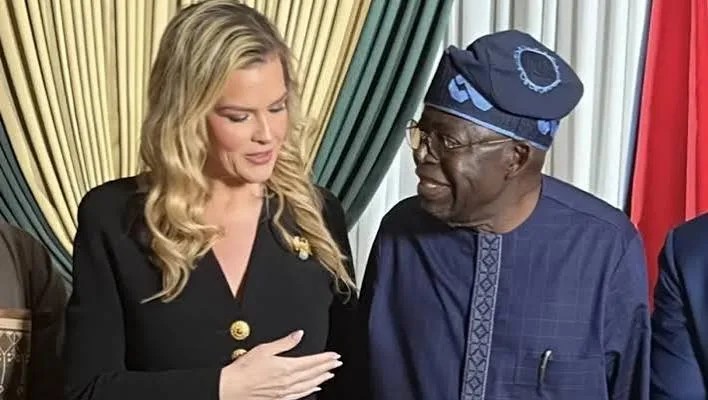
That is the situation surrounding Diana London, the American political strategist who recently sat down with Nigerian President Bola Tinubu at the Presidential Villa in Abuja.
Photographs from the meeting showed London alongside Tinubu and his Chief of Staff, Femi Gbajabiamila. Cameras and recording equipment suggested a formal interview rather than a routine courtesy visit.
The announcement came from Imran Muhammad, Senior Special Assistant on New Media to APC National Chairman Nentawe Yilwatda. He said the interview had taken place and would be released soon.
Then came another development.
London's posts about the presidential engagement and Nigeria-US relations disappeared from her X account. The removal was reported by Punch and TheCable on November 18.
Why did she delete them? There is no confirmed explanation.
But the disappearance has drawn attention to something beyond the interview itself: London's professional relationship with Nigeria and the American lobbying industry.
A strategist operating between politics, business and media
London is not simply a television personality who happened to meet a president.
She is the founder and chief executive of London Global Strategies, a Florida-based strategic advisory company. Her professional interests include political communications, government affairs, strategic partnerships and crisis communications.
Her company presents her as a strategist who works with political leaders, businesses and international organisations.
Her media profile adds another dimension. Newsmax identifies her as a political strategist and columnist. The Caldwell Institute for Public Safety also lists her as a television contributor and former US Congress communications director.
These roles place her at the intersection of political messaging, public affairs and media commentary.
That combination is particularly relevant when examining her Nigerian engagement.
A media personality asks questions and communicates information to audiences. A political consultant helps clients shape and communicate their interests. Sometimes, one professional may occupy both spaces.
Understanding which role applies in a particular engagement matters to readers.
The Nigerian connection goes beyond Aso Rock
The most revealing part of London's Nigerian story is found in American government records.
A December 18, 2025 filing with the United States Department of Justice identifies London as a consultant to DCI Group AZ, LLC.
DCI Group is an American public affairs and lobbying firm. The filing names the Republic of Nigeria, through Aster Legal, as the foreign principal connected to the engagement.
The stated work involved helping Nigeria communicate its efforts to protect Christian communities and maintain American support against jihadist groups and other destabilising elements in West Africa.
This is a documented professional relationship, not merely speculation based on her photographs with Nigerian officials.
The arrangement was connected to Nigeria's National Security Adviser, Nuhu Ribadu.
It also formed part of a wider lobbying contract reported to be worth $9 million if the possible renewal period was included.
The initial six-month engagement was valued at $4.5 million, with a further six months potentially taking the total to $9 million.
However, the contract was between Aster Legal and DCI Group. It would be inaccurate to describe the entire contract value as London's personal earnings.
TheCable separately reported that DCI Group disclosed payments of $75,000 and $375,000 to London Global Strategies under the Nigerian engagement.
The distinction is important. The company's reported payments, the wider lobbying contract and London's personal compensation are not automatically the same thing.
The deleted posts and the questions they leave behind
Before the posts disappeared, London had publicly praised the relationship between Tinubu and US President Donald Trump.
She described Nigeria-US security cooperation as “delivering results”. She also called Nigeria the United States' “greatest ally in Africa”.
Her messages discussed religious protection, security cooperation and possible economic opportunities.
Those comments became particularly interesting in light of her registered consulting relationship.
But there is a crucial distinction between documented facts and assumptions.
The US filing establishes her consulting role. It does not prove that the Tinubu interview was commissioned as part of that assignment.
Likewise, the disappearance of her posts does not establish that the Nigerian government ordered their removal or that the lobbying reports caused her decision.
No public explanation from London had emerged when the deletion was reported.
Her professional profiles also contain differences in the names and titles of companies associated with her. Newsmax, for example, uses a different business description from her current company website. The available profiles do not fully explain those differences.
The questions are therefore bigger than one deleted social media post.
Who arranged the interview? What was its intended audience? Was London participating as a journalist, a political commentator, a consultant, or in more than one professional capacity?
And what exactly did Tinubu discuss with her?
What her story tells us about political influence
London's growing visibility in Nigeria offers an opportunity to examine how modern political influence works.
Governments increasingly use international public relations firms, consultants and strategic communications specialists to explain their policies abroad.
These arrangements can help governments communicate with foreign officials, media organisations and influential audiences.
They also raise questions about transparency, particularly when the people involved have public media profiles.
In the United States, FARA requires certain individuals and organisations working for foreign principals to disclose their relationships and activities. Registration is a transparency requirement, not a declaration of criminal conduct.
London's registration should therefore be understood in its proper context.
Her career combines political strategy, media commentary and international advisory work. Her Nigerian engagement is now part of that public record.
The next important development is the release of the Tinubu interview. Until viewers can examine the questions and answers themselves, the full significance of the meeting remains difficult to assess.
For now, Diana London's story is no longer simply about an American strategist visiting Aso Rock. It is about the increasingly connected worlds of political communication, international lobbying and presidential media access.