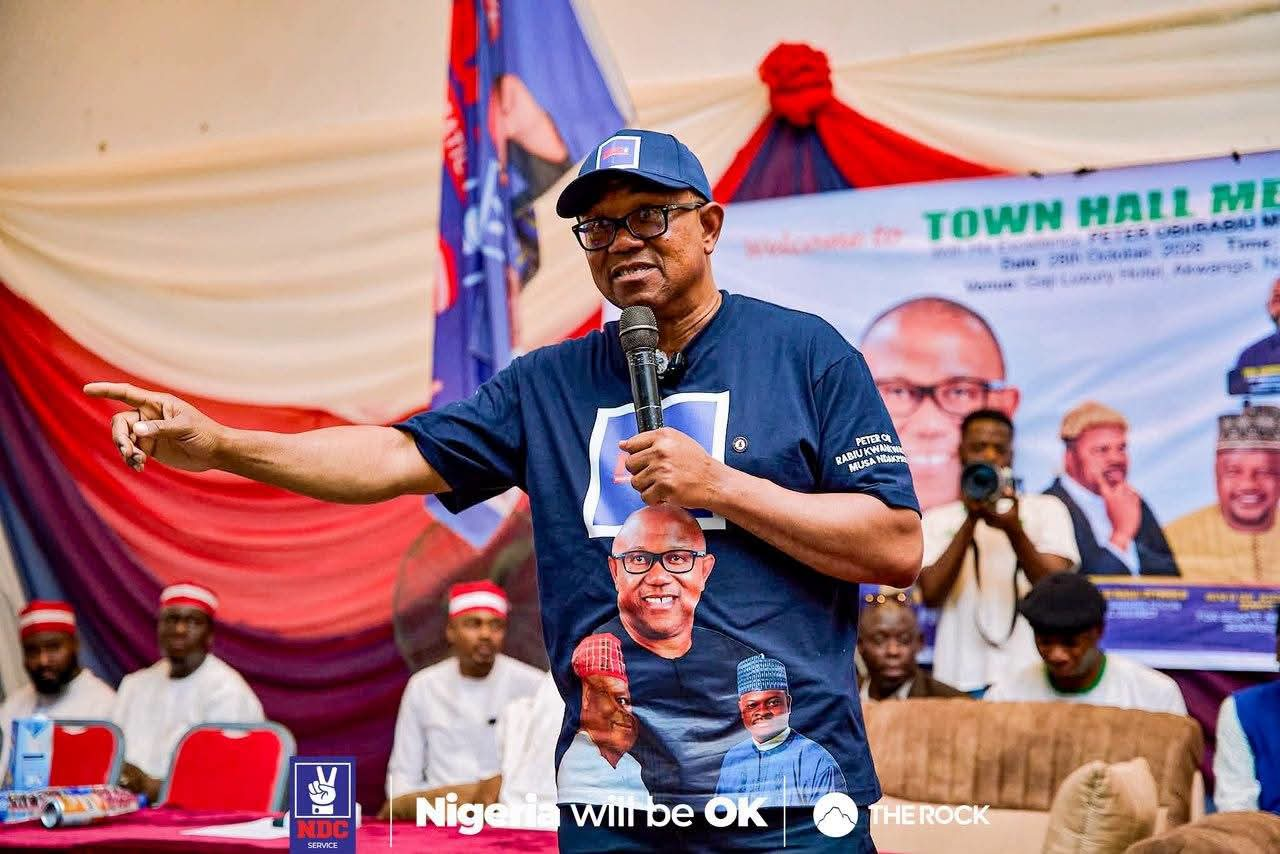
Former Anambra State Governor and 2027 NDC presidential candidate Peter Obi has defended his record in office, saying the governance model adopted by his administration can be replicated across Nigeria.
Obi made the declaration in the first instalment of a 10-part series titled “Nigerians, Go and Verify”, which he published on his X and Facebook accounts on Monday.
The opening instalment, titled “Introduction: Governance as a Public Trust,” provides an account of the philosophy, planning framework and development priorities that guided his administration.
Obi said Anambra was at a critical point when he assumed office, with leadership increasingly disconnected from the people and several institutions required to support a modern society either weak, ineffective or absent.
He argued that the situation required a different approach to governance, which he described as a public trust founded on transparency, prudence, accountability and measurable results.
“Our governing philosophy rested on four principles: character, competence, capacity, and compassion,” Obi wrote.
He said his administration viewed leadership as a responsibility to improve the lives of ordinary citizens rather than a platform for personal recognition, political slogans or self-promotion.
According to him, achieving that objective required a clear vision, careful planning and disciplined implementation.
Obi Explains Creation of ANIDS
A major part of Obi’s account focuses on the Anambra Integrated Development Strategy (ANIDS), which he described as the overarching development philosophy and strategic framework of his administration.
He said one of the first challenges identified by his government was the absence of a unified development plan to guide the state's priorities and determine how public resources should be allocated.
In response, his administration created the Ministry of Economic Planning to provide an institutional foundation for coordinated and sustainable development.
Obi said the government subsequently completed the necessary groundwork and consultations before launching ANIDS.
He explained that the framework was designed partly around the eight Millennium Development Goals (MDGs), which were being pursued internationally at the time.
The goals covered poverty and hunger reduction, universal primary education, gender equality and women's empowerment, lower child mortality, improved maternal health, the fight against HIV/AIDS and other diseases, environmental sustainability, and global development partnerships.
Obi said his administration adapted those objectives to Anambra's circumstances and priorities, translating international development targets into policies, programmes and measurable outcomes intended to improve people's lives.
He also recalled changing the state's public identity from “Home for All” to “The Light of the Nation”.
According to him, the change was intended to represent more than a new slogan, reflecting an effort to restore public confidence, renew civic pride and position Anambra as an example of purposeful leadership and development.
Education, Healthcare and Infrastructure Among Priorities
In the second section of his account, titled “The ANIDS Blueprint: A Comprehensive Framework for Development,” Obi said his administration pursued development across multiple sectors rather than concentrating on one area at the expense of others.
He listed education, healthcare, infrastructure, security, agriculture and effective public institutions as interconnected priorities, arguing that progress in one sector could not be sustained without corresponding improvements elsewhere.
The former governor also identified the restoration of the dignity of the Anambra person as a central objective of his administration.
He said this could not be achieved through political statements alone but should be reflected in the quality of roads and other infrastructure, access to healthcare, education standards, the performance of public institutions and the treatment of government workers, pensioners and traditional institutions.
“Our aim was to create a state where public resources produced tangible public benefits, institutions existed to serve the people and development was assessed by the lives transformed rather than by the promises made,” he wrote.
Obi added that his administration began by strengthening government institutions, improving their ability to function effectively and ensuring that they remained accountable to the public interest.
He attributed the pursuit of development across different sectors to careful planning, responsible management of resources and leadership anchored on accountability.
Obi Promises More Details in Second Instalment
Obi said the second instalment of the series would examine the measures his administration took to restore and strengthen state institutions and make government more effective in serving the people.
He also promised to review initiatives and accomplishments in education and other essential sectors.
The series comes amid renewed political scrutiny of his tenure as Anambra governor, particularly following President Bola Tinubu's criticism of his handling of erosion challenges in the state.
At an APC rally in Uyo, Akwa Ibom State, on November 6, Tinubu accused Obi of running away from erosion, contrasting the former governor's record with his own efforts to confront coastal erosion in Lagos.
Obi has rejected suggestions that he abandoned his responsibilities in Anambra. His new series provides an opportunity for him to present his account of the administration's policies, decisions and achievements.
However, the publication of his account does not, by itself, settle the wider disagreements over his administration's record. Some of the claims surrounding the state's finances, ecological funds and inherited liabilities have also been disputed by the current Anambra State Government.
Former Governor Says Anambra Model Can Be Replicated Nationwide
Obi ended the opening instalment by arguing that the progress recorded under his administration was not an isolated achievement that could not be reproduced elsewhere.
“I assure Nigerians that the progress demonstrated in Anambra State was neither a one-time occurrence nor an experiment that cannot be repeated,” he wrote.
He described the experience as a proven governance model that could be extended to the national level, provided the country had capable leadership, effective planning, responsible management and accountable institutions.
“What we accomplished in Anambra can also be accomplished in Nigeria,” he declared.
The former governor concluded with the appeal that gives the series its title: “Go and verify. -PO”
The remaining instalments are expected to provide more details of his administration's interventions across government institutions and key sectors, allowing Nigerians to assess his account as the series unfolds.