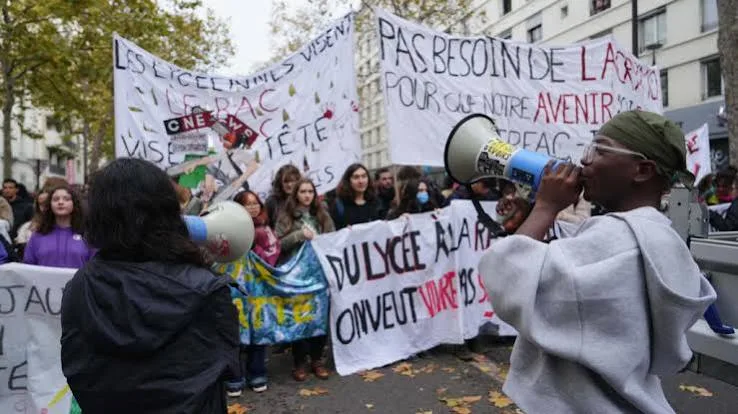
Thousands of young people and students are taking part in coordinated strikes and demonstrations across Europe on Friday, November 20, protesting rising living costs, education cuts, housing pressures and military spending.
The international mobilisation spans more than 25 countries, according to organisers from the Youth Strike Coalition, which says more than 50 youth and student organisations are involved.
The demonstrations are being held under the slogan “Fight for Our Future, Not Their Wars.” Students are calling on governments to prioritise education, social welfare, affordable housing and opportunities for young people.
The protests are taking place in countries including Britain, France, Italy, Spain, Germany, Belgium and Austria, with different cities focusing on their own economic and political concerns.
Rising costs and education concerns drive protests
Young demonstrators say everyday costs are making it increasingly difficult to build stable futures.
Housing shortages, rising rents, low wages, education funding concerns and limited opportunities have become common grievances across several European countries.
In Britain, organisers say students from more than 350 schools, colleges and universities are expected to participate in walkouts. In Germany, demonstrations are also planned, including in Cologne, where up to 10,000 students were expected to attend, according to local reporting cited by CNN.
The concerns extend beyond education. Many young people are also expressing frustration over unemployment, climate issues, political decisions and the growing influence of artificial intelligence on future jobs.
Although the protests share similar concerns, they remain driven by different national circumstances and demands.
Italy's strike brings workers and students together
Italy has seen particularly large demonstrations, as students joined workers during a nationwide general strike organised by the country's largest trade union, CGIL.
The strike called for higher wages, stronger public services and greater investment in healthcare and education. Demonstrations were planned across more than 100 cities, including Rome, Milan, Turin, Naples and Palermo.
Reuters reported that the strike affected public and private sectors, including schools and healthcare, while air and rail services were excluded from the general strike. A separate rail strike was scheduled to begin Friday night and continue into Saturday.
CGIL leader Maurizio Landini said more than one million people had demonstrated across over 100 cities, although Italy's Interior Ministry had not yet released its own estimate.
Students also criticised government spending priorities, arguing that public money should support schools, welfare and living standards rather than increased military spending.
Protesters challenge Europe's military spending priorities
A central theme of Friday's mobilisation is opposition to militarisation and increased defence spending.
Organisers argue that governments are directing billions of euros towards military programmes while young people face housing insecurity, underfunded schools and economic uncertainty.
The coalition's manifesto calls for an end to rearmament policies, investment in education and welfare, climate and social justice, and opposition to military conscription.
The protests also include solidarity with Palestinians and criticism of Europe's political response to the war in Gaza, although the specific demands differ between countries and organisations.
The mobilisation comes amid broader youth protests across Europe in recent weeks. In France, Germany, Portugal and other countries, young people have taken to the streets over economic hardship, housing, education and political dissatisfaction.
Friday's coordinated action may strengthen the visibility of these concerns, but organisers face the challenge of turning street demonstrations into lasting political change.