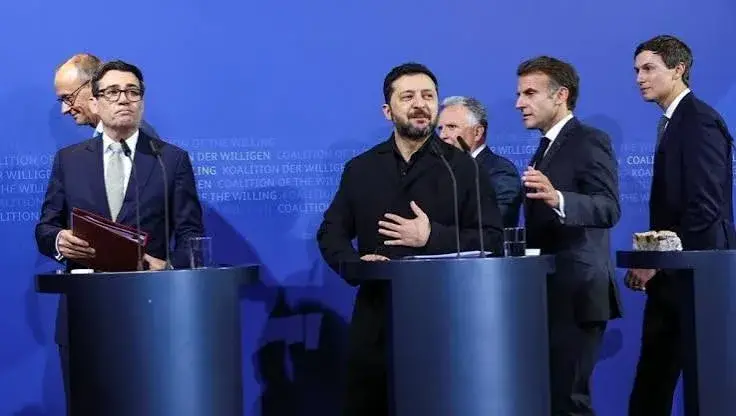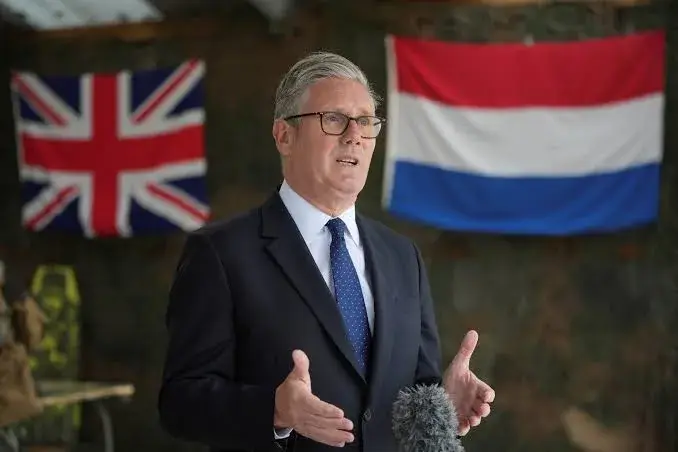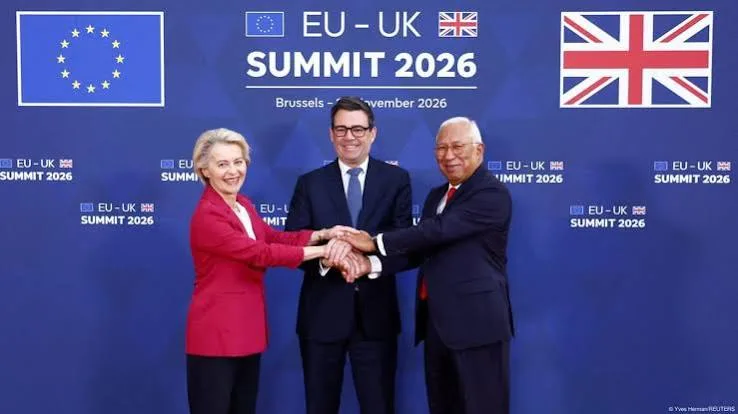
British Prime Minister Andy Burnham has secured a series of agreements with the European Union, marking a significant step towards rebuilding relations after Brexit.
The agreements were reached at the UK-EU summit in Brussels on Friday, November 20, 2026. They cover food and agricultural trade, emissions trading and a new youth mobility arrangement.
The package is expected to reduce trade barriers, support businesses and create opportunities for young people on both sides.
According to the British government, the agreements could increase the UK's gross domestic product (GDP) by 0.5 per cent by 2040. This represents an estimated £17 billion annually.
However, the announcement comes with an important complication. Britain and the EU have yet to settle their disagreement over university tuition fees.
The dispute has created uncertainty over when the wider agreements can formally take effect, despite Downing Street insisting that negotiations on the three main arrangements have concluded.
Food Trade Deal Targets Post-Brexit Barriers
One of the most significant agreements concerns trade in food, agricultural products, animals and plants.
Since Brexit, businesses moving these products between Great Britain and the EU have faced additional paperwork, inspections and certification requirements.
The new Sanitary and Phytosanitary (SPS) agreement aims to remove many of these obstacles by establishing common standards across the participating markets.
Under the arrangement, businesses will no longer need certain export health and phytosanitary certificates. Several routine border inspections will also be removed.
The changes are expected to make cross-border trade faster and less expensive.
British products, including fresh sausages, burgers, Scottish seed potatoes and certain seafood products, will also regain access to European markets.
The British government estimates that the food and agricultural agreement could contribute nearly £3.8 billion annually to the economy by 2040 in its detailed assessment. Its broader summit announcement also puts the potential economic contribution of the food agreement at up to £5.1 billion annually.
These are government economic projections, not guaranteed returns.
The agreement is expected to apply from March 1, 2028, subject to the required British and European procedures.
The government estimates that this food trade agreement could add up to £5.1 billion annually to the UK economy by 2040. The separate carbon-market agreement carries an estimated contribution of £3.8 billion annually.
Youth Mobility Scheme Opens New Opportunities
The summit also delivered a major development for young people seeking opportunities across Europe.
Britain and the EU have concluded negotiations on a new Youth Experience Scheme (YES).
The arrangement will allow eligible British and European nationals aged 18 to 31 to live in each other's territories for up to three years.
Participants will be able to work, study, volunteer, travel or take part in au pair arrangements.
The scheme will accommodate up to 100,000 young people from each side annually. This means a combined potential participation of 200,000 people every year.
Importantly, applicants will not need an existing job offer. The British government also says there will be no language or salary requirements.
However, the arrangement will operate through a visa system and remain subject to eligibility requirements.
Participants will not automatically qualify for social benefits in their destination countries. They will also be unable to bring dependants under the scheme.
British participants will be able to move between participating EU member states, with a maximum of three countries during the three-year period.
The first participants are expected to benefit no later than January 2030.
For young people who lost opportunities following Brexit, the arrangement represents a significant reopening of access to European work and cultural experiences.
It is important to understand that this is not a restoration of unrestricted freedom of movement. It is a limited, age-based and capped mobility programme.
Carbon Market Agreement Could Protect British Industries
Another important part of the package concerns emissions trading.
Britain and the EU have agreed to link their respective emissions trading systems, creating a larger carbon market.
An emissions trading system places a limit on greenhouse gas emissions. Companies operating within the system can buy and sell allowances, creating financial incentives to reduce pollution.
The agreement is particularly important for British manufacturers exporting products such as steel and aluminium to European markets.
Under the arrangement, eligible British exports will be exempt from the EU's Carbon Border Adjustment Mechanism (CBAM).
CBAM is an EU policy designed to address the carbon emissions associated with certain imported products. It helps prevent companies from gaining an unfair advantage by moving production to countries with weaker climate rules.
The British government estimates that linking the two markets could protect approximately £6.5 billion worth of exports from carbon border charges.
It also projects an additional £3.8 billion annual economic contribution by 2040.
The two sides are targeting January 1, 2028, for the operational launch of the linked emissions markets.
For British manufacturers, the agreement could reduce additional costs and make exporting to Europe more predictable.
Tuition Fee Dispute Threatens to Complicate the Agreement
Despite the progress, university tuition fees remain the biggest unresolved issue.
The European Union wants its students studying at British universities to enjoy the same tuition rates as British students.
Before Brexit, eligible EU students generally benefited from domestic tuition arrangements in the UK.
However, following Britain's departure from the bloc, most EU students became subject to international student fees.
These fees can be several times higher than the rates charged to British students.
The EU is therefore pushing for equal treatment. Britain, however, has resisted the demand, favouring significantly reduced fees rather than full domestic-rate access.
The disagreement is particularly sensitive because British universities depend partly on international student fees to support their finances.
Both sides have agreed to continue negotiations for another six months.
The official joint statement confirms that they will work towards a supplementary agreement covering tuition fees for students from both sides.
It also sets a six-month deadline for concluding those negotiations.
However, there are different interpretations of what the outstanding disagreement means for the wider package.
Downing Street insists that negotiations on the three main agreements have concluded. It says the parties will now proceed towards implementation through their respective legal processes.
European officials, meanwhile, have indicated that the four agreements form a single package. They have suggested that the three other arrangements may not enter into force until the tuition-fee question is settled.
This difference is important.
It means the agreements have been reached politically, but the precise conditions surrounding their implementation remain contested.
The joint statement provides implementation targets for the trade and mobility arrangements, while the tuition-fee negotiations continue.
Burnham Defends Closer European Ties as Farage Objects
Burnham has presented the agreements as an opportunity to improve Britain's economic prospects.
Speaking at the summit, he described the agreement as a win-win for Britain and Europe.
He argued that closer cooperation would reduce costs for businesses, help consumers and create opportunities for younger generations.
The Prime Minister also indicated that the agreements could represent the limit of what his government could achieve before the next national election, expected by mid-2029.
However, the announcement has attracted criticism from opponents of closer European integration.
Reform UK leader Nigel Farage accused Burnham of moving Britain towards renewed participation in the European single market.
Farage argued that Britain would risk surrendering regulatory independence by aligning with European rules.
He also described the agreements as a betrayal of the promises made during the Brexit campaign.
European Commission President Ursula von der Leyen welcomed the renewed cooperation.
She also expressed support for broader discussions about the future relationship between Britain and the EU.
The competing reactions show that Brexit remains politically sensitive, even as both sides pursue practical economic cooperation.
The developments also build on Burnham's earlier interventions on Britain's relationship with Europe. Follow Global Trends previously examined his comments about Russia's alleged interference in the Brexit referendum.
The latest agreements can be followed through the Follow Global Trends Europe Desk.
For the moment, the immediate test will be whether Britain and the EU can resolve their tuition-fee disagreement within the agreed six-month period.
That outcome could determine how smoothly the wider reset moves from political agreement to practical implementation.