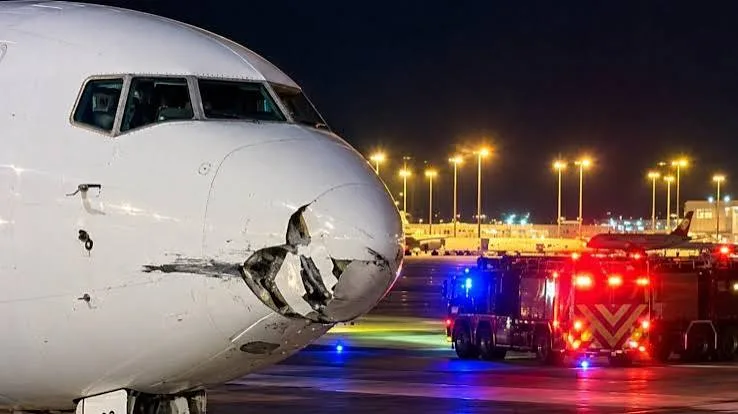
Two passengers sustained minor injuries after a commercial airliner and a cargo plane collided while taxiing at Miami International Airport on Saturday night.
The ground incident involved Copa Airlines Flight CM427, an arriving Boeing 737-800NG carrying 166 passengers and six crew members, and UPS Flight 358, a Boeing 767 cargo aircraft bound for Bogotá, Colombia.
The collision occurred around 9:15 p.m. local time at the crossing of two active taxiways as the passenger flight was taxiing toward its arrival gate following a scheduled service from Panama City.
First responders from Miami-Dade Fire Rescue treated two passengers at the terminal for minor abrasions. Initial airfield reports had indicated zero casualties before arriving passengers were formally evaluated at the gate.
Federal regulators launched an immediate inquiry into the collision, which happened just 24 hours after a nationwide air traffic control communication outage halted domestic departures across the United States.
Wingtip Collision at Taxiway Intersection
According to preliminary briefings from airport officials, both aircraft were traveling along adjacent ground routes when their flight paths converged.
Copa Airlines confirmed that the left wingtip of its Boeing 737 clipped the forward nose section of the UPS cargo jet.
The impact caused visible structural damage to the passenger plane’s winglet and punctured the exterior protective skin near the cargo aircraft’s radome.
"At approximately 9:15 p.m., an arriving aircraft and a departing aircraft made contact with each other at the intersection of two taxiways," said Greg Chin, communications director at Miami International Airport.
Ground controllers immediately rerouted other taxiing aircraft around the blocked crossing, allowing standard runway departures and arrivals to continue without widespread terminal delays.
Air Traffic Control Audio Documents Yield Instruction
Federal Aviation Administration audio transmissions captured the critical radio exchanges between air traffic controllers and the two cockpits.
Tower recordings confirmed that ground controllers had instructed the UPS cargo crew to hold their position and give way to the approaching Copa airliner.
Seconds after the aircraft collided, the pilot of the passenger jet radioed the control tower, reporting, "Somebody hit us."
When the controller asked the cargo aircraft, "UPS 358, did you hit that aircraft?", a pilot on the freighter acknowledged over the frequency, "We went too far."
Aviation safety experts cautioned that while the radio admission indicates cockpit misjudgment during ground movement, the FAA will analyze black-box telemetry before assigning official institutional responsibility.
Passenger Evacuation and Injury Reconciliations
Following the collision, Copa Flight CM427 taxied under its own power to an assigned gate, where emergency paramedics met the aircraft.
While early airport advisories suggested no one was hurt, medical teams later confirmed that two travelers required treatment on the scene for minor cuts and contusions. Neither passenger required hospital admission.
UPS reported that its flight crew members were uninjured. The shipping company stated that it was working directly with airport emergency personnel and federal investigators to inspect the grounded freighter.
Copa Airlines customer service teams assisted the remaining travelers with delayed luggage claims and rescheduled international connecting flights through the night.
Federal Aviation Administration Launches Ground Incursion Review
The Federal Aviation Administration initiated an official investigation into the taxiway collision on Sunday.
Federal safety specialists are reviewing airport surface movement radar recordings, cockpit voice audio, airfield lighting, and surface marking visibility at the intersection.
The inquiry will examine whether cockpit workload, ground radio handoffs, or blind spots contributed to the cargo aircraft crossing past its assigned hold point.
Both aircraft have been taken out of commercial service at Miami International Airport pending complete airframe safety certifications.
The FAA expects to complete its preliminary factual report on the incident within thirty days.