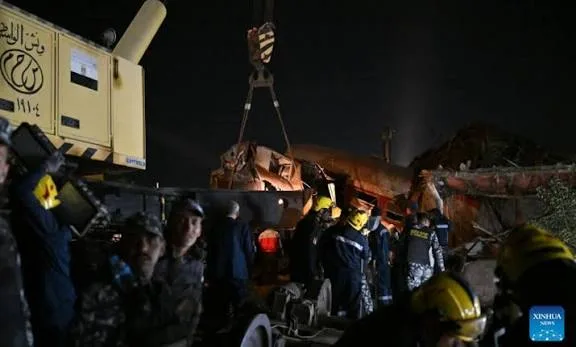
Death toll rises in Egypt train collision as emergency teams and hospital authorities confirm at least seven fatalities following Sunday's high-speed passenger rail disaster south of Cairo.
The catastrophic collision occurred in the al-Ayyat district of Giza governorate, roughly 52 kilometres south of the capital.
Egypt's Ministry of Health and Population reported that more than 112 passengers sustained injuries, with local hospital tallies indicating that the total number of wounded reached 125 as triage continued through the night.
Rear-End Crash Along Southbound Corridor
Initial findings from the Ministry of Transportation show that the accident involved two passenger services traveling along the same southbound track.
A stationary train heading from Cairo to Aswan had stopped on the line when a second service traveling from Giza to Fayoum rammed into its rear carriage.
The impact pulverized the rear coach and threw several passenger cars off the rails, trapping dozens of commuters inside crumpled steel compartments.
Local residents from the nearby village of Kafr Girza rushed to the tracks immediately after hearing the crash, helping extricate survivors from the wreckage before formal medical crews arrived.
Emergency Triage and Hospital Discharges
As the death toll rises in Egypt train collision, the national ambulance service mobilized more than 70 emergency vehicles to ferry victims to regional health centers.
Casualties were transferred to multiple treatment centers, including al-Wasta Central Hospital in neighboring Beni Suef province and specialized trauma facilities across Giza.
Attending physicians reported treating complex bone fractures, spinal trauma, pelvic injuries, and deep lacerations.
By Monday morning, health officials announced that over 70 patients had stabilized and were discharged, while dozens remain under intensive surgical care.
Forensic Probe into Network Failures
News that the death toll rises in Egypt train collision has renewed intense national scrutiny over chronic infrastructure weaknesses on Egypt's passenger rail network.
Egyptian President Abdel Fattah al-Sisi issued a formal directive mandating a swift, comprehensive investigation, pledging that any official or operator found negligent will face strict legal accountability.
Transport Minister Kamel al-Wazir and Chief Prosecutor teams inspected the crushed carriages overnight, while heavy cranes worked to clear the tracks and restore mainline service to Upper Egypt.
Investigators have seized signal logbooks, automatic train control recorders, and communication transcripts to determine why the trailing train was cleared onto an occupied track section.
Public grief deepened across the country as the death toll rises in Egypt train collision, highlighting ongoing challenges despite extensive capital investments aimed at modernizing the nation's railway lines.