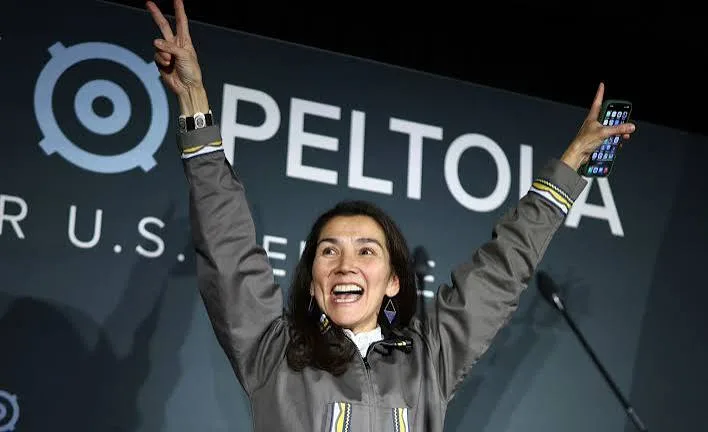
Democrat Mary Peltola has won Alaska’s closely watched US Senate race, defeating Republican incumbent Dan Sullivan and delivering another major victory to her party in the 2026 midterm elections.
The Associated Press called the race on November 17, after updated results pushed Peltola above the 50 per cent threshold needed to win outright. Her victory gives Democrats a 56–44 majority in the incoming Senate, following nine successful flips of Republican-held seats.
The result also makes Peltola the first Alaska Native ever elected to the US Senate. She is the first Democrat to win a Senate election in Alaska since Mark Begich won the seat in 2008.
The outcome marks a significant political shift in a state that supported President Donald Trump by 13 percentage points in the 2024 presidential election.
Peltola defeats Republican incumbent Dan Sullivan
Peltola defeated two-term Republican Senator Dan Sullivan in the November 3 election. The result remained unresolved for two weeks as Alaska officials counted outstanding ballots.
Updated figures reported on November 17 gave Peltola approximately 50.1 per cent of first-choice votes. Sullivan received about 45.8 per cent.
The Associated Press declared Peltola the winner after her lead became too large for Sullivan to overcome under the available vote count.
The result meant Alaska would not need further rounds of ranked-choice voting to determine its Senate winner.
Under Alaska’s ranked-choice voting system, voters can rank candidates in order of preference. If nobody receives more than half of the first-choice votes, officials eliminate the lowest-performing candidates and redistribute ballots according to voters’ next preferences.
Peltola crossed the required threshold, avoiding that additional process.
Her victory also ended Sullivan’s effort to secure another Senate term.
Democrats secure 56-seat Senate majority
Peltola’s victory gives Democrats 56 seats in the incoming Senate, compared with 44 for Republicans.
The result completes a remarkable series of nine Senate seat gains for Democrats during the midterm elections.
Before the election, Republicans held a 53–47 Senate advantage. Democrats have now reversed that balance and secured their largest Senate majority since 2009.
The party had already established its return to Senate control through victories in other closely watched races. Alaska was the final unresolved Senate contest.
Senate Democratic leader Chuck Schumer celebrated the result, describing Peltola’s victory as a major achievement for Alaska and the country.
The new Senate balance will take effect when the next Congress begins in January 2027.
Democrats will therefore enter the new legislative session with greater control over Senate proceedings, committee leadership and the consideration of legislation.
However, the size of their majority does not guarantee that every party proposal will pass. Individual senators, Senate rules and negotiations with the House will continue to shape legislative outcomes.
Peltola makes history as first Alaska Native senator
Peltola’s victory carries significance beyond the change in party control.
The 53-year-old politician is Yup’ik, an Indigenous people of Alaska. Her election makes her the first Alaska Native to serve in the United States Senate.
She previously made history in 2022 when she became the first Alaska Native elected to Congress.
Peltola won a special election that year to represent Alaska’s only seat in the US House of Representatives. She later secured a full term but lost her 2024 re-election campaign to Republican Nick Begich III.
Her return to national office through the Senate marks a major political comeback.
Before entering politics, Peltola worked in the commercial fishing industry. Her campaign focused heavily on issues affecting ordinary Alaskans.
These included the rising cost of living, housing affordability, food prices and the challenges facing remote communities.
Her campaign also promoted an Alaska-focused message, presenting her as a representative prepared to put local interests ahead of national political divisions.
That approach helped her compete in a state where Republicans have traditionally enjoyed strong support.
Controversy over second Sullivan candidate remains under investigation
Peltola’s campaign victory came amid controversy involving another candidate with a similar name to the Republican incumbent.
Daniel J. Sullivan Jr., a retired schoolteacher, also contested the Senate election as an independent candidate.
Republicans alleged that the second Sullivan was recruited to confuse voters and divert support away from Senator Dan Sullivan.
A report by The New York Times alleged that people connected to Peltola’s campaign helped recruit the alternative candidate.
Peltola’s campaign denied involvement in the alleged recruitment effort.
The controversy prompted legal action and investigations. The US Justice Department sought to delay certification while examining whether voters had confused the two candidates.
However, a federal judge dismissed the department’s lawsuit. The Justice Department subsequently appealed and pursued a criminal investigation into the alleged recruitment effort.
Alaska Governor Mike Dunleavy also ordered a state investigation.
Reuters reported that federal investigators had issued more than 140 subpoenas, letters and notices. Those investigative steps do not establish that Peltola or her campaign committed wrongdoing.
The second Sullivan’s presence on the ballot also did not automatically invalidate votes cast for him. Alaska’s election system counts votes according to the candidates voters actually select and rank.
The controversy remains an important part of the election’s aftermath. However, it should not be confused with the reported result of the Senate contest.
What Peltola’s victory means for American politics
The Alaska result strengthens the Democratic position ahead of the next congressional session.
With 56 seats, Democrats will have a substantial advantage in Senate votes and committee control. Their majority could influence debates over federal spending, government appointments, immigration, healthcare and economic policy.
The wider election outcome also gives Democrats control of the House of Representatives, according to Reuters.
That creates a different political landscape for President Donald Trump, whose Republican Party will face Democratic control of both chambers of Congress.
However, the Senate result does not mean Democrats can automatically advance every policy proposal.
Some legislation requires support beyond a simple majority. Party divisions and negotiations with Republicans may also affect what Congress can accomplish.
For Alaska, Peltola’s election brings an experienced former representative back to Washington in a new role.
Her priorities include addressing the high cost of living and representing communities that often face limited access to essential services.
The state’s final certification remains an important procedural step. Alaska’s Division of Elections lists November 25 as the target date for certifying the general election.
Until certification, the state’s posted results remain officially classified as unofficial.
Nevertheless, the Associated Press and major news organisations have called the race for Peltola, with the available count showing no viable path for Sullivan to win.
Her victory has now settled the final outstanding Senate contest of the 2026 midterms and confirmed the scale of the Democrats’ gains.