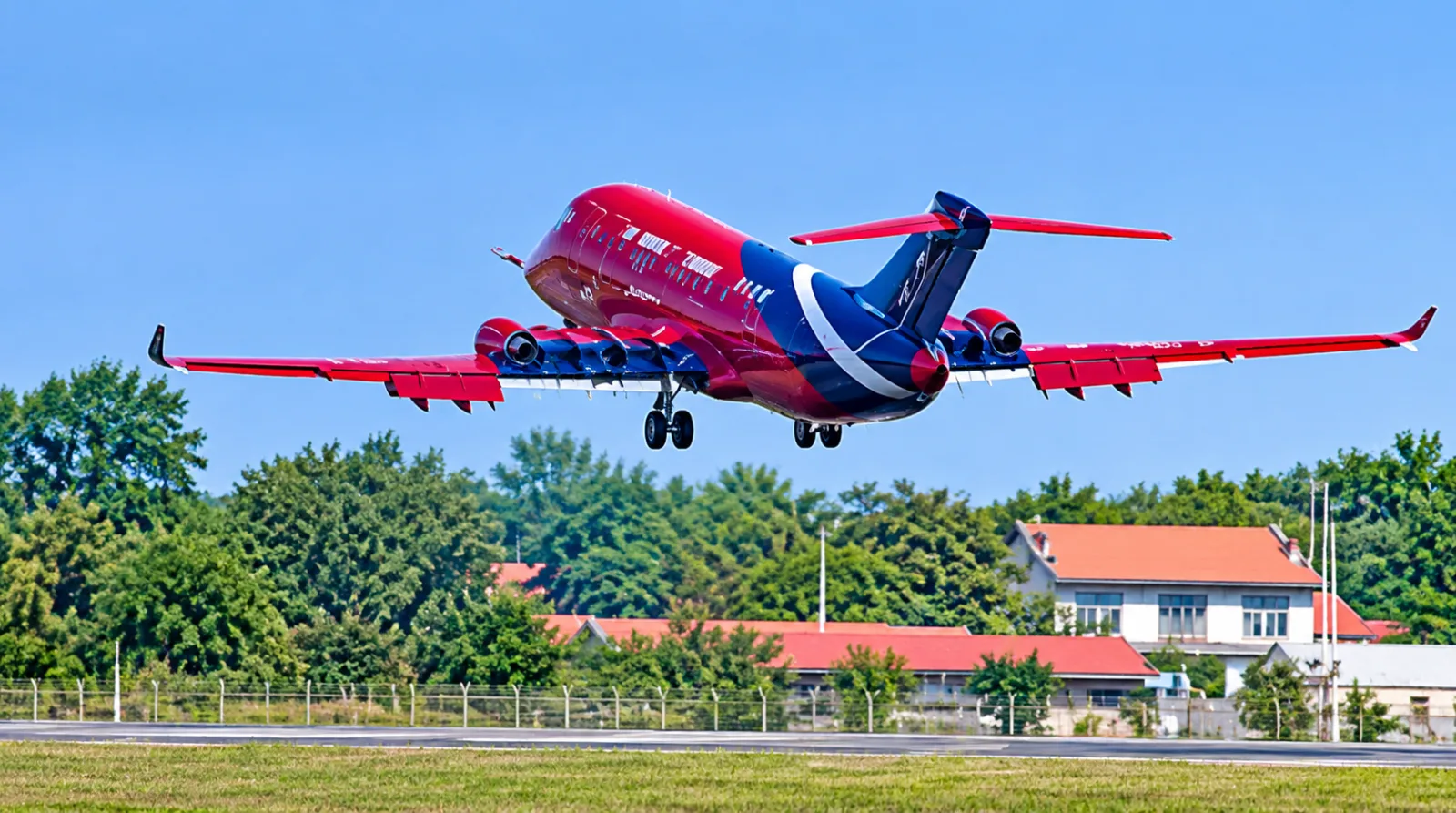
China’s first domestically developed 10-metric-ton-class electric commercial aircraft, the CE-25A, has successfully completed its maiden piloted test flight in Binzhou, Shandong province.
The aircraft, developed by the state-owned Commercial Aircraft Corporation of China (COMAC), carried two pilots and one flight-test engineer during the weekend flight.
The total test exercise lasted 57 minutes and 46 seconds, with the aircraft remaining airborne for 16 minutes and 38 seconds across a 60.4-kilometre flight path. COMAC confirmed that all systems functioned normally and key operational parameters met design expectations.
Maiden Crewed Flight in Shandong
The successful piloted mission represents a decisive transition from autonomous computer-guided testing to human-crewed flight operations.
The CE-25A conducted its first uncrewed autonomous test flight on February 2, 2026. Over the following nine months, development engineers completed 19 uncrewed autonomous flight validation missions to establish baseline safety, aerodynamics, and control stability before putting human test pilots in the cockpit.
Saturday's crewed flight in Binzhou proved that the aircraft can handle manual pilot inputs, emergency redundancies, and real-time flight management under standard atmospheric conditions.
Distributed Electric Ducted-Fan Propulsion
Unlike traditional commuter airliners that depend on kerosene-burning turboprop or turbofan engines, the CE-25A relies on a zero-emission distributed electric propulsion architecture.
The aircraft mounts 10 electric ducted fans arranged in balanced rows along its wings, with five propulsion units on each side. This multi-fan design provides strong thrust, enhances aerodynamic efficiency, and reduces noise footprints compared to conventional aircraft of similar weight.
Engineers developed the aircraft in partnership with Chinese battery manufacturer CATL and Shanghai Jiao Tong University. The collaboration focuses on integrating high-energy-density aviation-grade battery packs capable of sustaining multi-passenger commercial flight profiles.
Targeting Commuter Travel and Low-Altitude Economy
COMAC designed the CE-25A specifically for short-haul regional transport and intercity commuter travel between secondary airports.
The aircraft seats up to 19 passengers with a maximum takeoff weight of 10 metric tons. It operates at an optimal cruising speed of 300 kilometres per hour, an altitude of 2,400 metres, and a maximum operating range of 400 kilometres on a single battery charge.
These specifications position the aircraft to serve regional hub-and-spoke routes and support China's expanding low-altitude economy. Electric propulsion significantly lowers operating and maintenance costs per seat-kilometre, making short hops economically feasible while eliminating direct in-flight carbon emissions.
Path Toward Regulatory Certification
Following the maiden crewed flight, COMAC will advance the CE-25A through expanded flight envelope testing and airworthiness verification.
The Civil Aviation Administration of China (CAAC) has formally accepted COMAC's type certificate application. Acceptance of the filing initiates comprehensive regulatory evaluations covering structural integrity, battery thermal safety, system reliability, and flight handling standards.
Commercial passenger operations will depend on completing rigorous multi-phase certification protocols, but Saturday’s flight marks a major technical leap for China’s domestic green aviation sector.