
China Makes Floating Wind History as 16MW Platform Begins Powering Offshore Operations
China has connected the world’s first 16-megawatt floating wind power platform to the Lufeng oilfield grid, marking a major milestone in offshore renewable energy.
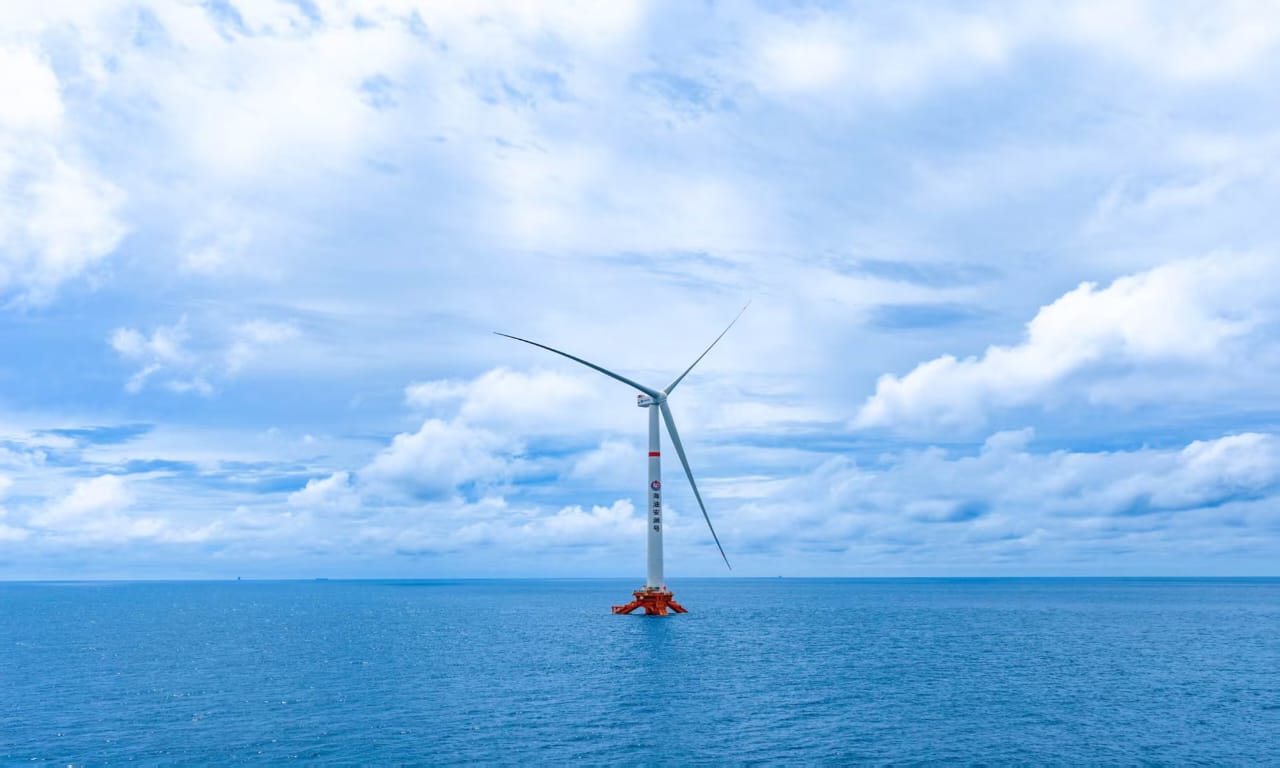
China has begun operating the world's first 16-megawatt tension-leg floating wind power platform, marking a major step in the country's push to take offshore renewable energy into deeper and more challenging waters.
The platform, known as Haiyou Anlan, was connected to the power grid on Thursday after being deployed at the Lufeng oilfield cluster in the South China Sea, where the electricity it generates will be used to support offshore oil and gas operations. Chinese state-owned energy giant China National Offshore Oil Corporation (CNOOC) is behind the project.
The significance of the project lies not simply in its size, but in the technology supporting it.
Traditional offshore wind turbines are generally installed on foundations fixed to the seabed, limiting where they can be deployed. Floating turbines, by contrast, can operate in deeper waters where fixed foundations become difficult and expensive to build.
The tension-leg platform (TLP) technology used by Haiyou Anlan keeps the floating structure in position through a system of taut mooring lines anchored to the seabed. That allows the enormous turbine to remain stable while operating in waters exposed to strong winds and waves.
According to Chinese reports, the platform was designed to withstand extremely severe marine conditions, including typhoon-force winds. Its deployment therefore represents a significant engineering test for floating wind technology in one of the world's most demanding offshore environments.
The scale of the installation is striking.
The platform stands more than 307 metres tall and weighs nearly 8,000 tonnes. Its 16MW turbine is among the most powerful single-unit floating wind installations ever deployed, while its electricity will travel through subsea cables directly to the Lufeng oilfield facilities.
The project is expected to generate an average of about 54 million kilowatt-hours of electricity each year, according to Chinese state media. That output is projected to reduce carbon dioxide emissions by roughly 35,000 tonnes annually and cut the oilfield's fuel consumption by about 15,000 cubic metres a year.
That connection between offshore wind and oil production is one of the more interesting aspects of the project.
Rather than using the floating turbine solely as a conventional power-generation asset, China is integrating renewable electricity directly into offshore oil and gas operations. The approach could provide a model for reducing the emissions associated with energy-intensive offshore facilities while the wider energy system gradually moves toward lower-carbon sources.
It also demonstrates why floating wind technology is attracting increasing attention.
Some of the world's strongest and most consistent offshore winds are found in waters too deep for conventional fixed-bottom turbines. Floating systems could potentially unlock those resources and allow countries with limited shallow-water areas to expand their offshore wind industries.
China has already established itself as a dominant force in the wider offshore wind market, and the latest project extends that ambition into a technically more difficult segment of the industry.
The challenge now is determining whether floating wind can move beyond individual demonstration projects and become commercially competitive on a much larger scale.
Floating platforms generally require more complex engineering, anchoring systems and installation methods than fixed-bottom turbines. Maintenance can also be more demanding because equipment is located far offshore and exposed to harsh marine conditions.
If those challenges can be overcome, however, the potential market is enormous.
The global energy industry is searching for ways to produce more electricity while reducing emissions, and offshore wind offers one route to achieving that balance. The development of increasingly powerful turbines could also reduce the number of platforms required to generate a given amount of electricity, potentially improving the economics of future projects.
China's latest deployment comes after another major floating-wind milestone earlier this year. In May, the China Three Gorges Corporation completed installation of a separate 16MW floating offshore wind turbine off Guangdong province. That semi-submersible platform was installed more than 70 kilometres offshore in waters deeper than 50 metres.
The two projects highlight China's growing interest in developing different floating-platform technologies and testing them in real offshore environments.
For FollowGlobalTrends, the bigger story is what happens when renewable energy moves beyond the coastline.
The future of offshore wind may not be limited to rows of turbines anchored to relatively shallow seabeds. Floating platforms could eventually allow enormous turbines to operate far out at sea, where stronger winds can be captured without the same seabed limitations.
China's 16MW Haiyou Anlan is therefore more than another giant wind turbine.
It is a test of whether the next generation of offshore energy can float, and whether that technology can eventually help reshape how the world produces power at sea.
More on Technology

Technology
Apple Unveils iPhone Duo, Its First-Ever Foldable Smartphone
10 Sept 2026

Technology
Nvidia to Buy Hugging Face for $12.93 Billion in Landmark AI Dea
4 Sept 2026

Technology
Dubai Ranks World’s Second-Highest Intelligent City as AI Transforms Urban Life
9 Aug 2026

Technology
Singapore National Pleads Guilty to $245m Bitcoin Heist in US
11 Sept 2026

Technology
UAE, France Launch Altair NextGen to Lead the World in AI-Powered Space Technology
9 Sept 2026
You may also like

Technology
Historic Win: Mary-Brenda Akoda Becomes First Woman to Earn NLNG Science Prize
9 Sept 2026

Technology
Uber Launches Robotaxi Service in London Days After Nigeria Exit
6 Sept 2026
Technology
Starlink Gets 10-Year UAE Licence, Opening New Era for Satellite Internet
31 Aug 2026

Technology
MTN Nigeria Marks 25 Years as Subscriber Base Surpasses 92 Million
29 Aug 2026

Technology
No Follower Threshold: How Yolly Is Changing the Way Creators Earn
22 Aug 2026
Technology
Spotify to Put AI Badge on Virtual Artists as Music’s Digital Era Expands
12 Aug 2026