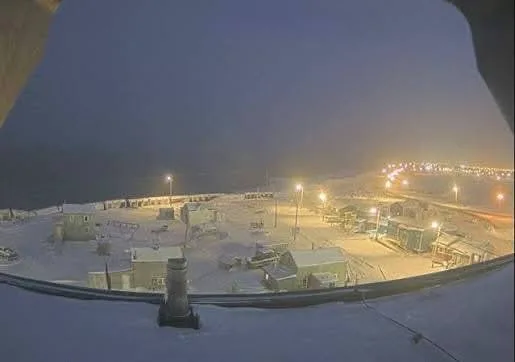
Utqiaġvik, Alaska, the northernmost municipality in the United States, has officially entered its annual polar night. The sun rose at 12:41 p.m. local time on Wednesday, November 18, and slipped beneath the southern horizon just 61 minutes later at 1:42 p.m. Alaska Standard Time.
That brief afternoon appearance marked the community's last direct glimpse of the sun for 2026. For the next 65 consecutive days, the sun will remain entirely below the Arctic horizon.
Roughly 4,500 people reside in the North Slope Borough seat, located about 320 miles north of the Arctic Circle. The community will greet its next official sunrise on Saturday, January 23, 2027, shortly after 1:00 p.m.
The Science Behind 65 Days of Polar Night
Utqiaġvik sits at latitude 71.29 degrees North, near where the Chukchi and Beaufort seas meet. Earth spins on an axis tilted roughly 23.5 degrees relative to its orbital plane around the sun.
Because of that tilt, the Northern Hemisphere leans away from the sun throughout the winter months. As winter deepens, the sun traces an increasingly low path across the southern sky.
By mid-November, even the peak of that daily arc drops below the horizon. The phenomenon is the seasonal counterpart to the Arctic summer's "midnight sun," when Utqiaġvik experiences more than 80 straight days without a single sunset between May and August.
Understanding Twilight: Why Polar Night Is Not Total Blackness
A widespread myth assumes polar night brings 24 hours of pitch blackness every day. In practice, the city experiences several hours of functional civil twilight around solar noon.
Civil twilight occurs whenever the center of the sun sits within six degrees below the horizon line. During this daily window, atmospheric refraction scatters sunlight across the upper sky, creating striking shades of cobalt blue, violet, and soft pink over the frozen landscape.
Even on the winter solstice on December 21—the shortest daylight period of the year—Utqiaġvik will receive nearly three hours of civil twilight, spanning roughly 11:56 a.m. to 2:55 p.m. Streetlights illuminate roads and buildings continuously, yet residents still enjoy visible daylight during the midday hours.
Daily Life, Arctic Culture, and the Winter Ahead
Community life in Utqiaġvik continues uninterrupted through the winter darkness. Public schools maintain normal hours, local businesses welcome customers, and municipal services operate on regular schedules.
Severe weather remains the most demanding seasonal factor. Winter temperatures frequently plunge below minus 20 degrees Fahrenheit, while sustained Arctic gales generate dangerous wind chills.
The predominantly Iñupiat community possesses millennia of cultural knowledge and resilience in this extreme climate. Subsistence hunting, community craft circles, and indoor sports keep spirits high. When the sun finally crests the horizon on January 23, locals will gather on rooftops and frozen shores to celebrate its arrival.
Recommended Winter Wellness: Navigating Low-Light Seasons
Sustaining energy and emotional balance during extended periods of reduced daylight requires proactive daily routines. Doctors and sleep specialists emphasize the value of morning light exposure, consistent rest schedules, and vitamin D supplementation to protect natural circadian rhythms.
Our Seasonal Light Therapy and Arctic Wellness Guide highlights verified, UV-safe 10,000-lux light boxes and dawn-simulating alarm clocks built to ease winter fatigue and sustain everyday focus safely.