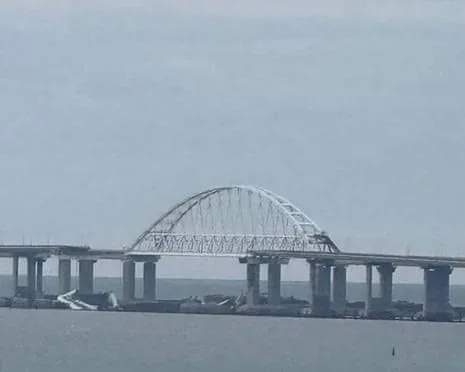
A Ukrainian strike has brought down a major section of Russia's Crimea Bridge, also known as the Kerch Bridge, connecting mainland Russia with the occupied Crimean Peninsula.
Images and videos published on Tuesday, November 17, show a large section of the bridge's road arch lying in the Kerch Strait. The collapse followed a second Ukrainian attack within two nights.
Ukraine's President Volodymyr Zelenskyy confirmed that his country's military carried out the operation. He described it as an unprecedented mission that had taken several weeks to prepare.
Russian authorities have also acknowledged structural damage to the bridge. Traffic has been suspended following the attacks.
The development marks a major setback for a structure that carries enormous strategic and symbolic importance for Russian President Vladimir Putin.
Ukraine confirms operation against strategic Crimea Bridge
Zelenskyy said the operation involved several stages, beginning with efforts to weaken Russian air defences around the bridge.
According to the Ukrainian president, military forces first targeted Russian air defence systems, radar installations and electronic equipment.
He said drones subsequently struck the road section, while Neptune missiles and drones targeted the railway section.
Zelenskyy described the operation as an important response to Russia's continued attacks on Ukrainian infrastructure.
The Ukrainian president also said the operation was intended to remind Moscow that the war could reach strategic locations Russia considers secure.
The attack followed an earlier strike on Monday, November 16, when Ukrainian forces targeted the same bridge.
That first attack caused damage and forced authorities to restrict traffic. Russian officials initially described the damage as minor.
The second attack, however, appears to have caused far more serious structural damage.
What the collapse means for Russia and occupied Crimea
The Kerch Bridge stretches approximately 19 kilometres across the Kerch Strait, connecting Russia's Krasnodar region with Crimea.
Russia built the crossing after seizing and annexing Crimea from Ukraine in 2014. Its construction cost approximately $3.7 billion, according to figures cited by CNN from Russian state media.
The bridge opened to road traffic in 2018, with railway services following in 2019.
Beyond its transport function, the structure became a powerful symbol of Moscow's control over the peninsula.
It has also served as an important supply route for Russian military operations in Ukraine. Although Russia can now use a land corridor through occupied southern Ukraine, the bridge remains important for civilian travel and transport connections.
The latest damage could therefore complicate movement between Russia and Crimea.
The collapse also raises questions about maritime traffic through the Kerch Strait. The waterway connects the Black Sea with the Sea of Azov and supports shipping movements in the region.
Images reviewed by international media suggest the fallen road arch may have obstructed part of the shipping channel. The full impact on maritime navigation remains to be established.
Russia confirms structural damage as traffic remains suspended
Russian-installed authorities in Crimea confirmed the latest attack and suspended traffic across the bridge.
The Russian Investigative Committee also confirmed that the attacks on November 16 and 17 caused structural damage. Authorities have opened an investigation into the incident.
The Russian Transport Ministry said experts were assessing the damage following the attacks.
While the road arch appears to have collapsed, the full condition of the railway crossing remains less clear. Reports indicate that the neighbouring railway structure also sustained damage.
Russian officials have not provided a complete technical assessment of the bridge or announced a confirmed timeline for repairs.
The Russian-installed governor of Crimea, Sergey Aksyonov, urged residents and visitors to avoid travelling towards the crossing.
The attacks also came amid a wider escalation involving strikes on strategic infrastructure in both countries.
Previous attacks and the wider Ukraine war
The Kerch Bridge has been a repeated target since Russia launched its full-scale invasion of Ukraine in February 2022.
In October 2022, an explosion damaged the crossing, killing four people and disrupting its operations.
Ukraine later carried out another major attack in July 2023, using naval drones against the structure.
The latest operation appears to have caused more extensive damage than the earlier attacks, although the full extent of the destruction remains subject to technical assessment.
Meanwhile, Russian forces struck two major bridges across the Dnipro River in Kyiv during the latest wave of attacks.
Kyiv Mayor Vitali Klitschko reported damage to the city's North and South bridges. The strikes also disrupted water and power supplies in some areas.
The exchanges underline how infrastructure has become an increasingly important target in the war.
For Ukraine, striking the Kerch Bridge challenges a major symbol of Russian control and disrupts an important transport connection. For Moscow, restoring the crossing will be another test of its ability to protect and maintain critical infrastructure in occupied Crimea.
The immediate priority is assessing the damage, restoring safe transport links and determining whether the fallen section has also obstructed shipping through the strait.