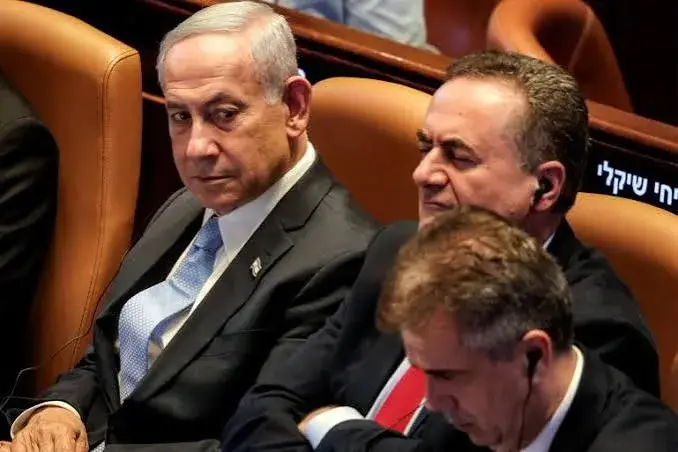
Israel's political deadlock has deepened after coalition talks between caretaker Prime Minister Benjamin Netanyahu and opposition leader Gadi Eisenkot ended without an agreement.
Representatives of Netanyahu's Likud party and Eisenkot's Yashar party met on Sunday, November 22, for discussions lasting about four hours. However, the meeting failed to resolve major disagreements over how a new government would be formed.
The two sides said they had discussed several substantive issues and would hold another meeting. However, they did not announce a date or disclose a breakthrough.
The failed negotiations leave Israel facing continued political uncertainty following its October 27 general election, which produced no clear parliamentary majority for either major political bloc.
Disagreements over leadership and coalition partners
The negotiations have been complicated by disagreements over who would serve as prime minister and which political parties would participate in the proposed government.
Netanyahu has reportedly pushed for a national unity arrangement that could involve a rotation of the premiership. However, Eisenkot has resisted an arrangement that would place Netanyahu at the head of the government.
Another major disagreement concerns the possible inclusion of far-right National Security Minister Itamar Ben-Gvir.
Reports indicate that Netanyahu's Likud wants Ben-Gvir included in a potential government, while Eisenkot's camp opposes his participation.
These differences have made it difficult for the two political camps to agree on a workable coalition arrangement.
Israel's election results leave both blocs short
The October election produced a complicated parliamentary balance.
Netanyahu's right-wing and religious bloc secured 53 seats in the 120-member Knesset, Israel's parliament. The opposition bloc led by Eisenkot secured 48 seats.
A government requires at least 61 seats to command a parliamentary majority.
The remaining 19 seats were won by Arab-led political parties, including the Joint List and Ra'am. Their support could become decisive in determining whether a government can be formed.
However, cooperation with Arab parties remains politically controversial among several opposition groups, making the negotiations even more difficult.
Eisenkot faces deadline as political uncertainty continues
Eisenkot has been given the first opportunity to attempt forming a government. His mandate is expected to run until December 6, with the possibility of an additional 14-day extension.
If negotiations fail, other political options may emerge, including another candidate attempting to form a government or the possibility of another election.
The prolonged uncertainty is also affecting economic confidence. On November 23, the Bank of Israel kept its benchmark interest rate at 3.25%, citing domestic and global uncertainty, geopolitical tensions and the absence of a new government following the inconclusive election.
The central bank's decision highlights how the political crisis is unfolding alongside wider economic and security concerns.
Political deadlock leaves Israel's next government uncertain
The latest failed talks have reinforced the difficulty of building a stable government from Israel's divided political landscape.
Netanyahu and Eisenkot remain separated by disagreements over leadership, political alliances and the role of key parties. While both camps continue exploring possible arrangements, no agreement has yet been announced.
With the formation deadline approaching, Israel's political future remains uncertain. The next round of negotiations could determine whether the country secures a new coalition or moves closer to another election.