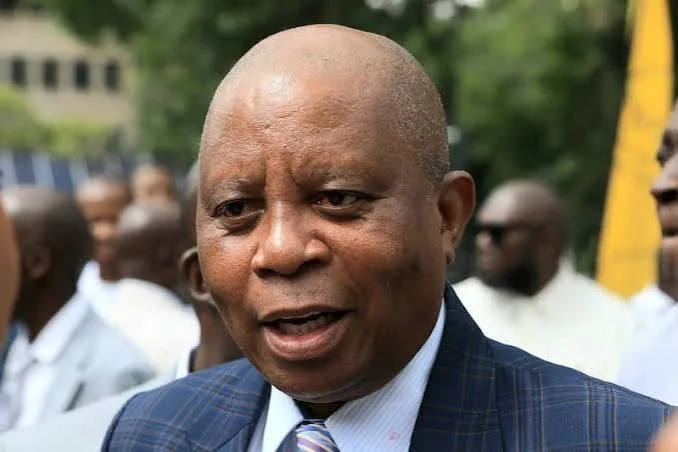
ActionSA leader Herman Mashaba has been elected mayor of Johannesburg, winning decisive backing during a heated council session on Friday.
Mashaba secured 170 votes in the 270-member municipal assembly, easily clearing the required threshold to take charge of South Africa’s commercial capital.
His victory was sealed through a cross-party coalition agreement that brought together ActionSA, the African National Congress (ANC), the Economic Freedom Fighters (EFF), and the uMkhonto weSizwe (MK) Party alongside smaller civic groups.
The outcome marks a dramatic return for Mashaba, who previously served as Johannesburg mayor from 2016 until his resignation in late November 2019.
Councillors erupted in celebration inside the Connie Bapela Council Chamber in Braamfontein as the official tally was confirmed, concluding weeks of tense inter-party negotiations.
Defeating Helen Zille and Shifting the Council Balance
Mashaba defeated Democratic Alliance (DA) Federal Council chairperson Helen Zille, who received 97 votes. Two ballots were declared spoiled during the secret vote.
Despite the DA entering the council sitting as the largest single party with 91 seats, the party was unable to assemble a governing majority. Zille confirmed that the DA will now assume the role of official opposition on the council benches.
The political shift was reinforced earlier in the day during the election of council speaker.
ANC councillor Vhonani Adolph Marema won the speaker's post with 171 votes, defeating DA candidate Alex Christians, who secured 99 votes.
The coordinated voting confirmed the durability of the governing bloc, which successfully united former political rivals behind a shared municipal administration.
Pledging an Infrastructure Overhaul for South Africa’s Economic Hub
Mashaba succeeds outgoing ANC mayor Dada Morero, taking office at a critical juncture for the metropolis of six million residents.
Johannesburg faces acute urban challenges, including recurring water supply disruptions, chronic electrical outages, decaying roadway networks, and neglected inner-city buildings.
Speaking before the vote, Mashaba pledged an aggressive urban renewal programme focused on restoring basic municipal services and attracting private commercial capital.
"I have a very comprehensive plan to turn this city around," Mashaba told reporters in Braamfontein. "Given the opportunity, by June next year this city is going to become a construction site."
His administration is expected to prioritize pipeline repairs, road resurfacing, and enforcement of building safety codes across the central business district.
Overcoming a History of Coalition Instability
The new administration must now deliver political stability in a city that has cycled through multiple leadership changes in recent years.
Johannesburg has seen six mayors over the past three years as fragile municipal coalitions repeatedly fractured over budget disputes and portfolio allocations.
Mashaba’s return also represents a significant realignment in South African municipal politics. Although he previously vowed never to partner with the ANC, both parties agreed to collaborate to prevent municipal gridlock and pass pending capital budgets.
Civic organizations and business leaders have urged the newly formed coalition to put governance ahead of partisan maneuvering.
With key executive mayoral committee positions set to be announced in the coming days, Mashaba faces immediate pressure to stabilize the city's balance sheet and restore public confidence.