Africa's Financing Debate Heats up as Dangote Disputes Ramaphosa's Banking Claim
A public exchange between Aliko Dangote and South African President Cyril Ramaphosa has reignited debate over whether Africa's biggest projects can truly be financed with local capital.
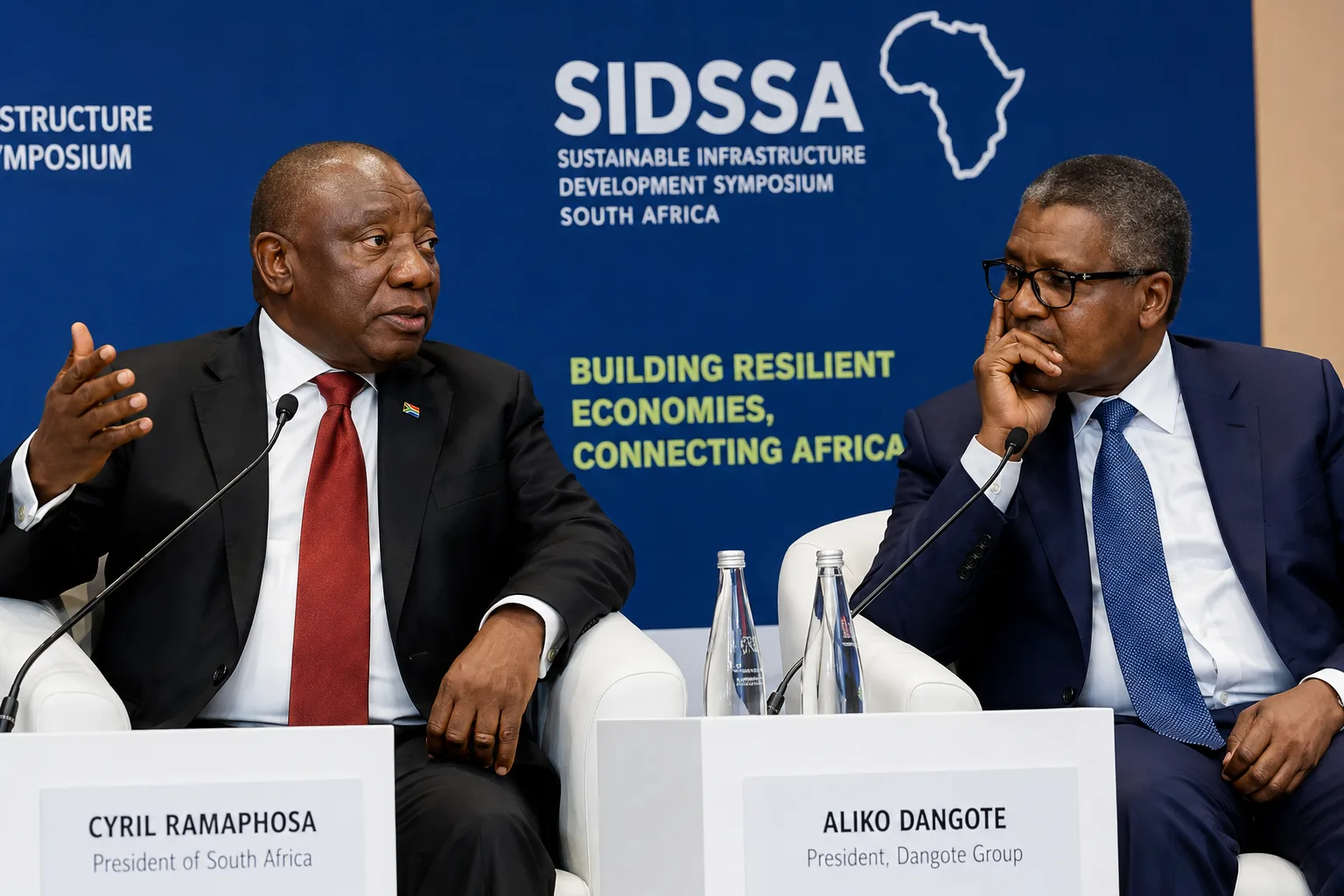
Africa's richest businessman, Aliko Dangote, and South African President Cyril Ramaphosa have publicly disagreed over one of the continent's biggest economic questions: whether African banks have the capacity to finance large industrial and infrastructure projects without relying heavily on foreign capital.
The exchange took place during a panel discussion at the Sustainable Infrastructure Development Symposium South Africa (SIDSSA), where Ramaphosa argued that domestic financial markets hold substantial pools of capital for viable projects. Dangote responded that the real obstacle is not the availability of money, but the high cost of borrowing and the currency risks businesses face across African economies.
Ramaphosa told delegates that well-structured, commercially viable projects should be able to attract funding from local banks and institutional investors. In his view, improving project bankability is more important than searching for external financiers, saying Africa already possesses significant domestic savings that can be mobilised for development.
Dangote challenged that optimism, drawing on his experience building the multi-billion-dollar Dangote Refinery in Nigeria. He argued that businesses may technically have access to local capital, but interest rates in many African countries make long-term financing prohibitively expensive for manufacturers and infrastructure developers.
The Nigerian industrialist also warned against borrowing in foreign currencies when project revenues are earned in weaker local currencies, saying such mismatches expose companies to severe exchange-rate shocks. Using the Zambian kwacha as an example, he argued that dollar-denominated debt can quickly become unsustainable when local currencies depreciate.
The debate reflects a wider challenge confronting governments and private investors across Africa. Major projects in energy, transport and manufacturing often require billions of dollars in long-term capital, yet domestic lending rates in several African markets remain among the highest globally. At the same time, borrowing abroad can reduce interest costs but introduces significant foreign-exchange exposure.
Dangote's own financing strategy illustrates that balancing act. His refinery, now operating at full capacity, is preparing for what could become Africa's largest-ever initial public offering, with plans to raise about $5 billion to support expansion and future regional investments, including a proposed refinery project in Kenya.
Economists say neither side of the debate is entirely wrong. Domestic capital markets are expanding, particularly through pension funds and commercial banks, but many lenders remain cautious about funding long-tenor industrial projects without stronger guarantees, lower financing costs and stable macroeconomic conditions.
The Dangote–Ramaphosa exchange highlights a defining issue for Africa's economic future: the continent is no longer asking whether it has ambitious projects, but whether it can build a financial system capable of funding them sustainably. How African nations bridge the gap between abundant local capital and affordable long-term financing may ultimately determine the pace of the continent's industrial transformation.
More on Africa
Africa
Nigeria–South Africa Tensions Rise as Fani-Kayode Issues Strong Warning
13 Sept 2026
Africa
Immigration Tensions Rise as South African Activists Issue September Ultimatum
11 Sept 2026
Africa
Nigeria Escalates South Africa Xenophobia Row to AU, Seeks Collective Action
31 Aug 2026

Africa
South African Surgeon Makes History With 3D-Printed Ear Transplant That Restores Hearing
17 Sept 2026

Africa
Multi-Car Crash Kills 21 in South Africa’s Western Cape
14 Sept 2026
You may also like
Africa
Xenophobia: 1,695 Nigerians Evacuated from South Africa, Says Ambassador Ajayi Alexander
5 Sept 2026
Africa
Afreximbank, ATDC Sign $500 Million Facility to Boost African Commodity Trade
23 Sept 2026
Africa
US Imposes Targeted Visa Restrictions on South Africans Over Land and Race Policies
16 Sept 2026
Africa
Business Forum 2026: Mauritius Pitches Itself as Africa’s Financial Bridge
13 Sept 2026
Africa
Former Sierra Leone President Koroma Returns Home Under Nigerian Escort
6 Sept 2026

Africa
24-Hour AfCFTA Certificate Reform Set to Accelerate Nigeria’s Non-Oil Exports
10 Sept 2026