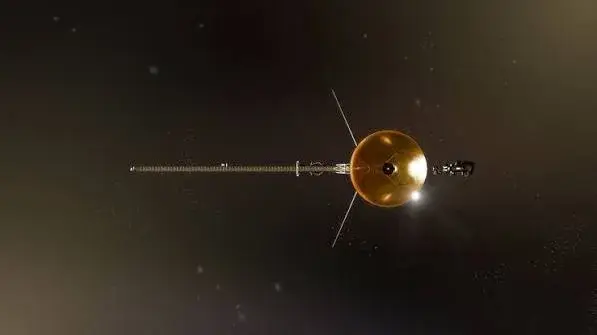
Flight controllers at the Jet Propulsion Laboratory have confirmed that NASA Voyager 1 is communicating normally following a brief communications blackout. The Deep Space Network detected no transmission from the probe during scheduled sessions across two consecutive days.
The spacecraft autonomously resolved the issue after 48 hours without needing diagnostic commands from ground teams. Telemetry data revealed that the spacecraft’s onboard fault-protection systems activated when an active group of thrusters shut down. The computer automatically switched to backup thrusters to stabilize the vehicle.
Mission managers noted that this specific autonomous response was unexpected, though the probe performed as designed to safeguard its systems. Engineers continue to examine telemetry to pinpoint why the primary thruster group went offline.
Approaching One Light-Day From Earth
The brief outage occurred as the spacecraft closes in on an extraordinary operational threshold. On November 18, Voyager 1 will reach a distance of one light-day—approximately 16.09 billion miles (25.89 billion kilometres) from Earth.
At that immense range, radio signals traveling at the speed of light require a full 24 hours to reach the spacecraft. A reply takes another 24 hours to return to ground stations. This 48-hour round-trip lag means mission engineers cannot intervene in real time, making onboard automated safeguards vital.
The probe relies on three massive antenna complexes situated in California, Spain, and Australia to keep contact. Even the faintest whisper of a signal demands the full listening power of these 70-meter parabolic dishes.
Engineering Feats Keep Ancient Systems Alive
Launched in 1977, Voyager 1 and its twin, Voyager 2, have explored deep space for nearly half a century. Both craft derive electrical energy from radioisotope thermoelectric generators, which convert heat from decaying plutonium into power.
Because the plutonium fuel depletes continuously, the generators lose roughly four watts of electrical output every year. To prevent critical science instruments from shutting down, engineers executed a major conservation procedure code-named the "Big Bang."
The delicate operation swapped three high-draw warming devices for lower-power alternatives simultaneously. That power reconfiguration followed a similar adjustment on Voyager 2, stretching remaining energy supplies to keep active sensors gathering data on interstellar particles and magnetic fields.
Exploring the Boundary of the Solar System
Despite running on computer memory measured in kilobytes, Voyager 1 remains humanity's premier scientific outpost beyond the sun’s protective bubble. The probe entered interstellar space in 2012, sampling cosmic rays and plasma that cannot be measured from within our solar system.
Flight teams plan to nurse the spacecraft's remaining instruments for as long as power margins allow. With backup systems continuing to function and power carefully rationed, NASA expects the historic spacecraft to continue reporting from deep space as it crosses its next distance record.