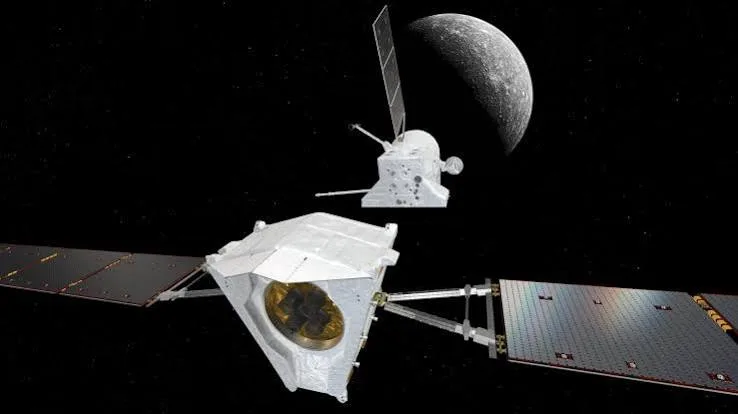
The joint European and Japanese BepiColombo spacecraft has successfully entered orbit around Mercury, completing an eight-year voyage through the inner solar system.
The European Space Agency (ESA) confirmed the arrival following a critical thruster burn lasting more than thirty minutes.
The orbital capture represents a major scientific milestone for the four-tonne probe, jointly developed by ESA and the Japan Aerospace Exploration Agency (JAXA).
BepiColombo is only the second robotic mission in human history to enter orbit around the solar system’s innermost planet.
Taming The Sun's Immense Gravitational Pull
Reaching Mercury required navigating one of the most demanding flight trajectories in modern interplanetary exploration.
Because Mercury orbits close to the Sun, the spacecraft had to fight the Sun’s tremendous gravitational pull throughout its flight.
Engineers designed a complex ten-billion-kilometre path to slow the spacecraft down safely.
Since blasting off from French Guiana in October 2018, BepiColombo performed nine gravity-assist flybys, looping once past Earth, twice past Venus, and six times around Mercury itself.
Two Probes Preparing For Independent Orbits
The mission currently flies as a composite stack containing two distinct scientific orbiters.
On 9 and 10 December, the two robotic probes will separate to follow independent flight paths around Mercury.
ESA’s Mercury Planetary Orbiter will skim just 480 kilometres above the scorched surface. It carries advanced imaging cameras and the Mercury Imaging X-ray Spectrometer to map surface minerals.
Meanwhile, JAXA’s Mercury Magnetospheric Orbiter, named Mio, will follow a wider elliptical orbit reaching up to 11,000 kilometres. It will analyse the planet’s magnetic shield and solar wind interactions.
Unlocking Mysteries Of The Innermost Planet
Operating in orbit around Mercury exposes the spacecraft to some of the harshest conditions in the solar system.
Surface temperatures swing wildly between daytime highs of 430 degrees Celsius and nighttime lows of minus 180 degrees Celsius.
Scientists hope the mission will solve longstanding geological puzzles, including how water ice survives inside permanently shadowed polar craters.
The probes will also investigate mysterious hollows across the crust and study the planet's disproportionately massive iron core.
Full scientific observations will begin in April 2027, delivering unprecedented insights into how rocky planets formed close to our central star.