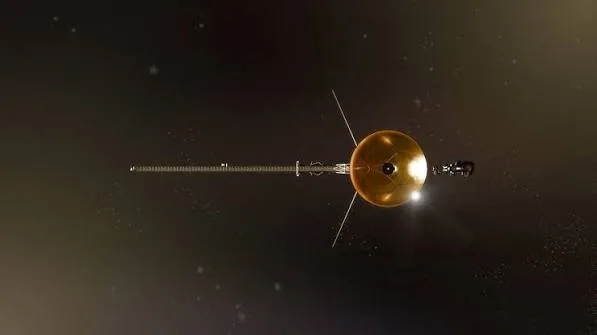
Humanity has marked a historic threshold in deep space exploration as NASA Voyager 1 hits distance milestone of one full light-day from Earth. The veteran robotic explorer has traveled more than 16.09 billion miles (25.90 billion kilometres) into interstellar space since departing Florida in September 1977.
Crossing a light-day means that electromagnetic radiation, traveling at approximately 186,000 miles per second, requires a full 24 hours to travel the expanse between mission controllers and the spacecraft. A radio transmission dispatched from ground antennas takes an entire day to arrive, and telemetry returning home takes another 24 hours.
NASA has scheduled global public engagement initiatives to honour the achievement, inviting observers worldwide to illuminate skies with symbolic light signals. Mission engineers at the Jet Propulsion Laboratory in Southern California confirmed that both the spacecraft's core flight computers and its active scientific instruments continue operating as scheduled.
Measuring Astronomical Distances in Light
In cosmic exploration, physical miles become too vast for routine operational calculations, leading scientists to track deep-space probes using the speed of light. While sunlight reaches Earth in just over eight minutes and crosses to the moon in 1.3 seconds, Voyager 1 has pushed humanity's physical horizon into a completely new metric.
Its twin spacecraft, Voyager 2, followed a different trajectory through the outer solar system to conduct historic flybys of Uranus and Neptune. Flight dynamics specialists project that Voyager 2 will not cross its own one-light-day marker until November 2035.
The massive separation requires NASA's Deep Space Network to utilize its largest 70-meter parabolic dishes in California, Spain, and Australia. These sensitive ground stations must detect microwave signals that arrive on Earth with less energy than the whisper of a snowflake touching the ground.
Longevity Engineered Across Decades
Originally designed for an initial four-year mission to study Jupiter and Saturn, Voyager 1 has far outlasted its planned operational lifespan. The probe officially exited the sun’s heliosphere in 2012, becoming the first manufactured object to sample the pristine environment of interstellar plasma directly.
To sustain the mission, engineering teams have continually adapted to depleting power supplies. The probe relies on radioisotope thermoelectric generators that lose roughly four watts of electrical capacity annually due to the natural radioactive decay of plutonium-238 fuel.
Earlier this autumn, controllers completed a synchronized power reconfiguration known as the "Big Bang." By disabling three legacy heating units and transitioning systems to lower-draw alternatives, technicians preserved sufficient electrical reserves to keep critical instruments online through the late 2020s.
An Eternal Messenger to the Stars
Beyond its technical contributions, Voyager 1 carries the famous Golden Record, a gold-plated copper phonograph record containing sounds, images, and cultural greetings selected to represent human civilization.
Calculations show that the probe is traveling toward the constellation Ursa Minor and will eventually pass within 1.6 light-years of the star AC +79 3888 in approximately 40,000 years. Long after its power cells fall silent, Voyager 1 will drift perpetually through the Milky Way as an enduring monument to human curiosity.