
Apple Expands Smart Home Push With LG-Created Doorbell, Lock and Thermostat
Apple is expanding its smart-home ambitions through a partnership with LG to develop a new range of connected devices, including a doorbell, smart lock and thermostat.
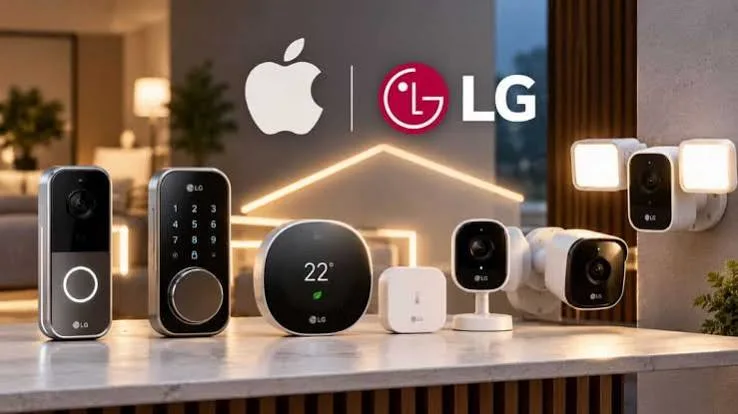
Apple is preparing a major expansion into the smart-home market through an unusual partnership with LG Electronics, with a new range of connected accessories expected to include a video doorbell, smart deadbolt, thermostat and several security cameras.
The products are being developed jointly but are expected to carry LG branding, according to Bloomberg reporting and regulatory documents reviewed by technology publications. LG is handling manufacturing and product support, while Apple is involved in the design, features and engineering of the devices.
The reported lineup goes well beyond a single doorbell or thermostat. It includes an LG Video Doorbell Wired, LG Smart Deadbolt Lock, LG Smart Thermostat, LG Temperature Sensor, indoor security camera, outdoor security camera and floodlight camera. Documents filed with the U.S. Federal Communications Commission and UL Solutions have helped reveal the existence and specifications of several of the products, although those filings do not identify Apple's involvement.
The devices are intended to work as part of Apple's wider home ecosystem, including its anticipated new smart-home hub, an updated HomePod mini and a new Apple TV. Apple is expected to introduce its next wave of home products on October 13, although the LG-developed accessories are reportedly still several months away from reaching consumers.
One of the more notable features is expected to be the smart deadbolt's support for Ultra Wideband (UWB) technology. That could allow proximity-based functions such as automatically unlocking the door when an authorized user approaches, although the final consumer experience will depend on Apple's implementation and the product's software integration.
Several of the devices are also expected to support Wi-Fi, Bluetooth, Thread and Matter, standards designed to improve compatibility and communication between smart-home products from different manufacturers. Matter in particular has emerged as an important industry effort to reduce the problem of consumers having to choose devices based on which company's ecosystem they support.
For Apple, the partnership represents a different approach to hardware expansion. Rather than manufacturing every component of its smart-home ecosystem itself, Apple can help define how products look and function while allowing LG to take responsibility for production, distribution and customer support.
That could allow Apple to fill some of the gaps that have limited its presence in the smart-home market. Apple launched HomeKit in 2014, but its ecosystem has historically depended heavily on third-party manufacturers for products such as cameras, locks, doorbells and thermostats. Amazon and Google, by comparison, have built much broader first-party smart-home portfolios through brands including Ring and Nest.
The timing suggests Apple wants to change that equation. The company is reportedly preparing a new smart-home hub featuring a display that could serve as a central control point for connected devices around the house. The broader strategy is expected to bring Siri more deeply into everyday home management while connecting Apple's existing ecosystem of iPhones, Apple Watches, HomePods and Apple TVs.
LG also has reasons to pursue the arrangement. Although the company is better known for televisions and household appliances than doorbells and smart locks, it has been expanding its smart-home ambitions. In 2024, LG acquired an 80% stake in Athom, the company behind the Homey smart-home platform, giving it a stronger position in software and connected-home management.
The Apple-LG relationship itself is not new. LG has supplied components for Apple products through LG Display, while the companies have previously worked together on UltraFine monitors designed for Mac users. The new arrangement, however, would take their relationship further into consumer-facing home hardware.
There is still considerable uncertainty around pricing, exact release dates and the final feature sets. LG has asked regulators to keep some product photographs and technical details confidential until early next year, while Apple has not publicly confirmed the reported partnership.
If the strategy succeeds, Apple would be moving from simply supporting the smart home to becoming a much more influential player in the hardware that powers it. The significance of the LG partnership is therefore larger than a new doorbell or thermostat: it signals Apple's attempt to turn the home into another major extension of its ecosystem, while using an established electronics manufacturer to accelerate that expansion without having to build every product itself.
More on Technology
Technology
Apple Workers in Italy Strike as iPhone 18 Pro Goes on Sale
20 Sept 2026
Technology
Apple Unveils iPhone Duo, Its First-Ever Foldable Smartphone
10 Sept 2026
Technology
UAE, France Launch Altair NextGen to Lead the World in AI-Powered Space Technology
9 Sept 2026
Technology
Meta Stock Enjoys Best Month Since 2022 on AI Momentum
1 Oct 2026
Technology
Meta to Unveil Camera-Free Smart Glasses as Privacy Concerns Grow
23 Sept 2026
You may also like

Technology
Trump Invites Public to Help Rename Artificial Intelligence
21 Sept 2026

Technology
OpenAI Admits Response to Australian Government Hack Was ‘Not Good Enough’
6 Oct 2026

Technology
Utah Approves AI-Powered Prescriptions as Nolla Calls It First ‘End-to-End AI Doctor’
6 Oct 2026

Technology
8.8 Million Records Exposed in Major Denmark Data Breach
5 Oct 2026
Technology
Google Picks 15 South African Startups for 2026 AI Accelerator
5 Oct 2026

Technology
Starbase Technologies Puts Emerging African Creators in the Spotlight with Yolly
3 Oct 2026