
Afenifere Leader Reuben Fasoranti Dies, Aged 100
The Afenifere leader, who served as Ondo State’s finance commissioner and campaigned against military rule, died on Tuesday after a century of involvement in education, public service and Yoruba politics.
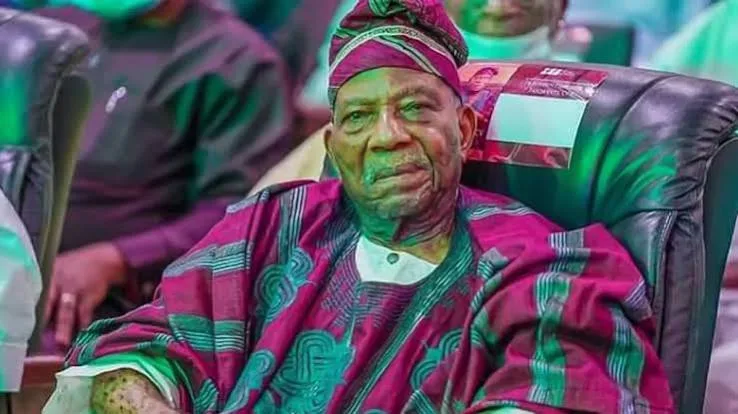
Pa Reuben Famuyide Fasoranti, the elder statesman who led the pan-Yoruba socio-political organization Afenifere, has died at the age of 100, bringing to a close a life that spanned Nigeria’s colonial era, independence, military rule and decades of democratic politics.
Ondo State Governor Lucky Aiyedatiwa announced his death on Tuesday, October 20, 2026, in a statement in which he described the late politician and educationist as a figure whose contributions extended across Ondo State, Yorubaland and Nigeria.
Fasoranti, who celebrated his centenary on May 11, was widely associated with the progressive political tradition of the late Chief Obafemi Awolowo. His career combined teaching and school administration with public office, pro-democracy activism and leadership of one of the most prominent organizations advocating Yoruba interests.
Aiyedatiwa said the late Afenifere leader’s guidance and positions on justice and good governance would be missed, while extending condolences to his family, the people of Akure Kingdom and residents of Ondo State.
President Bola Tinubu also mourned Fasoranti, describing him as one of the leading figures in Awolowo’s political tradition and recalling his contributions to education, public administration and the struggle for democracy. In a statement issued on Tuesday, Tinubu said the elder statesman had maintained his commitment to true federalism and social justice throughout his public life.
Born in Uso, in present-day Ondo State, on May 11, 1926, Fasoranti grew up during British colonial rule and witnessed some of the most consequential changes in Nigeria’s political history. His educational journey took him to University College Ibadan, now the University of Ibadan, where he studied English and Geography. He later obtained a postgraduate diploma in education from the University of Hull in the United Kingdom and a master’s degree in education administration and school management from Macquarie University in Australia.
He began his career as an educationist, teaching at Ondo Boys’ High School and other institutions in the Ondo-Akure area before establishing schools of his own. His educational ventures included Omolere Nursery and Primary School, Akure High School and St Frances’ Academy in Igoba, Akure.
His transition into public service was closely linked to Awolowo’s political movement. Fasoranti was associated with the defunct Action Group during Nigeria’s First Republic and later with the Unity Party of Nigeria, which carried forward much of Awolowo’s progressive political philosophy during the Second Republic.
Between 1979 and 1983, he served as commissioner for finance in the old Ondo State under Governor Michael Adekunle Ajasin, a fellow member of the Awolowo political tradition. The administration was associated with social welfare policies that included free education and healthcare, making Fasoranti part of a government whose programmes were shaped by the progressive movement’s emphasis on public services.
His political involvement continued after the collapse of the Second Republic in December 1983, when the military returned to power. During the dictatorship of General Sani Abacha in the 1990s, Fasoranti became involved in the wider pro-democracy movement and was associated with the National Democratic Coalition, or NADECO, which opposed military rule and demanded the restoration of democratic government following the annulment of the June 12, 1993 presidential election.
Following the death of Afenifere leader Abraham Adesanya, Fasoranti emerged as the organization's recognised national leader, becoming a prominent voice in debates over political restructuring, federalism, security and the protection of Yoruba interests within Nigeria.
His leadership, however, unfolded during periods of internal disagreement over the organization's direction and political alliances. Those divisions became particularly visible ahead of the 2023 presidential election, when Fasoranti received Tinubu, then the All Progressives Congress candidate, and backed his candidacy, while another Afenifere faction associated with the late Ayo Adebanjo supported Labour Party candidate Peter Obi. The disagreement reflected wider differences within the organization over political strategy and the representation of its founding ideals.
Fasoranti also experienced profound personal loss. His daughter, Funke Olakunrin, was killed by gunmen in July 2019, an incident that drew national attention and renewed public concern over insecurity in southwestern Nigeria.
Despite his advanced age, he remained an influential figure in political discussions. His 100th birthday in May attracted tributes from political leaders, including Tinubu, who praised his contributions to education, democratic activism and public service.
Afenifere announced his death in a statement issued on Tuesday, describing his life as one devoted to the organization's founding ideals and the common good. The organization said arrangements for his burial would be announced later.
Fasoranti’s death removes a figure whose personal history connected several generations of Nigerian political development, from the early progressive movements to the pro-democracy struggle and contemporary debates over federalism. His record as an educator, state commissioner and Afenifere leader leaves him closely associated with the evolution of Yoruba political thought and the continuing debate over how Nigeria should be governed.
More on Nigeria

Nigeria
Nigeria Mourns as NAF Names 25 Killed in Ondo Military Plane Crash
6 Oct 2026

Nigeria
Nigerian Air Force ATR-42 Crashes Near Igbokoda, 32 on Board
5 Oct 2026

Nigeria
Nigeria to Host Global Alliance–World Public Relations Forum 2026 in Historic African First
24 Sept 2026
Nigeria
FG Sets Up 10-Member Panel to Probe Deaths of 37 Miners in NSCDC Custody
20 Sept 2026
Nigeria
Ibezim Defies Primate’s Six-Month Leave Order, Officiates at Awka Cathedral
19 Oct 2026
Partner with Follow Global Trends
Display banners, sponsored stories and founder spotlights.
You may also like
Nigeria
Enugu to Begin ₦32bn Legacy Gratuity Payments Next Week
17 Oct 2026
Nigeria
Former Military President Denies Mine Ownership, Seeks Justice for 37 Miners
21 Sept 2026
Nigeria
Tinubu Orders Probe Into Deaths of Suspected Illegal Miners Detained by NSCDC in Niger
19 Sept 2026
Nigeria
Tinubu Rules Out Petrol Subsidy Return, Says ‘Moses Can’t Go Back to Egypt’
20 Oct 2026
Nigeria
Church of Nigeria Faces Possible Awka Diocese Exit Amid Leadership Row
18 Oct 2026
Nigeria
Nigeria Woos Investors With 65 Projects Requiring $78.5bn
17 Oct 2026