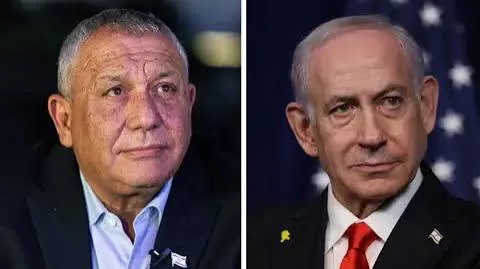
Millions of voters asking who won Israel election 2026 woke up Wednesday to an unresolved political race. Neither incumbent Prime Minister Benjamin Netanyahu nor challenger Gadi Eisenkot has secured the numbers needed to claim an outright victory.
Tuesday’s national vote saw turnout climb to roughly 77 percent, the highest figure seen in decades. Yet official vote counting shows both rival camps falling short of the 61-seat threshold needed to control the 120-seat Knesset.
The election was widely framed as a national verdict on Netanyahu’s wartime leadership. It marked the first general vote held since the October 7, 2023 attacks and the prolonged regional conflict that followed.
Netanyahu’s right-wing Likud party remains the largest single faction in parliament, on track for roughly 27 seats. However, Likud lost seats compared to the previous parliament, shrinking the overall strength of its traditional religious and nationalist partners.
Eisenkot, a former military chief leading the centrist Yashar alliance, finished second with roughly 21 projected seats. His broader opposition alliance made steady gains, but it still lacks enough seats to form a government on its own.
Both leaders took the stage in the early hours of Wednesday morning to address supporters and outline their next steps.
Speaking in Jerusalem after 3:00 a.m., Netanyahu stopped short of declaring outright victory. Instead, he called for a "strong government of the right" and urged Zionist factions to unite behind him. He also highlighted his foreign policy stance and his close relationship with the United States.
In Tel Aviv, Eisenkot greeted an energized crowd of supporters. He insisted that the broad public desire for change was undeniable, warning that the country needed stable, responsible leadership after years of deep division.
Under Israel’s parliamentary system, an aspiring prime minister must assemble a coalition of at least 61 lawmakers. With Netanyahu’s right-leaning bloc projected around 52 to 56 seats and the anti-Netanyahu opposition hovering near 49 to 51 seats, neither side holds a clear majority.
This stalemate leaves smaller and non-aligned factions in pivotal positions. Arab Israeli parties, including the New Joint List and Ra'am, saw strong voter turnout and together won substantial representation.
Whether Jewish opposition parties will partner formally with Arab factions remains one of the largest strategic dilemmas facing Eisenkot’s bloc. Without them, the arithmetic for an alternative government remains exceptionally narrow.
The Central Elections Committee is continuing to process remaining ballots throughout Wednesday. Final certified tallies will confirm the exact seat distributions by the end of the week.
Once the final numbers are certified, President Isaac Herzog will meet with party delegations. He will then assign the official mandate to whichever leader demonstrates the most viable path toward a 61-seat coalition.
If neither Netanyahu nor Eisenkot can strike an agreement with potential partners over the coming weeks, Israel could face prolonged political paralysis or the prospect of another snap election.