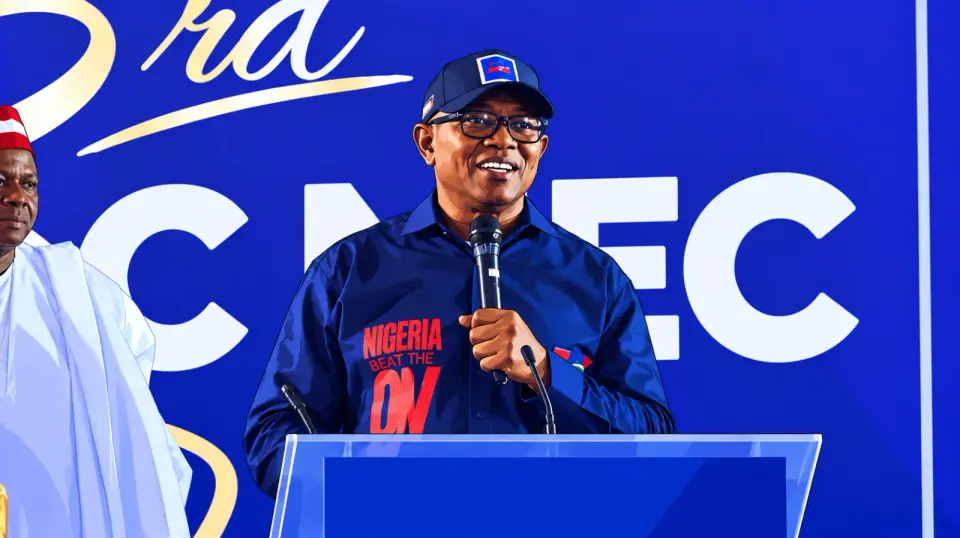
Nigeria Democratic Congress (NDC) presidential candidate Peter Obi has challenged his political opponents to leave their comfort zones and face the realities facing everyday citizens across the country.
Speaking before hundreds of party supporters at the Citi-Hub Centre in Abakaliki, Ebonyi State, Obi criticized presidential hopefuls who remain detached from the daily struggles of ordinary families. The gathering formed part of a nationwide series of interactive town halls ahead of the 2027 general elections.
The former Anambra State governor questioned how politicians can govern effectively when they know nothing about rural and semi-urban communities.
"People want to contest for president, but they don’t know where Abakaliki, Ikwo or Nkalagu is," Obi told the cheering crowd. "We won’t vote for people who stay in their houses while the people are suffering."
Obi stressed that genuine leadership requires direct engagement with citizens in their own neighborhoods. He noted that leaders must listen to public grievances before designing national policies.
Demanding Accountability from the Seat of Power
During the Abakaliki address, Obi turned his attention directly to the current administration of President Bola Tinubu.
He challenged the president to visit Ebonyi State personally and explain what three years of federal borrowing have delivered for local communities. Obi argued that public officials must account for state resources in front of the citizens they serve.
"I want President Tinubu to come to Abakaliki to tell the people what he has done in the past three years," Obi stated. "I want him to come to Abakaliki to tell you what he used the money he has been borrowing to do."
The NDC candidate asserted that effective governance requires energy, presence, and constant physical oversight across all geopolitical zones. He argued that when leaders isolate themselves in government villas or travel abroad frequently, citizens bear the burden of insecurity and inflation.
Obi maintained that governance should operate on the principles of demand and supply. In his view, the people must set the agenda, while leaders must supply honest service.
Seven Priorities for Emergency National Action
Laying out his policy framework for the 2027 race, Obi pledged to declare an immediate state of emergency across seven key sectors if elected.
These targeted areas include electric power, national security, healthcare, agriculture, education, national unity, and anti-corruption. He described food production and rural security as immediate lifelines needed to rescue vulnerable households from severe poverty.
On public integrity, Obi promised an aggressive campaign against corruption, warning that accountability must start at the very top of government.
"Public money must be used for the public good. Nobody will steal our money again," Obi said. He pledged that anti-graft agencies would operate independently to prosecute offenders regardless of their political connections or status.
He also addressed his regional base directly, urging voters across the South-East to reject tribal loyalty and judge candidates strictly on character and competence.
"I don't want the people of Ebonyi to vote for me because I am from the South-East," Obi urged. "I want you to vote for me because I am an Igbo person. I want you to vote for me because I am qualified to be the president of this country."
Listening Tours Reshape the 2027 Campaign Trail
The Abakaliki town hall reflects a noticeable shift toward community-level campaigning as political parties prepare for the 2027 election cycle.
Rather than relying solely on grand stadium rallies, several opposition candidates are adopting consultative formats. These events permit direct questioning from market traders, youths, and community elders.
Political analysts observe that referencing specific farming and industrial hubs like Ikwo and Nkalagu resonates strongly with local populations. Ikwo serves as a major agrarian hub, while Nkalagu hosts historical industrial limestone assets that once powered regional cement production.
The presidency has not issued a formal reply to Obi's remarks in Abakaliki. However, ruling party spokespersons have consistently maintained that federal infrastructure investments and macroeconomic reforms will deliver long-term growth across all thirty-six states.
Obi concluded his Ebonyi visit by assuring party members that the NDC would continue taking its consultations directly into secondary cities and rural towns across the nation.