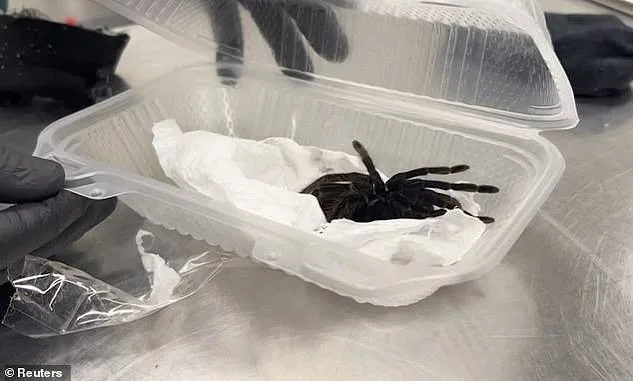
A routine terminal check-in turned into one of South America’s largest exotic wildlife busts when border agents halted three travelers bound for Europe.
Customs and border protection officers made the discovery at Jorge Chávez International Airport. The facility is Peru’s flagship international aviation hub, located in the coastal province of Callao, an autonomous port territory immediately bordering the capital city of Lima. Serving as the primary gateway for commercial flights across the country, the busy hub handles tens of thousands of overseas passengers daily.
Terminal security flagged three pieces of checked luggage after inspectors observed abnormal movement and irregular organic shapes during baggage screening. When customs officers opened the bags for manual inspection, they discovered that dozens of everyday clothing items were moving on their own.
Officers unrolled bundle after bundle of heavy socks, revealing more than 3,000 live tarantulas packed tightly across three separate suitcases. The travelers—two German nationals and one Polish citizen—were immediately taken into custody before they could board their flight to Germany.
Thousands of Spiders Hidden in Everyday Wardrobe Items
The concealment method relied on everyday thermal socks to shield the live cargo from standard terminal checks. Wildlife technicians counted between 15 and 22 heavily stuffed socks in each suitcase, with each garment holding dozens of specimens sorted into separate compartments.
The confiscated containers held specimens across every stage of biological development. Officers cataloged fertile egg sacs, fragile newly hatched spiderlings, developing juveniles, and fully grown mature adults.
Inspectors confirmed the presence of several highly sought-after neotropical genera, including Brachypelma, Pamphobeteus, and Avicularia. These varieties range from vibrant pink-toed tree-dwelling species to massive terrestrial bird-eater spiders known for striking body markings and metallic carapaces.
Because wild tarantulas display richer pigmentation and greater genetic diversity than captive-bred domestic lines, exotic pet collectors overseas pay premium prices for wild-caught South American specimens.
European Black Markets and High-Profit Trafficking Routes
Wildlife crime specialists estimate that mature wild-caught tarantulas can fetch up to €500 ($540) each on unregulated European collector exchanges. With more than 3,000 specimens packed across the three bags, the potential retail value of the shipment exceeded €1.5 million.
Global environmental authorities rank illegal wildlife trafficking alongside the arms, narcotics, and counterfeit goods trades, generating roughly $20 billion annually worldwide. Tropical ecosystems across Latin America remain primary targets for international poaching syndicates seeking rare reptiles, songbirds, amphibians, and arachnids.
Extracting thousands of predatory arachnids also inflicts severe damage on regional ecosystems. Tarantulas serve as vital apex predators in rainforest leaf litter and forest canopies, maintaining natural balances by consuming beetles, grasshoppers, and small pests.
Smuggling animals in tightly tied fabric inside unpressurized cargo holds causes extreme physiological stress. Wildlife handlers noted that high mortality rates are common in illicit shipments, prompting traffickers to collect massive surplus volumes to offset expected transit losses.
Criminal Prosecution and Specialized Rescue Efforts
The three detained European passengers were transferred directly to environmental crimes investigators and the specialized environmental prosecutor’s office. Under national forestry and wildlife conservation statutes, unauthorized extraction, commercial transport, and unlawful export of protected fauna carry mandatory criminal penalties, including multi-year prison sentences and substantial financial fines.
Meanwhile, specialized veterinary personnel and forestry technicians transferred the surviving spiders to secure quarantine terrariums. Teams are providing vital hydration, treating stressed specimens, and separating fragile spiderlings from territorial adults.
Entomologists and conservation scientists are running regional genetic checks to pinpoint the specific jungle basins where the spiders were collected. Once health clearances are complete, conservation officials will determine whether healthy adult spiders can be returned safely to protected nature reserves.