The Royal Moroccan Football Federation (FRMF) announced on Tuesday, November 24, 2026, that it will pursue all available legal avenues to challenge a decision by the Court of Arbitration for Sport (CAS) that officially reinstated Senegal as winners of the 2025 Africa Cup of Nations (AFCON).
The announcement came hours after sport’s supreme judicial authority in Lausanne, Switzerland, issued a unanimous verdict setting aside an earlier Confederation of African Football (CAF) ruling that had stripped the Teranga Lions of their title.
Expressing deep astonishment at the court's award, Moroccan football authorities confirmed they are preparing further appeals, setting up a potential legal showdown before the Swiss Federal Tribunal.
CAS Overturns CAF Forfeiture Ruling in Unanimous Verdict
The dispute stems from the dramatic AFCON 2025 final played in January at the Prince Moulay Abdellah Stadium in Rabat.
Senegal originally won the match 1-0 after extra time through a 94th-minute strike by Pape Gueye. However, in March, a CAF Appeals Board sensationally overturned the result. CAF awarded Morocco a 3-0 default victory, citing Articles 82 and 84 of tournament regulations, which penalize teams that abandon the pitch before the final whistle.
The Senegalese Football Federation (FSF) took the case to CAS in Lausanne, where a three-judge panel heard arguments behind closed doors. In its final judgment, CAS ruled that referee Jean-Jacques Ndala acted within his exclusive "field of play" authority when he allowed the match to resume after a 15-minute stoppage.
Because the game was completed in full, CAS determined that the automatic forfeiture clauses were improperly applied by CAF.
Moroccan Federation Expresses Astonishment and Vows Appeal
The verdict provoked an immediate and sharp reaction from Rabat. In an official communiqué, the FRMF stated that it was “astonished by the decision rendered by the Court of Arbitration for Sport.”
Moroccan football officials maintained that walking off the field during an active match severely undermines sporting discipline, competition integrity, and refereeing authority. The federation emphasized its determination to defend what it views as the legitimate regulatory application of African football statutes.
Interestingly, prior to the verdict, Moroccan national team captain Achraf Hakimi publicly expressed respect for fair competition, acknowledging on social media that outcomes decided on the pitch carry primary athletic legitimacy.
How the Dramatic Stoppage-Time Final Unfolded in Rabat
The controversy originated during an extraordinary period of second-half stoppage time with the final locked at 0-0.
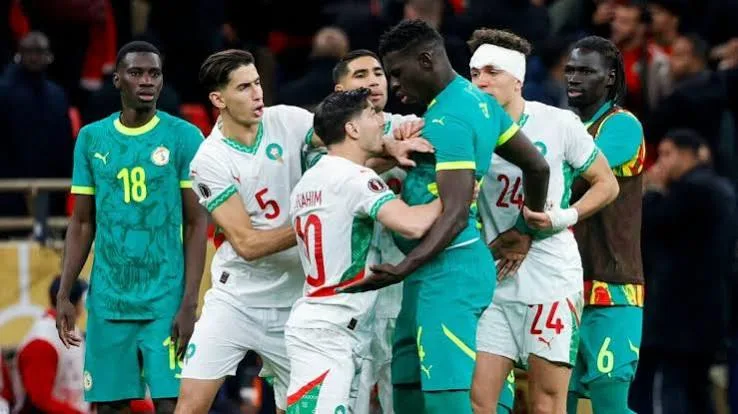
In the 92nd minute, Senegal had a potential opening goal disallowed by VAR. Minutes later, in the 98th minute, the referee awarded Morocco a contested penalty kick. Amid intense protests, Senegal players and staff left the pitch in the 112th minute of match time.
Following high-level interventions by team officials and match delegates, Senegal returned to the pitch after a 15-minute delay. Morocco forward Brahim Díaz stepped up in the 124th minute to take the spot-kick, attempting a Panenka chip that was easily caught by Senegalese goalkeeper Édouard Mendy.
Senegal capitalized on the reprieve, scoring early in extra time to secure what they believed was their second continental crown.
Next Steps Before the Swiss Federal Supreme Court
Because CAS acts as the ultimate arbitral tribunal for global sports, its substantive awards cannot be appealed on the sporting merits.
Morocco’s primary remaining legal recourse is to petition the Swiss Federal Supreme Court (Tribunal Fédéral) in Lausanne. Under Swiss private international law, the federal court can only annul CAS awards on very narrow grounds, such as lack of jurisdiction, serious procedural violations, denial of the right to be heard, or decisions that violate Swiss public policy.
As the legal battle shifts to Switzerland's highest civil court, Senegal retains possession of the trophy, while African football prepares for further regulatory debate over match abandonment protocols.