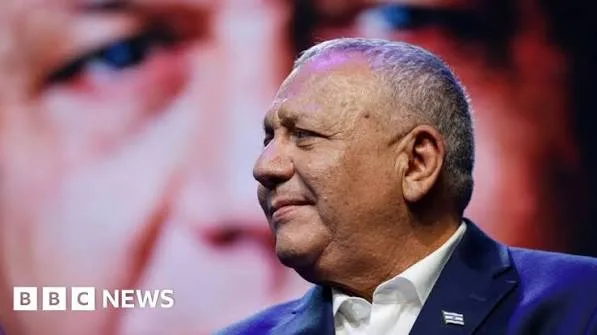
Israeli President Isaac Herzog has officially moved to break the country's political stalemate. On Saturday evening, his office confirmed that he will ask opposition leader Gadi Eisenkot to form government.
The decision follows the October 27 general election, which left Israel's parliament, the Knesset, without a clear majority. The formal handover ceremony takes place on Sunday afternoon at the President’s Residence in Jerusalem.
The move marks a critical turning point for Israel. Prime Minister Benjamin Netanyahu, the country's longest-serving leader, failed to gather enough parliamentary recommendations to secure the first opportunity to build an administration.
A Historic Shift at the President’s Residence
President Herzog made the announcement after concluding consultations with delegations from all incoming Knesset factions. During those meetings, 67 lawmakers endorsed Eisenkot for prime minister. Only 46 members backed Netanyahu, while seven abstained.
Under Israeli law, the president has broad discretion to assign the mandate to the lawmaker deemed to have the best chance of assembling a viable coalition.
"Now is the time to form a national emergency government," Eisenkot stated shortly after the announcement. "I will do everything to ensure we are worthy."
Eisenkot, a former chief of general staff of the Israel Defense Forces, leads the centrist Yashar party. He now has 28 days to build a coalition of at least 61 seats in the 120-seat Knesset. If necessary, the president can grant a single 14-day extension.
The Mathematical Puzzle of the Knesset
Building a stable majority will test Eisenkot's political skill. The recent election produced a fragmented legislature shaped by deep public fatigue after years of war and social division.
Netanyahu’s right-wing Likud party and its religious allies won 53 seats, falling well short of the 61 needed to govern. Eisenkot’s four-party centrist alliance secured 48 seats.
The balance of power shifted dramatically because Arab-led alliances, the United Arab List and the Joint List, won an unprecedented 19 seats. Record turnout among Arab citizens made these factions potential kingmakers.
Lawmakers from Arab-led parties endorsed Eisenkot to block Netanyahu from retaining power. However, bridging the gap between those recommendations and an agreed cabinet remains a steep challenge.
Deep Divisions Facing Coalition Talks
Eisenkot faces major policy disagreements among the parties that supported his nomination. Several right-leaning opposition figures have repeatedly refused to sit in a formal coalition that relies on Arab-led parties.
To reach a 61-seat majority without that reliance, Eisenkot must convince ultra-Orthodox religious parties, such as Shas and United Torah Judaism, to break away from their long-standing alliance with Netanyahu.
That path carries its own friction. Secular opposition leaders insist on universal military conscription and an end to blanket draft exemptions for religious seminary students. Ultra-Orthodox leaders view those exemptions as a non-negotiable red line.
Eisenkot could also explore a minority government that relies on outside votes for parliamentary confidence, though such arrangements in Israel have historically faced severe instability.
What Happens Next in Jerusalem
The formal mandate ceremony begins Sunday at 5:00 p.m. local time at the President’s Residence. Once Eisenkot accepts the task, his official 28-day countdown begins immediately.
Netanyahu and his allies have already signaled that they will mount intense political pressure on right-leaning opposition members to prevent any agreement.
If Eisenkot succeeds, his coalition will end Netanyahu’s uninterrupted run in office since late 2022. If he fails, the president can pass the mandate to another lawmaker or return it directly to the Knesset, which could trigger yet another national election.