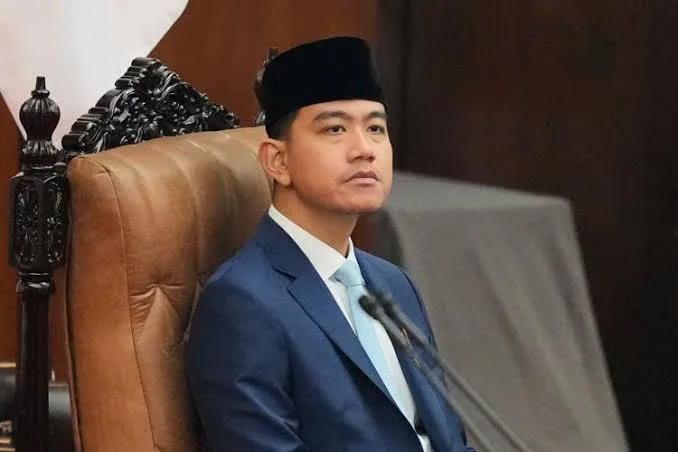
Indonesia's Vice President Gibran Rakabuming Raka officially stepped down from his post on Thursday, following binding court determinations that invalidated his secondary educational credentials.
The 39-year-old politician, the eldest son of former President Joko Widodo, submitted his formal resignation letter to the leadership of the People’s Consultative Assembly (MPR) at the parliamentary complex in Jakarta. His departure came after private deliberations with President Prabowo Subianto, who announced during a joint palace press conference that he accepted the resignation with a heavy heart to safeguard constitutional stability.
Under Indonesian electoral law, candidates for both the presidency and vice presidency must hold at least a senior high school diploma or a certified foreign equivalent.
Supreme Court Invalidates Equivalence Certificate
The catalyst for Gibran’s exit was Supreme Court ruling No. 742 K/TUN/2026, which mandated the Ministry of Education and Culture to cancel the Certificate of Equivalence granted to him in August 2019.
The Supreme Court declared the equivalence document null and void after conducting a substantive examination of Gibran's academic history. The bench ruled that records from his overseas studies only documented classroom attendance rather than the successful completion of an accredited secondary education programme.
The decision followed an earlier review by the Constitutional Court in October, which found no convincing proof that Gibran possessed a foreign certificate equivalent to senior high school graduation. With his official equivalence revoked by the highest judicial authorities, Gibran lost the legal baseline required to retain executive office.
Impeachment Pressure and Parliamentary Challenge
The judicial findings triggered rapid political blowback across parliament. On Wednesday, a coalition of 120 lawmakers in the House of Representatives introduced a formal motion to challenge Gibran’s eligibility, opening the path toward impeachment hearings.
To avoid prolonged constitutional paralysis, Gibran offered his resignation to Prabowo during a two-and-a-half-hour meeting at the State Palace before delivering his formal letter to parliamentary leaders on Thursday.
Speaking to journalists in his hometown of Solo, former President Joko Widodo struck a measured tone regarding his son's departure. Widodo remarked that political dynamics are an ordinary reality of governance, reminding the public that elected posts are inherently temporary while affirming his family’s ongoing support for President Prabowo's national agenda.
Unravelling of the Prabowo-Widodo Governing Pact
Gibran’s resignation fundamentally reshapes Indonesia’s political landscape. His selection as vice-presidential running mate in 2024 forged an alliance between Prabowo Subianto and the outgoing Widodo political machine, delivering a decisive electoral victory.
However, Gibran’s candidacy was controversial from the start, following a 2023 constitutional ruling overseen by his uncle that carved out an age exemption for elected officials. The nullification of his secondary academic credentials has now dissolved that partnership, leaving President Prabowo with complete executive authority as he navigates the coalition without the Widodo family's direct presence in the cabinet.
Cabinet officials acknowledged that stepping down was the only viable path to avert nationwide street protests and restore certainty to Southeast Asia’s largest economy.
Constitutional Process to Select a Successor
Under Article 8 of Indonesia’s 1945 Constitution, a vice-presidential vacancy does not trigger a general election. Executive authority remains uninterrupted under President Prabowo Subianto.
The legislative process requires the MPR to formally register Gibran's resignation. President Prabowo then has sixty days to submit two vice-presidential nominees to the assembly.
Lawmakers from both the House of Representatives and the Regional Representative Council will convene in a joint plenary session to elect the new vice president by majority ballot. Parliamentary factions have already begun internal consultations as the president prepares his constitutional shortlist.