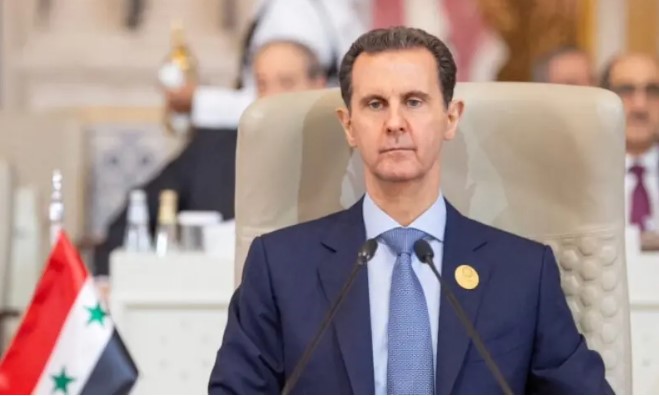
Syria has sentenced former president Bashar al-Assad to death in absentia, delivering the most dramatic judicial reckoning yet against the man who ruled the country for nearly a quarter of a century and whose government was accused of overseeing some of the worst abuses of Syria's devastating civil war.
A criminal court in Damascus found Assad guilty of premeditated murder, torture, arbitrary arrests and crimes against humanity linked to the conflict that erupted after the 2011 uprising against his rule. His younger brother, Maher al-Assad, was also sentenced to death in absentia, while former security official Atef Najib received the same punishment after being tried in person.
The verdict marks the first major conviction of Bashar al-Assad by Syria's post-regime authorities since his government collapsed in December 2024.
But there is an immediate complication: Assad is not in Syria.
After rebel forces swept into Damascus in a lightning offensive in December 2024, Assad fled the country and eventually received asylum in Russia, where he and Maher remain. Moscow has previously resisted calls for their extradition, leaving the death sentence with limited immediate practical effect unless Syria can somehow secure their return.
That makes the ruling as much about accountability as punishment.
For Syrians who spent years under bombardment, imprisonment and displacement, the verdict represents an attempt by the country's new authorities to formally establish responsibility for abuses committed during the war. In Daraa, the southern city where the 2011 uprising began, news of the ruling was met with public celebrations.
Najib's involvement in the case gives it particular historical significance.
He was the former head of political security in Daraa and became notorious for the early crackdown on protests there. The detention and torture of teenagers accused of writing anti-government graffiti helped ignite demonstrations that eventually grew into a nationwide uprising and, ultimately, a devastating civil war.
The conflict killed roughly half a million people, according to widely cited estimates, while millions more were displaced inside Syria or forced to flee abroad.
For years, accountability for the alleged crimes of Assad's government largely depended on courts outside Syria. European prosecutions, particularly in Germany and France, have pursued former Syrian officials under universal-jurisdiction laws, while international investigators have documented allegations of torture, unlawful detention, chemical attacks and other abuses.
The Damascus verdict therefore represents a major change: the new Syrian authorities are now attempting to prosecute senior figures from the former regime themselves.
That effort will not be without controversy.
Human-rights organisations have welcomed the symbolic importance of holding former regime figures accountable but have also raised concerns about the use of the death penalty and the need for fair-trial guarantees. Human Rights Watch has said the verdict carries symbolic value while maintaining its opposition to capital punishment and stressing the importance of credible judicial proceedings.
The question of what constitutes justice in post-war Syria is particularly sensitive.
The country is still dealing with the consequences of the conflict, political upheaval and sectarian violence. The transitional authorities have presented prosecutions of former regime officials as part of an effort to establish accountability and prevent the abuses of the Assad era from being forgotten.
But transitional justice is rarely straightforward.
There is a difference between punishing former leaders and rebuilding institutions capable of delivering justice consistently. Syria's new authorities must contend with competing demands from victims, former opposition groups, minority communities and people who fear that prosecutions could become instruments of political revenge.
The Assad case will therefore be watched closely beyond Syria.
It could help establish how the country intends to deal with thousands of people accused of involvement in abuses during the war. It could also influence future efforts to recover suspects who have fled abroad and determine whether Syria's transitional justice process will gain international credibility.
For Assad himself, the ruling changes little in his immediate circumstances. He remains outside Syria, and there is no indication that Russia is prepared to hand him over.
Yet politically, the symbolism is enormous.
The man who once appeared almost untouchable has now been condemned by a Syrian court under a government that emerged from the collapse of his own regime.
For FollowGlobalTrends, that is the deeper significance of the verdict. The death sentence may not bring Assad back to Damascus, but it represents a decisive break with the era in which his government held absolute power.
After years of war, exile and uncertainty, Syria's former ruler has finally faced a verdict in his own country's courts.
The sentence may be difficult to enforce. The judgment itself, however, is already historic.