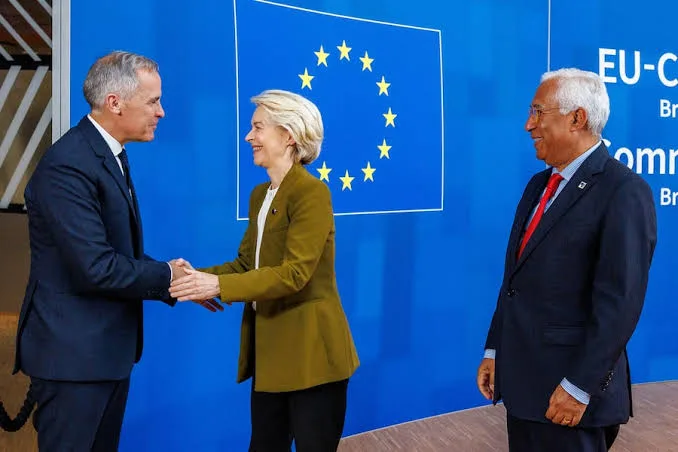
Canadian Prime Minister Mark Carney has called for a new strategic partnership between Canada and the European Union, telling the European Parliament that an associate membership arrangement would help safeguard the country’s sovereignty, democratic values and economic resilience during what he described as a “ferocious storm” confronting the world.
Speaking in Strasbourg on Thursday, Carney argued that the international landscape has become increasingly unstable, with rising geopolitical rivalry, economic fragmentation, security threats and technological competition demanding deeper cooperation between like-minded democracies. He presented the proposed EU–Canada pact as a long-term framework for collaboration rather than a bid for full European Union membership.
Carney said Canada and Europe share common commitments to freedom, the rule of law and open democratic institutions, arguing that these principles should form the foundation of a stronger political and economic alliance. He told lawmakers that defending sovereignty today requires trusted partnerships capable of responding collectively to global crises rather than acting in isolation.
Although the proposal remains at an early stage, officials say the concept of associate membership would expand cooperation in areas including trade, defence, innovation, energy security and critical supply chains while preserving Canada’s political independence. No formal accession process or treaty has been announced.
Canada and the European Union already maintain one of the world’s closest transatlantic relationships through the Comprehensive Economic and Trade Agreement (CETA), which has significantly expanded bilateral commerce since its provisional implementation. Carney suggested that evolving geopolitical realities now require the partnership to move beyond trade into broader strategic cooperation.
The speech comes as Western governments seek to strengthen alliances in response to growing global uncertainty, including conflicts affecting Europe, shifting security dynamics and increasing competition over advanced technologies and industrial policy. European leaders have likewise emphasized reducing strategic vulnerabilities while maintaining strong partnerships with democratic allies outside the bloc.
Carney’s remarks were warmly received by several members of the European Parliament, who described Canada as one of Europe’s most reliable democratic partners. While significant legal and political questions would need to be resolved before any associate arrangement could be defined, the address signalled Ottawa’s intention to deepen engagement with European institutions at a pivotal moment in international politics.
The proposal reflects a broader shift in global diplomacy, where economic resilience and national sovereignty are increasingly being pursued through stronger international partnerships rather than greater isolation. Whether the EU–Canada pact evolves into a formal institutional framework or remains a strategic vision, Carney’s message underscores the growing importance of democratic alliances in navigating an increasingly turbulent world.