
US Deports Dozens to Haiti as Migrants Return to an Unfamiliar Country
The United States has deported dozens of Haitians to a country many had not seen for years, as Washington pushes ahead with removals despite Haiti’s worsening security crisis.
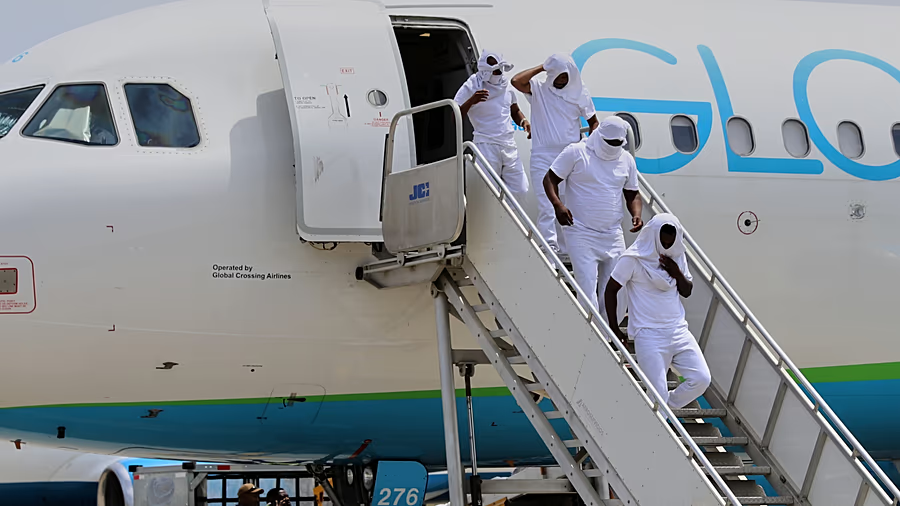
Dozens of Haitians have been deported from the United States to Haiti, where they arrived in a country that many had not lived in for years and that is still struggling with widespread gang violence, displacement and a severe humanitarian crisis.
More than 50 people arrived in the northern Haitian city of Cap-Haïtien on Thursday on the latest US deportation flight, according to The Associated Press. It was the second such flight since the Trump administration ended Temporary Protected Status for hundreds of thousands of Haitians living in the United States.
For some of those arriving, Haiti was no longer a familiar home. Many had spent years or even decades in the United States, building families, finding employment and establishing lives in communities far from the Caribbean nation. Their return comes at a moment when conditions inside Haiti remain deeply unstable.
The deportations follow the Trump administration's decision to terminate Temporary Protected Status, or TPS, for Haitians. The programme had allowed eligible Haitians already in the United States to remain and work legally because conditions in their home country made a safe return difficult. The US Supreme Court recently cleared the way for the administration to proceed with ending those protections.
The change affects roughly 350,000 Haitians, according to US government and media estimates. Those who do not obtain another form of immigration relief can now face removal from the United States. The administration has argued that TPS is temporary by design and that Haiti's circumstances no longer justify maintaining the designation.
The timing has intensified the controversy. Haiti is experiencing one of the worst periods of insecurity in its recent history, with armed gangs controlling large parts of Port-au-Prince and expanding their influence into other areas. More than 1.5 million people have been displaced, while the United Nations says nearly 200,000 people have been forcibly returned to Haiti from various countries so far in 2026, already exceeding the total recorded last year.
The latest US flight also arrived only days after a brutal gang attack in the Kenscoff area near Port-au-Prince that killed at least 47 people, including children, and involved kidnappings and other serious abuses. The violence has renewed international calls for a stronger security response and greater support for Haiti's overstretched authorities.
The US government maintains that people who have no legal basis to remain in the country can be removed under American immigration law. The administration has also argued that areas of Haiti are sufficiently secure for returns to take place, a position that has faced criticism from human-rights advocates and immigration groups who point to the country's continuing violence and weak public services.
The situation has created a particularly difficult dilemma for Haitians who spent years under TPS. Some had jobs, homes and children in the United States and had little recent connection to the country to which they were being returned. For them, deportation is not simply a journey home but a forced transition into a society they may barely recognise.
Haiti's government and humanitarian agencies are also facing the practical challenge of receiving growing numbers of returnees while already struggling to provide shelter, healthcare, food and security for displaced residents. The United Nations has warned that the country's humanitarian needs are expanding even as international efforts to strengthen security remain under-resourced.
The debate over the deportations therefore extends beyond US immigration policy. It raises a broader question about what happens when a country exercises its right to remove migrants while the destination country is facing an extraordinary humanitarian and security emergency. For Washington, the flights represent the enforcement of a tougher immigration policy; for those arriving in Haiti, they can mean starting again in a country where even basic safety remains uncertain.
The broader significance is that Haiti's crisis is increasingly intersecting with America's immigration crackdown in ways that are difficult to separate. As more Haitians lose temporary protection and face removal, the pressure on a country already struggling with gang violence, mass displacement and weak institutions will grow. The coming months will test not only Washington's determination to carry out its deportation policy, but also whether Haiti and the international community have the capacity to receive people being returned to a country that many of them no longer know as home.