
UK Gets Rare Access to Ukraine’s Battlefield AI Data in Major Defence Partnership
Britain has secured unprecedented access to Ukraine’s battlefield data as London seeks to turn hard-won combat experience into AI systems for future conflicts.
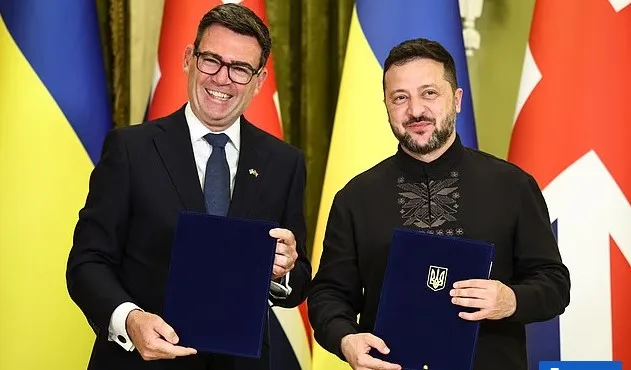
Britain is gaining access to a vast trove of Ukrainian battlefield intelligence under a new defence partnership designed to help develop artificial-intelligence systems capable of identifying threats, improving military decision-making and protecting critical infrastructure.
The agreement, signed in Kyiv on Monday by Prime Minister Andy Burnham and Ukrainian President Volodymyr Zelenskyy, makes the UK the first international partner granted access to Ukraine’s Avengers AI Labs. The facility has built a large database from the war with Russia, drawing on drone footage, battlefield cameras, sensors and other operational data collected over several years.
The scale of the information involved is substantial. British officials and media reports say the database includes around five million annotated battlefield images, while Ukraine's AI systems process more than 100,000 drone-video feeds each month. Ukrainian forces have reportedly used the technology to identify Russian targets, with current systems achieving detection rates of about 70 per cent in some applications.
For Britain, the attraction is not simply the volume of data but the fact that it has been generated during an active, technologically intensive war. Ukraine has spent more than four years adapting to Russian drones, electronic warfare, surveillance systems and rapidly changing battlefield tactics. That gives its data a practical quality that conventional military exercises cannot easily reproduce.
The new partnership will allow British researchers, defence companies and engineers to work with insights from Avengers while developing AI-enabled capabilities of their own. The British government says the cooperation will focus on areas including autonomous systems, cyber security, AI assurance and secure data and computing infrastructure.
One early application will be considerably closer to home than the Ukrainian battlefield. British companies are working on systems using fibre-optic sensors and AI to detect potential threats around sensitive locations, including defence facilities and other critical infrastructure. The technology is intended to help identify hostile-state activity and other security threats before they develop into serious incidents.
The arrangement also involves private industry. The British government says vetted start-ups, researchers and technology firms will work alongside Ukrainian and British specialists, with initial pilot projects testing new systems at undisclosed UK sites. The two countries also intend to explore low-power AI chips for drones and other autonomous machines.
The data exchange is part of a broader two-way relationship rather than a one-sided transfer of Ukrainian know-how. On the same visit, Britain announced that defence company MBDA would be permitted to share classified information on British components of the SCALP long-range missile with Ukraine, allowing Kyiv to work towards domestic assembly and production.
The partnership comes as Britain itself accelerates its military adoption of AI. In June, the Ministry of Defence established a Rapid AI Delivery Taskforce intended to move AI-enabled technology into the hands of British forces more quickly, with applications ranging from battlefield decision-making to uncrewed systems. A separate £2 billion, 15-year contract announced in July is designed to use AI, analytics and virtual environments to train as many as 60,000 British soldiers a year.
Ukraine's role in Britain's military learning has also expanded beyond technology. A UK-led training programme has already trained more than 63,000 Ukrainian personnel, while Ukrainian soldiers are increasingly sharing battlefield lessons on drones, electronic warfare, logistics and other capabilities with Western forces.
There are, however, limits to what the new AI partnership can immediately deliver. Battlefield data can improve the systems used to train algorithms, but it does not automatically translate into reliable battlefield performance. The UK-Ukrainian declaration itself stresses safeguards around data, intellectual property, export controls and responsible AI, while describing the agreement as a framework for pilot projects rather than a guarantee that specific technologies will quickly enter operational service.
The political significance is nevertheless difficult to miss. Britain is effectively turning Ukraine's experience of fighting Russia into part of its own preparation for future conflict, while giving Kyiv access to British technology and industrial expertise in return. The relationship is moving beyond the traditional model of one country supplying another with weapons and towards a shared effort to develop the technologies that could define the next generation of warfare.
For Ukraine, the arrangement offers another way to convert battlefield innovation into long-term strategic partnerships. For Britain, it is an opportunity to learn from a war that has exposed how quickly drones, sensors, electronic warfare and AI can reshape combat. The deeper significance is that the battlefield in Ukraine is increasingly becoming a laboratory for the militaries of the future, and Britain now has privileged access to some of the data being generated there.