
Trump Escalates Media Fight, Threatens FCC Action Against Kristen Welker
President Donald Trump is demanding possible FCC action against NBC’s Kristen Welker after she described his record of endorsing Republican candidates as producing “mixed results.”
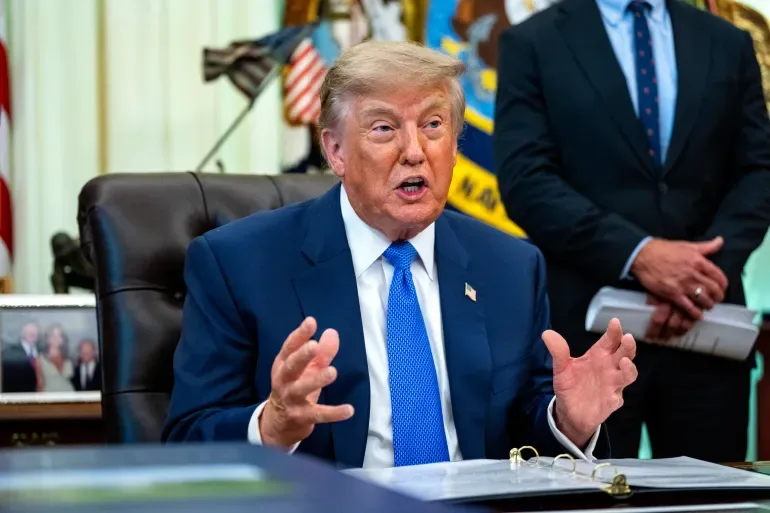
US President Donald Trump has escalated his latest confrontation with the American media, threatening to report NBC News journalist and Meet the Press moderator Kristen Welker to the Federal Communications Commission after she described his record of endorsing Republican candidates as having “mixed results.”
Welker made the remark during a pre-show live appearance on NBC’s Washington, D.C., affiliate, WRC-TV, while discussing Trump’s influence over the November midterm elections. She said Trump would remain a major force in the races but noted that his endorsements had produced mixed outcomes. She pointed to the recent Republican primary victory of South Carolina Senate candidate Darline Graham as a success.
Trump strongly disputed the characterization. In a series of posts on Truth Social, he pointed to victories by Graham and Oklahoma gubernatorial candidate Mike Mazzei and cited his own figures showing what he described as a 100 per cent success rate in Senate Republican primaries and 98 per cent in House GOP primaries.
He accused Welker of making a “purposeful inaccuracy” and said she would be reported to the FCC for “rebuke or punishment.” Trump also appealed directly to FCC Chairman Brendan Carr, urging the commission to take what he called a threat to the country seriously.
NBC News has stood by Welker. A spokesperson for the network said she was “one of the best in the business” and that NBC supported her.
There is, however, an important distinction between Trump's demand and what the FCC can actually do. The commission regulates broadcast stations that use the public airwaves, but its authority over editorial decisions and news content is tightly constrained by the First Amendment.
The FCC's own policy says it generally does not intervene simply because someone alleges that a broadcast was inaccurate or one-sided. The commission has said it may investigate claims of deliberate news distortion when there is documented evidence that a broadcaster intentionally falsified or manipulated the news, but ordinary disputes over journalistic judgement do not ordinarily meet that threshold.
That makes the prospect of punishment over Welker's two-word description considerably more complicated than Trump's social-media posts suggest. The available evidence does not indicate that the FCC has opened a proceeding against Welker, and the agency had not immediately commented on Trump's demand.
The underlying political argument is itself more complicated than either side's presentation. Trump has enjoyed substantial success with Republican primary endorsements, particularly in some Senate and House contests, but he has also backed candidates who have lost primaries. Recent setbacks have included defeats involving candidates in several states, giving Welker's description some basis even as Trump's broader success-rate figures demonstrate significant influence.
The dispute also comes at a particularly sensitive time for the relationship between the Trump administration and major US broadcasters. Disney and ABC filed a lawsuit against the FCC earlier this month after the commission ordered an unusually early review of the broadcast licences for eight ABC-owned stations. The companies allege that the regulatory pressure is retaliation for programming and coverage disliked by the administration, while the FCC has defended its actions as regulatory matters rather than censorship.
Trump's clash with Welker is not new. During a Meet the Press interview in June, the president walked out after the journalist challenged his claims concerning election fraud and pressed him to provide evidence. The latest confrontation therefore fits into a longer pattern of antagonism between Trump and a journalist who regularly questions him on national television.
For NBC, the immediate issue is defending the independence of one of its most prominent journalists. For Trump, it is another opportunity to challenge coverage he considers unfair and reinforce his argument that major news organizations routinely misrepresent his political strength. But the involvement of the FCC raises a much larger question: whether the government's regulatory power over broadcast licences can become a pressure point against editorial decisions.
That question matters well beyond one journalist or one description of Trump's endorsements. As the 2026 midterm campaign gathers pace, the boundary between political criticism of the press and government pressure on the press is becoming increasingly contested. If broadcasters begin altering coverage because they fear regulatory consequences, the effect would reach far beyond Kristen Welker's “mixed results” remark, touching the independence of American journalism itself.