
Saudi Arabia, Türkiye and Pakistan Join Forces in Major New Defence Pact
Saudi Arabia, Turkey and Pakistan have signed a joint defence pact, strengthening security ties as tensions continue to rise across the Middle East.
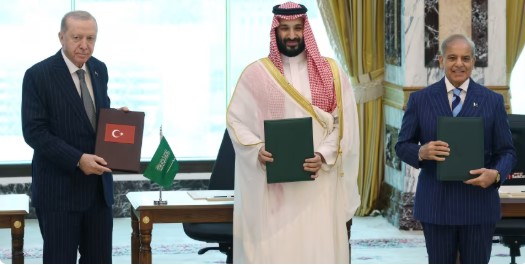
Saudi Arabia, Türkiye and Pakistan have signed a landmark joint defence agreement in Mecca, creating a new trilateral security framework that commits the three countries to treating an armed attack against one of them as an attack against all.
The agreement, signed on Friday, brings together three strategically important countries spanning the Gulf, South Asia and the eastern Mediterranean. It comes at a particularly sensitive moment for the region, with governments facing continuing missile threats, geopolitical tensions and uncertainty over the future shape of Middle Eastern security.
The pact, known as the Mecca Joint Defence Agreement, builds on the longstanding military relationship between Saudi Arabia and Pakistan and adds Türkiye to the framework. The three governments say the agreement is intended to strengthen defence cooperation, improve coordination and enhance collective deterrence rather than create a new mechanism for offensive military action.
The timing is significant. Saudi Arabia and Pakistan already signed a Strategic Mutual Defence Agreement in September 2025, under which aggression against either country would be regarded as aggression against both. Pakistan has subsequently deployed military aircraft and personnel to Saudi Arabia under that agreement, demonstrating that the relationship has already moved beyond diplomatic declarations toward practical military cooperation.
Türkiye's inclusion substantially broadens the strategic reach of the arrangement. Ankara is a NATO member with an increasingly influential defence industry, while Pakistan possesses one of the region's most capable armed forces and is a nuclear-armed state. Saudi Arabia, meanwhile, has been rapidly expanding and modernising its military capabilities as it seeks greater responsibility for its own security.
Together, the three countries bring different strengths to the partnership. Saudi Arabia provides substantial financial resources and a strategically important geographic position; Türkiye contributes a growing domestic defence industry and extensive military experience; while Pakistan brings a large conventional military, established defence cooperation with Riyadh and nuclear deterrence capabilities.
The agreement also reflects a wider effort by regional powers to strengthen their own security arrangements at a time when traditional alliances are under pressure. Analysts have previously described the emerging Saudi-Pakistani-Turkish alignment as part of a broader shift toward more diversified security partnerships, particularly as Middle Eastern states seek greater strategic autonomy.
Recent developments have given that search for stronger security guarantees added urgency. Saudi Arabia has faced missile threats during periods of regional conflict, while Türkiye has repeatedly condemned attacks against Saudi territory and called for measures to prevent further escalation. In July, Ankara publicly condemned a Houthi missile attack targeting southern Saudi Arabia and reaffirmed its solidarity with Riyadh.
The three countries have also increasingly coordinated diplomatically. Türkiye, Saudi Arabia and Pakistan were among the countries participating in recent consultations on Middle Eastern security, alongside Egypt and other regional powers. Their governments have repeatedly called for de-escalation and stronger regional cooperation as conflicts have threatened energy markets, shipping routes and wider economic stability.
The pact could therefore have consequences well beyond military affairs. A closer security relationship among Riyadh, Ankara and Islamabad could influence arms cooperation, military training, intelligence sharing and defence-industrial partnerships. It could also affect how other regional powers assess their own security calculations.
At the same time, the agreement does not automatically mean that the three countries will enter every future conflict together. The practical meaning of the mutual-defence commitment will depend on how its provisions are interpreted and implemented when an actual security crisis occurs. Analysts are therefore likely to focus closely on the agreement's operational mechanisms, command arrangements and rules governing a collective response.
For Saudi Arabia, the pact offers another layer of security cooperation at a time when Riyadh is seeking to strengthen its ability to respond to threats independently. For Pakistan, it deepens a decades-old strategic relationship with the Gulf while expanding its military diplomacy. For Türkiye, the agreement reinforces Ankara's growing role in shaping security arrangements beyond its immediate borders.
The broader message is unmistakable: the security architecture of the Middle East and surrounding regions is changing.
For readers of FollowGlobalTrends.com, the Mecca agreement is significant not simply because three countries have signed a defence pact, but because of what their combined capabilities and geographic reach could mean for the emerging balance of power. As regional states increasingly build partnerships outside traditional alliances, Saudi Arabia, Türkiye and Pakistan may be laying the foundations for a new model of security cooperation stretching from the Gulf to South Asia.