
Putin Steps Onto Disputed Kurils as Japan Warns Russia Over ‘Unacceptable’ Visit
Putin’s visit to the disputed Kuril Islands has drawn a sharp rebuke from Japan, which called the move “unacceptable” and renewed its territorial objections.
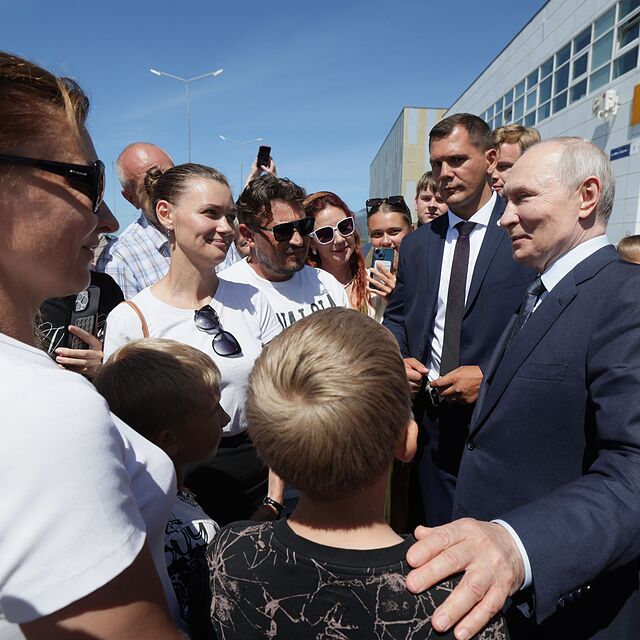
Russian President Vladimir Putin has made his first visit to the disputed Kuril Islands, stepping onto territory claimed by Japan and triggering a strong diplomatic protest from Tokyo at a time when relations between the two countries are already deeply strained.
Putin travelled on Thursday to Iturup, known as Etorofu in Japan, one of four southern islands controlled by Russia but claimed by Japan as part of its Northern Territories. The visit is the first time Putin himself has travelled to the contested islands, although former Russian President Dmitry Medvedev visited the territory in 2010.
The Russian leader's trip was presented as part of a broader tour of Russia's Far Eastern Sakhalin region. During his time on Iturup, Putin visited a fish-processing plant, a hospital and a school, met local officials and residents, and inspected economic activity on the island.
But for Japan, the visit carried a significance far beyond Putin's itinerary.
Japanese Prime Minister Sanae Takaichi described the visit as “absolutely unacceptable,” while Foreign Minister Toshimitsu Motegi summoned Russia's ambassador and lodged a formal protest. Tokyo reiterated that the four southernmost Kuril islands-Iturup, Kunashir, Shikotan and the Habomai Islands, are inherently Japanese territory under its historical and legal position.
Moscow, however, has no intention of accepting that argument.
Russia regards the islands as sovereign Russian territory and has repeatedly rejected Japanese claims. Russian officials have pointed to post-Second World War arrangements to support their position, while the Kremlin has continued to strengthen its administrative and military presence in the region.
The dispute dates back to the final days of the Second World War.
Soviet forces seized the islands in 1945 following Japan's surrender. Japan has continued to claim the four southern islands, and the unresolved territorial dispute has prevented Moscow and Tokyo from signing a formal peace treaty formally ending their wartime state of conflict.
For decades, both countries periodically explored ways to settle the disagreement.
There were moments when diplomacy appeared to be making progress. Former Japanese Prime Minister Shinzo Abe pursued closer relations with Putin and sought an agreement over the islands, while Moscow and Tokyo discussed economic cooperation and possible arrangements involving some of the disputed territory.
Those efforts have largely collapsed since Russia's full-scale invasion of Ukraine in 2022.
Japan joined Western sanctions against Moscow, while Russia suspended peace-treaty negotiations and other bilateral initiatives. The relationship has subsequently become increasingly hostile, with Tokyo viewing Russia as a growing security concern alongside China and North Korea.
Putin's visit therefore comes at a particularly sensitive moment.
The Russian leader was not simply travelling to a remote group of islands. His presence provided a highly visible reaffirmation of Moscow's control over territory that Japan insists belongs to it.
The timing was also notable because Russian military activity was taking place in the surrounding region. Reports said Putin's visit coincided with military exercises involving Russia's Pacific Fleet, adding a security dimension to an already politically charged trip.
For Japan, the implications extend beyond the territorial dispute itself.
The country is facing a complicated strategic environment, with China expanding its military capabilities, North Korea continuing its missile programme and Russia maintaining a significant military presence in the Far East. Tokyo has responded by strengthening its defence cooperation with the United States and increasing its own military capabilities.
The Kurils also have strategic importance because of their location between the Sea of Okhotsk and the North Pacific. Control of the islands gives Russia an important military position in the waters north of Japan and contributes to Moscow's wider Pacific security posture.
That makes the dispute about more than history.
It is also about geography, military access and control of a strategically important maritime zone.
Russia has increasingly developed infrastructure on the islands, including military installations and economic facilities. Japan, meanwhile, has continued to insist that the sovereignty issue cannot simply be erased by decades of Russian administration.
Putin's personal appearance on Iturup now adds a powerful political symbol to that reality.
The Russian president's decision to visit the territory himself can be interpreted as a message that Moscow considers its sovereignty over the islands settled, regardless of Tokyo's position. Japan's immediate response demonstrates that the issue remains very much alive.
The episode also highlights how the Ukraine war has reshaped disputes far beyond Europe.
Before 2022, Moscow and Tokyo could still pursue economic cooperation while negotiating their territorial disagreement. Today, sanctions, military concerns and competing strategic alliances have pushed the two countries further apart.
A breakthrough on the Kurils therefore appears more distant than it did a decade ago.
For FollowGlobalTrends, Putin's visit is significant because it brings an old territorial dispute back into the centre of East Asian geopolitics. A journey that might otherwise have been viewed as a routine presidential visit to Russia's Far East has instead become a diplomatic confrontation, reminding the region that the borders drawn after the Second World War remain contested, and that the unresolved Kuril question still has the power to strain relations between two major Asian powers.
Putin has now personally set foot on the disputed islands. Japan's response makes clear that the territorial battle is far from over.