
Peter Obi’s blocked Benue visit ignites fresh political standoff
Peter Obi’s blocked visit to Yelwata has escalated into a political standoff, with the Benue State Government and the NDC offering conflicting accounts over security notification and responsibility.
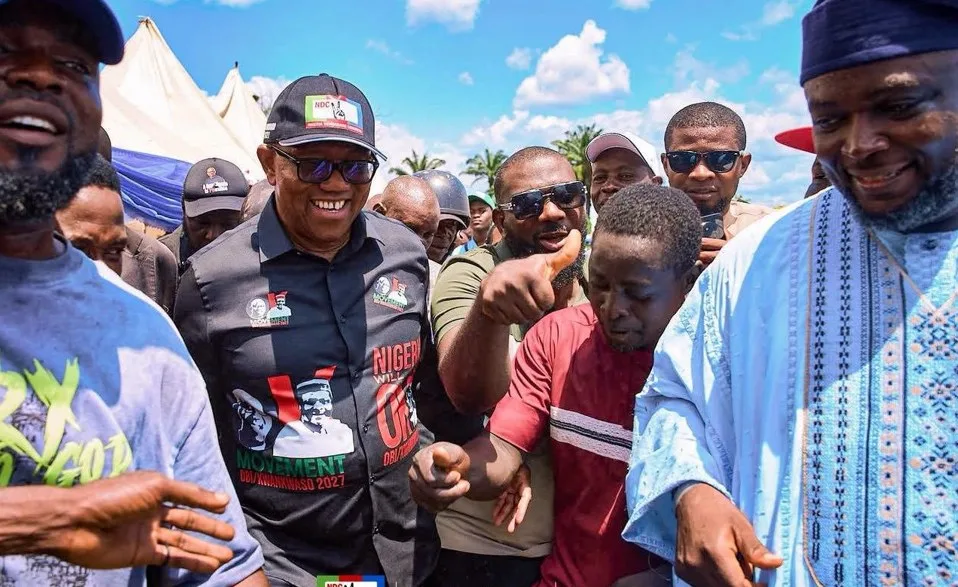
What began as Peter Obi’s visit to victims of the Yelwata massacre has quickly become one of Nigeria’s most politically charged controversies, after the opposition presidential candidate was prevented from reaching the community and the Benue State Government publicly denied any responsibility for the incident.
Obi, the presidential candidate of the Nigeria Democratic Congress (NDC), travelled from Abuja to Benue on Tuesday, saying his purpose was to mourn with families, meet survivors and express solidarity with communities devastated by the June 2025 massacre in Yelwata, where more than 270 people were reportedly killed.
According to Obi, his convoy was stopped by a group of youths along the Gyado Villa axis of Gboko Road before it could reach Yelwata. He said the men repeatedly chanted “Peter Obi, go back,” forcing his team to abandon the journey and return to Abuja. Obi alleged that the group were hired thugs and described the encounter as a disturbing example of how political rivalry is beginning to interfere with humanitarian and civic engagement. That allegation has not been independently verified.
In a statement issued after the incident, the former Anambra governor insisted the visit had no connection with campaign activities despite Nigeria’s increasingly active political season. He said he arrived in Benue at about 9:00 a.m. on what he called a purely humanitarian mission, arguing that grieving communities should never become battlegrounds for partisan interests.
“I came to Benue not for partisan politics, but to mourn with our people, listen to grieving families and offer comfort at a moment of unimaginable sorrow,” Obi said.
The Benue State Government has, however, rejected the narrative that it played any role in obstructing the visit. Responding to the controversy, Governor Hyacinth Alia’s Chief Press Secretary, Kula Tersoo, said the government was never informed that Obi was coming to the state and only learned of the incident through media enquiries.
Tersoo argued that, as a former governor and presidential candidate, Obi is entitled to federal security protection and said proper communication with the host state would ordinarily have allowed security agencies to coordinate the visit. He also dismissed suggestions that the youths who blocked the convoy were acting on behalf of the government.
“Youth cannot do anything on behalf of government. Our government doesn’t patronize thugs, and Obi is not a threat to the governor. We were not aware he was coming to Benue,” Tersoo said.
The government’s position was immediately challenged by the NDC. The party’s Benue governorship candidate, Prof. Terhemba Shija, said Obi’s team formally notified both the Nigeria Police Force and the Department of State Services (DSS) before the visit. According to Shija, security personnel were deployed to accompany the presidential candidate, contradicting the state government’s claim that the visit took place without official notice.
The conflicting accounts have left a crucial question unanswered: whether there was a breakdown in communication between security agencies and the state government, or whether the disagreement reflects a deeper political dispute over the presence of a leading opposition figure in Benue.
The Yelwata massacre remains one of the defining security tragedies of the year and has drawn nationwide condemnation from political leaders, civil society organisations and humanitarian groups. Obi’s attempt to visit the affected community was widely viewed as part of a broader effort by opposition figures to demonstrate solidarity with victims of Nigeria’s worsening insecurity, but the blockade has now shifted attention from the massacre itself to the politics surrounding it.
With the next presidential election already shaping political calculations across the country, the Benue episode is likely to carry significance far beyond a single failed visit. It has become a test of how state institutions engage opposition leaders, how security protocols are applied during politically sensitive movements, and whether democratic competition in Nigeria can coexist with the freedom of political actors to travel, meet citizens and hold governments to account.