Nigeria Prize for Literature Narrows $100,000 Race to Three Poets
James Ngwu Eze, Ogaga Ifowodo and Tares Oburumu are the final three contenders for Nigeria’s $100,000 literature prize after emerging from 223 poetry submissions.
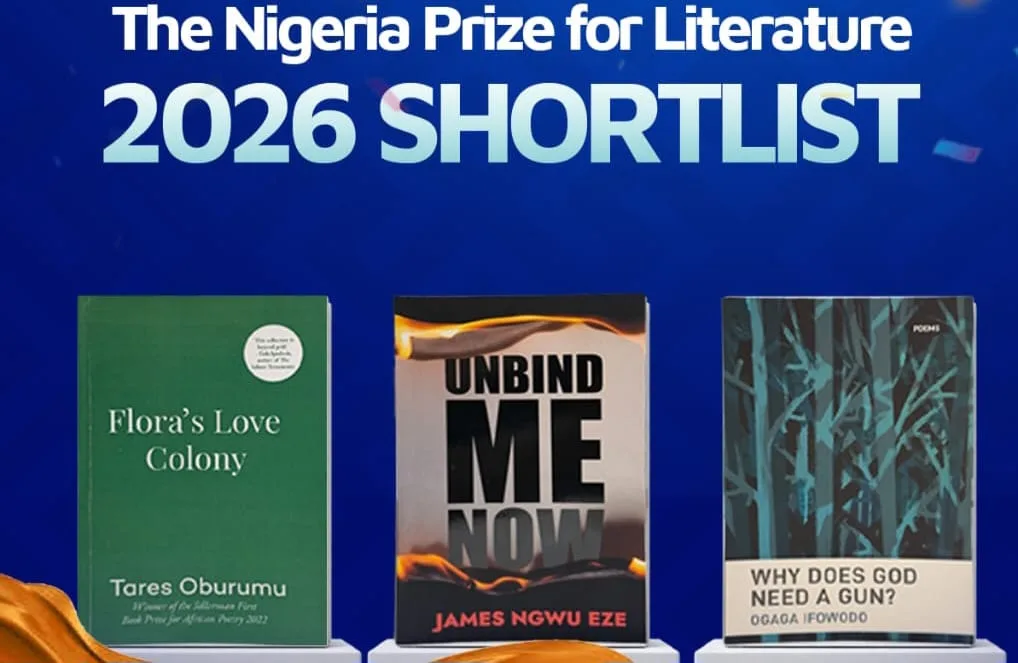
The race for the 2026 Nigeria Prize for Literature has been narrowed to three poets, with James Ngwu Eze, Ogaga Ifowodo and Tares Oburumu now competing for one of Africa’s most valuable literary awards.
The final shortlist, announced on Wednesday, August 26, came after judges reduced an initial field of 223 submissions to 11 longlisted poetry collections before selecting the final three. The winner will receive the $100,000 prize sponsored by Nigeria LNG Limited (NLNG).
Eze is shortlisted for Unbind Me Now, Ifowodo for Why Does God Need A Gun?, and Oburumu for Flora’s Love Colony. The three collections represent markedly different approaches to contemporary Nigerian poetry, but the judging panel said each demonstrated strong literary craft, originality and the ability to engage with the realities of society.
The judges praised Eze's collection for its fluid and compelling use of language, while highlighting its examination of political and social dysfunction and its wider interrogation of the human condition. Ifowodo's work, meanwhile, was recognised for confronting religious and political violence through allegory and a structure built around the body, mind and spirit.
Oburumu's Flora’s Love Colony takes a different route, drawing on Nigeria's troubled history and challenging established versions of the past. The jury pointed to its dense poetic style, vivid imagery and historical perspective as among the qualities that separated it from the wider field.
The shortlist follows a competitive first stage in which 223 poetry collections were submitted for consideration. Eleven were selected for the longlist in July, including established names such as Tanure Ojaide alongside younger and emerging voices. The official Nigeria Prizes website says the 2026 competition is devoted to poetry, continuing the award's rotation through prose fiction, poetry, drama and children's literature.
The final selection also underscores the breadth of subjects being explored by Nigerian poets. The longlisted works collectively addressed themes including history, identity, resilience, culture and the human condition, while drawing on folklore, oral traditions, cultural memory and contemporary social realities.
Professor Akachi Adimora-Ezeigbo, chairperson of the prize's Advisory Board, described the process of reaching the final three from 223 submissions as demanding. She said the shortlisted works stood out through their literary quality, originality and capacity to connect with readers and engage with the wider world.
Now in its 22nd year, the Nigeria Prize for Literature has become a major fixture in the country's literary calendar. Its $100,000 award places it among the most financially significant literary prizes on the continent, while its annual genre rotation gives writers across different forms an opportunity to compete for the same level of recognition.
The final three now face the last stage of judging, with the central question no longer which works deserve recognition but which collection will ultimately be judged the strongest of the year's submissions. Last year's prize, which focused on prose fiction, went to Oyin Olugbile's Sanya.
Beyond the competition itself, this year's shortlist offers another snapshot of where Nigerian poetry is finding its voice: in questions of political violence, historical memory, social dysfunction and the search for redemption. The significance of the prize therefore extends beyond the eventual $100,000 winner. By placing three very different poetic responses to Nigeria and the wider human experience before a national and international audience, the award is also helping determine which stories, ideas and literary voices receive greater attention in contemporary Nigerian culture.