NFF Board Resigns as Nigeria’s Football Crisis Deepens
Nigeria’s football leadership has been thrown into fresh uncertainty after NFF President Ibrahim Gusau, the general secretary and executive committee members resigned amid mounting criticism and calls for reform.
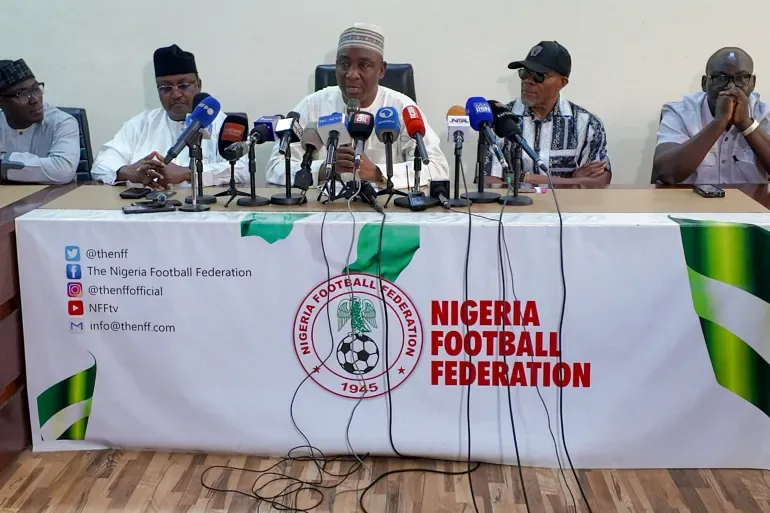
The leadership of the Nigeria Football Federation has resigned en masse, opening a new chapter of uncertainty for Nigerian football after months of mounting pressure over the performance and administration of the country’s national teams.
NFF President Ibrahim Musa Gusau announced his resignation in Abuja on Thursday, August 27, saying he had taken the decision after consulting his family, friends and stakeholders in the football community. The federation subsequently confirmed that General Secretary Mohammed Sanusi and members of its Executive Committee had also stepped down.
Gusau, who was elected in September 2022, was due to complete his four-year term in September. In explaining his departure, he said the resignation was intended to create room for what he described as a comprehensive and orderly reform process aimed at addressing longstanding institutional, governance and developmental problems within Nigerian football.
The leadership crisis follows a difficult period for Nigeria’s national teams. The Super Eagles failed to qualify for the 2026 FIFA World Cup after losing to the Democratic Republic of Congo in a penalty shootout, while the Super Falcons suffered an even more historic setback by missing the 2027 Women’s World Cup. Their defeat to South Africa ended Nigeria’s unbroken record of appearing at every edition of the women’s tournament since it began in 1991.
Those failures intensified criticism of the NFF and raised broader questions about how Nigerian football is managed. The federation had already established a fact-finding committee to examine the disappointing performances of the national teams, but the resignation of its top leadership now places the organisation itself at the centre of the crisis.
There are also financial questions surrounding the federation. Nigerian security authorities are reportedly examining the use of a N17 billion government intervention fund released in 2024 to clear outstanding payments owed to national-team players and officials. Reports have linked the Department of State Services investigation to allegations of possible misuse of the funds. These remain allegations and an investigation does not establish wrongdoing by Gusau or other NFF officials.
Gusau, for his part, has defended the record of his administration. In his final appearance as NFF president, he pointed to developments in areas including coaching education, domestic football, refereeing and infrastructure, while presenting his resignation as a decision taken in the wider interest of the sport rather than an admission of failure.
The federal government has now signalled that it wants the crisis to result in a wider restructuring rather than simply a change of personalities. President Bola Tinubu ordered a “comprehensive reform” of Nigerian football, with his administration saying the process should address governance, administration, stakeholder representation, player-development pathways, domestic competitions and accountability.
The timing also matters. The NFF's elective congress is scheduled for September 27 in Lafia, meaning the organisation must navigate a leadership transition while preparing for an election that will determine who takes responsibility for rebuilding confidence in Nigerian football. The mass resignation therefore creates an immediate administrative question as well as a longer-term leadership contest.
For Nigerian football, the real issue now goes beyond who occupies the NFF presidency. The country has enormous football talent and a national-team tradition that includes multiple Africa Cup of Nations titles and sustained success by the Super Falcons, yet recent failures have exposed weaknesses that cannot be solved simply by changing coaches or replacing officials. The next leadership will be judged by whether it can restore credibility, improve financial accountability, strengthen domestic development and ensure that Nigeria’s best players are supported by a system capable of matching their talent.
The mass resignation is therefore both an ending and an opportunity. It closes the Gusau era under intense public scrutiny, but it also gives Nigerian football a rare chance to confront structural problems that have been debated for years. Whether the coming transition produces genuine reform or merely another rotation of officials will determine whether this crisis becomes a turning point — or simply another chapter in Nigeria’s long-running football administration saga.