‘Hormuz Is Ours’: Iran Hits Back After Trump’s Shock US Territory Claim
Iran has rejected Donald Trump’s claim that the Strait of Hormuz could become US territory after the war, dismissing the proposal as unacceptable.
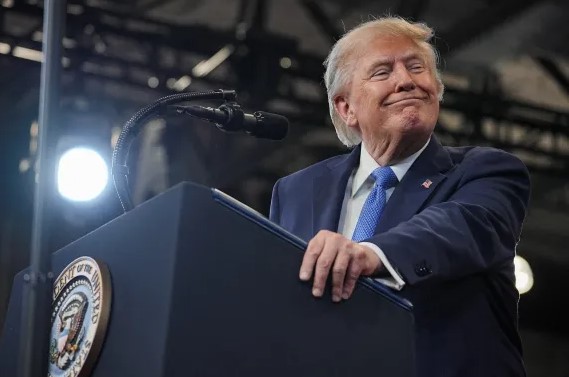
Iran has sharply rejected President Donald Trump’s suggestion that the Strait of Hormuz could become United States territory after the war, setting up an extraordinary new confrontation over one of the world’s most important maritime chokepoints.
Trump made the claim during remarks in New York on Friday, saying that after what he described as the defeat of Iran, the United States would soon declare the strategic waterway American territory. Iran responded by insisting that Hormuz remains under its control and cannot simply be claimed by Washington.
Iranian officials have gone further, arguing that the waterway will remain closed until Washington accepts Tehran’s terms for ending the confrontation.
Iranian Deputy Foreign Minister Kazem Gharibabadi said the strait would be opened and closed only under Iran's authority, while accusing Trump of refusing to acknowledge what Tehran considers a defeat for the United States.
The exchange has pushed the long-running dispute over Hormuz into unfamiliar territory.
This is no longer simply an argument about whether commercial vessels can pass through the strait. It has become a broader contest over who has the power to determine the rules of one of the world's most strategically important waterways.
Why Hormuz matters so much.
The Strait of Hormuz connects the Persian Gulf with the Gulf of Oman and the wider Indian Ocean. At its narrowest point, it is only about 21 nautical miles wide, with Iran to the north and Oman's Musandam Peninsula to the south.
Before the current conflict, roughly 100 to 140 major vessels crossed the strait each day, carrying a substantial share of the world's oil and gas supplies.
That makes any prolonged disruption immediately global.
Oil prices rise. Shipping insurance becomes more expensive. Tankers change routes or remain anchored. Refineries worry about supplies. Consumers eventually feel the pressure through higher fuel and transportation costs.
The current crisis has already produced those effects.
Reuters reported that shipping through Hormuz has fallen dramatically, while Trump has acknowledged that American motorists are facing higher gasoline prices as the confrontation continues.
Iran says it controls the waterway
Tehran has repeatedly rejected Trump's assertion that the United States has “total control” over Hormuz.
Iranian officials say the strait remains under their command and have insisted that vessels comply with Iranian instructions before passing through.
That position has already affected international shipping.
Only a small number of vessels have continued to transit the waterway, with many operators avoiding the route because of the risk of attack, higher insurance costs and uncertainty over which authority can guarantee safe passage.
The dispute has also produced a competing American claim.
Trump has said the US Navy effectively controls the strait through its blockade and has indicated that Washington can determine which vessels are permitted to pass. Earlier this week, he described the American naval presence as a “WALL OF STEEL.”
Iran sees that as an attempt to impose American authority over a waterway it regards as being within the territorial waters of Iran and Oman.
But can Trump actually make Hormuz American territory?
That is where the political rhetoric runs into international law.
The Strait of Hormuz is not simply an unclaimed stretch of ocean waiting for a powerful country to take possession of it.
The strait lies between Iran and Oman, whose territorial waters cover the narrow waterway. International maritime law also recognises special rules for straits used for international navigation, including rights of transit passage.
The United States and Iran have not ratified the UN Convention on the Law of the Sea, but key principles governing freedom of navigation are widely regarded as part of customary international law.
That means a unilateral American declaration would not automatically transfer sovereignty over the strait to Washington.
There is another important complication: Oman.
Muscat controls the southern side of the waterway and has been trying to mediate between Washington and Tehran. Britain and France have also stressed the importance of restoring safe navigation while respecting the sovereignty of states in the region.
Any attempt to convert Hormuz into US territory would therefore collide not only with Iran but with the existing territorial and legal arrangements involving Oman.
The White House later softened the statement
There is also an important twist to Trump's remarks.
A senior White House official subsequently said the president was joking when he talked about declaring Hormuz US territory and had not discussed such a move with his advisers.
That clarification reduces the likelihood that Washington has an actual plan to annex the waterway.
But the statement has nevertheless had political significance because it came amid an increasingly bitter struggle over who controls access through Hormuz.
For Iran, Trump's words provided another opportunity to reinforce its message that the United States cannot dictate the future of the strait.
For Washington, the episode underscores the administration's determination to prevent Tehran from using Hormuz as economic leverage.
The wider war is making the dispute harder to resolve
The confrontation comes as attempts to revive a fragile US-Iran ceasefire have stalled.
Iran says Washington must address sanctions, the blockade of Iranian ports and frozen Iranian assets before Tehran will consider reopening the waterway. The US, meanwhile, continues to demand that Iran reopen Hormuz and abandon its nuclear ambitions.
That leaves both sides with powerful incentives not to blink.
Iran has a strategic weapon in the form of its ability to disrupt one of the world's most important energy corridors.
The United States has overwhelming naval power and the ability to impose severe economic pressure on Tehran.
Neither side appears willing to surrender its leverage.
And the longer the standoff continues, the greater the pressure becomes on countries that depend on uninterrupted energy supplies.
The United Arab Emirates, for example, has accused Iran of attacking one of its energy vessels in the strait and has called for the waterway to be reopened.
Hormuz has become the symbol of the war
What happens next could have consequences far beyond Iran and the United States.
The Strait of Hormuz is effectively a pressure point for the global economy. Its disruption has already affected shipping, fuel prices and energy security, while the continuing military confrontation creates the risk of further attacks on commercial vessels.
For FollowGlobalTrends, the latest exchange between Trump and Tehran reveals how dramatically the conflict has changed the meaning of the Strait of Hormuz. Iran wants the waterway to remain a source of strategic leverage. Trump wants to demonstrate that American military power can override that leverage. And Oman, Gulf states and the wider international community want something much simpler: safe passage for ships and an end to the disruption.
Trump's “US territory” remark may ultimately have been a joke. But the argument behind it is very real. Whoever determines what happens in Hormuz will wield enormous influence over the next chapter of the US-Iran conflict, and potentially over the price of energy around the world.